
 Jon Daniel
A hiring manager forwards you a vendor email with the subject line "SSN verification available." Somewhere in the thread, someone suggests adding an SSN verification form to your onboarding packet so you can "confirm everyone's identity up front." Two questions sit underneath that suggestion: What is an SSA-89 form, and when do employers need it? The answer matters because the wrong tool applied to the wrong problem means collecting one of the most sensitive data elements your organization will ever hold.
Employers in remote-hiring and regulated environments increasingly raise identity assurance as a screening concern. More verification is not automatically better verification. Employers who add the request to a hiring step without an approved business purpose tend to create three problems at once:
- They collect Social Security numbers they do not need.
- They confuse identity data matching with employment eligibility verification.
- They generate mismatch results that nobody knows how to resolve fairly.
Disclaimer: This content is provided for informational purposes only and should not be construed as legal advice. Employers should consult qualified counsel for their specific situation. Employers should also confirm all current SSA program requirements directly with the Social Security Administration.
Key Takeaways
- Form SSA-89 is a signed authorization, used in the Social Security Administration's Consent-Based Social Security Number Verification (CBSV) process, that permits a comparison of an individual's submitted name, date of birth, and nine-digit Social Security number against SSA records.
- The output is a match or mismatch on submitted identity data. It does not establish work authorization, immigration status, criminal history, creditworthiness, or general employability.
- For standard hiring, Form I-9 is the federal employment eligibility documentation process, not SSA-89. E-Verify is a separate system with its own enrollment and process rules.
- Use the authorization only with a specific, written business purpose and through an eligible, authorized CBSV participant. It should not be embedded as blanket pre-employment screening.
- A mismatch requires human review. Transposed digits, hyphenation differences, changed names, and outdated records can produce a non-match without indicating fraud.
- A signed authorization is valid only for a limited period stated on the current form. Confirm the current window with SSA and build your submission timing around it; a stale authorization cannot be reused.
- Because a Social Security number is involved, common practice is to keep the authorization separate from other paperwork and to apply restricted access, encrypted transmission, defined retention limits, and a recorded resolution path before any material decision. Confirm with counsel what your jurisdiction and vendor arrangement actually require.
What Is an SSA-89 Form?
The form's full title, as printed on the current version, is "Authorization for the Social Security Administration (SSA) to Release Social Security Number (SSN) Verification." Confirm the exact title and the revision date on the copy you download, since the Social Security Administration updates both. In plain terms, it is the document an individual signs to allow a specific requesting party to submit that individual's identifying information to SSA and receive back a verification of whether the submitted Social Security number matches SSA's records for that person.
The form authorizes a data comparison and nothing beyond it: not a records search, not a history report, not an eligibility determination. When a vendor describes "SSN verification," this is often the underlying mechanism, and it is far narrower than most people assume.
Use precise language internally. Say "identity-data match" rather than "identity verified." The first is accurate, while the second implies a level of assurance the process does not deliver, and that distinction matters if a candidate later challenges a hiring decision.
Did You Know: A signed authorization is valid only for a limited period stated on the current form. Confirm the current window with SSA and build your submission timing around it; a stale authorization cannot be reused.
What the Authorization Does and Does Not Cover
Consent is the whole point, so the document identifies the individual, the requesting party, and the party that will receive the result. Within the CBSV process, SSA does not return a verification to a requesting party without the number holder's signed authorization. The comparison is limited to a small set of identifying data elements submitted by the requesting party and checked against SSA's records: name, date of birth, and the nine-digit number, as reflected on the current version of the form.
Consider a hypothetical. A candidate, call her Maria Ruiz-Delgado, married two years ago and now uses Maria Delgado professionally. Her SSA record may reflect one version of her name, her application reflects another, and the recruiter typed a third. The submitted data does not align, yet nothing fraudulent has occurred. The process simply reported that the strings it received did not match the strings it holds.
A match does not tell you whether someone is authorized to work in the United States. It does not indicate immigration status, and it reveals nothing about criminal history, prior employment, professional credentials, or credit. It does not even confirm that the person in your interview is the person the record describes. It confirms alignment between two sets of data fields.
How Verification Works Through the CBSV Service
The Consent-Based Social Security Number Verification service is the SSA program through which authorized participants submit verification requests supported by a signed SSA-89. Employers frequently assume they can submit requests directly. SSA sets participation and submission requirements, so confirm eligibility and registration mechanics with the agency or with a provider that can document its authorization status.
SSA also operates an electronic Consent-Based Social Security Number Verification service with its own eligibility rules and a narrower set of permitted participants. If a vendor references one, confirm which service it actually uses and whether your organization qualifies.
Three parties appear in a typical request. When roles are unclear, that is usually what shows up in a compliance review.
- The individual providing authorization reviews the request, confirms the identifying information is accurate, and signs. They should understand who will see the authorization and how the result will be used before signing.
- The organization with a permissible business need carries the burden of recording why this verification is necessary for a defined role or process, and "it seemed prudent" is not a business purpose.
- The registered CBSV provider or submitter transmits the request in accordance with SSA's program requirements and returns the result. Ask any vendor to confirm its authorization status in writing.
Decide in advance who collects consent, who submits it, who receives the results, and who may access the underlying records, and record those decisions in writing. That document becomes your evidence of a governed process.
Participation carries obligations beyond submitting requests. SSA sets enrollment requirements, fees, recordkeeping expectations for signed authorizations, and oversight procedures for participants. Confirm the current terms directly with SSA before budgeting or building a workflow.
Reading a Match or Mismatch Result
A match means the submitted name, date of birth, and Social Security number aligned with SSA records. A mismatch means they did not. Confirm the full set of response codes your provider returns against SSA's current CBSV documentation, including whether any response can carry an indicator beyond a simple match or no-match result. If you receive a response type you have not planned for, such as a death indicator, pause, take no action on the result and escalate to compliance and counsel.
Treat a mismatch as a signal that something needs checking, not as a finding. Pause, verify the submitted data, and give the individual a path to clarify a name change or record discrepancy. If a result could influence an employment decision, involve counsel early. Adverse action, consumer reporting, and state-law considerations depend on your specific process and vendor arrangement.
|
Pro-Tip: Build a manual review queue for every mismatch. Require reviewers to rule out obvious input errors and allow the individual to explain a name change or record discrepancy before escalating. |

When Do Employers Need an SSA-89 Form?
For most ordinary hiring, it is not the right tool. The authorization fits a narrow set of situations where an organization has a genuine, high-assurance identity need, meaning a documented need to confirm that a candidate's identifying details match government records before granting access to something sensitive. Nothing below means any role, industry, or employer automatically qualifies.
- High-assurance roles. Some positions carry heightened identity-assurance requirements because of what the person will access: customer financial data, controlled substances, critical infrastructure, or vulnerable populations. A documented, role-based need may support the evaluation of this process. Sensitivity alone does not grant permission, and it never replaces required employment-eligibility verification.
- Regulated, financial, or license-dependent roles. In some regulated settings, an identity check may support a specific control your compliance team has already defined. Matching identity data is not the same as confirming that a license or certification is valid and current; that requires checking with the issuing body.
- Authorized third-party submission. A qualified provider may handle collection and submission on your behalf. Vendor involvement does not transfer your responsibility for purpose, consent, data security, and decision governance.
A Practical Employer Decision Test
Run every proposed use through three questions. A "yes" to all three supports further legal and compliance evaluation. It does not authorize automatic deployment.
- Is there a written business purpose? You need a specific operational reason tied to a defined role, process, or risk control, approved by a named owner. A general preference for more screening does not qualify.
- Is this verification more appropriate than a less sensitive alternative? Compare it honestly against Form I-9 for employment eligibility, E-Verify where you are enrolled or required, credential verification for licenses, or a governed background screening program for history-based risk.
- Can you obtain informed, voluntary authorization? Provide a clear notice, collect the signature through a secure channel, and avoid any description that overstates what the result means or what happens if it does not match.
When Employers Should Not Use Form SSA-89
Most problems in this area trace to using the wrong tool rather than to bad intent. Five situations call for a different instrument.
Not a substitute for Form I-9. For ordinary hiring, Form I-9 is the federal process through which employers document an employee's identity and authorization to work, subject to current rules. An identity-data result does not satisfy any part of that obligation and will not help you in an I-9 audit.
Not a substitute for E-Verify. E-Verify is a separate electronic system used by enrolled employers to confirm information from Form I-9 against records held by the Department of Homeland Security and the Social Security Administration, with its own enrollment, usage, and notice rules. E-Verify also has its own defined process for handling case results that require follow-up, with notice and timeframe rules that do not apply to an SSA-89 mismatch. Do not route the two through the same internal workflow.
Not a replacement for background checks. Identity-data matching produces no investigative information: no criminal history, no employment and education verification, no credit data. If a third party furnishes a report that you use for employment purposes, consumer-reporting obligations may apply, and that determination is best left to counsel.
Not appropriate for blanket screening. Collecting numbers and authorizations from every applicant creates privacy exposure, proportionality problems, and inconsistency risk without a corresponding benefit. If you cannot articulate why a given role requires it, you are collecting data out of habit rather than operating a control.
Not applied selectively by perceived origin or status. Requesting verification from some candidates and not others, or triggering it based on a candidate's name, accent, or perceived citizenship or national origin, can create discrimination exposure under federal and state law, including the anti-discrimination provisions administered by the Department of Justice Immigrant and Employee Rights Section. Apply any approved use case uniformly within a defined role or workflow, document the rule, and review it with counsel.
Did You Know: A Social Security number match does not establish a person's immigration or work-authorization status. Employers must use the applicable Form I-9 process and, where relevant, E-Verify.
Comparing Form SSA-89 With Form I-9, E-Verify, and Background Checks
The fastest way to avoid misuse is to name the question each tool answers.
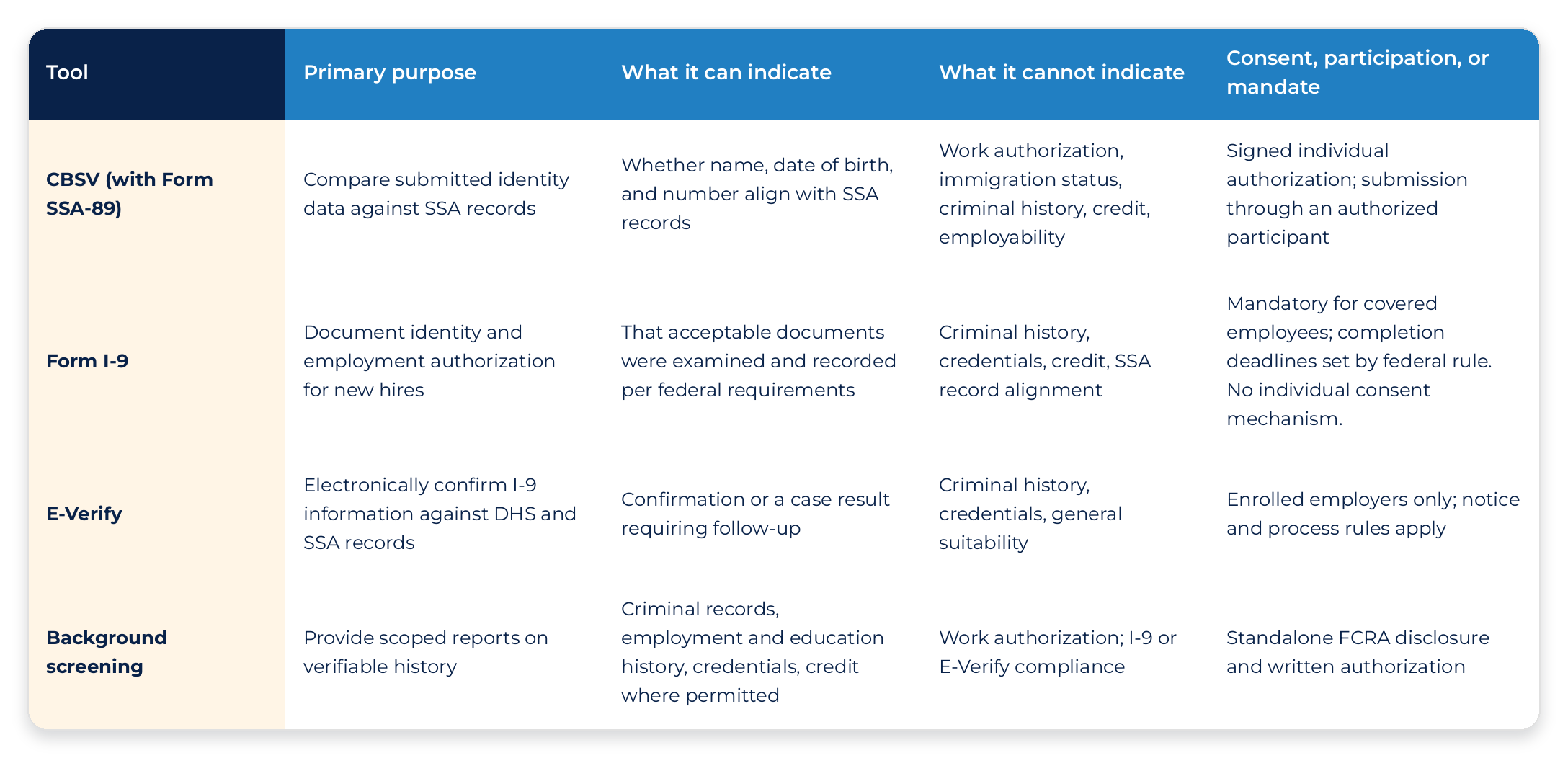
Read the table as a routing guide, not a feature comparison. Work authorization is an I-9 and, where applicable, an E-Verify question. History-based risk belongs with a properly scoped, FCRA-compliant background screening program. Credential validity requires primary-source license and certification verification. Only a documented high-assurance identity need makes CBSV worth evaluating with counsel. Start with the business question, not the vendor feature list.
A Note on SSA's Wage-Reporting Verification Service
SSA operates a separate name and Social Security number verification service tied to wage reporting, which employers sometimes confuse with consent-based SSN verification. Its permitted uses are defined and restricted by SSA, and it exists to support accurate wage reporting rather than candidate screening. It is not an alternative route to pre-hire identity screening, and using it that way can put you outside SSA's stated terms. Confirm current permitted uses directly with SSA before anyone in payroll or HR touches it for hiring purposes.
How to Obtain and Complete Form SSA-89
The Social Security Administration publishes the current Form SSA-89 and the governing program requirements through its CBSV materials. Pull the form directly from SSA rather than relying on a saved copy, a screenshot or a vendor-hosted version you have not confirmed. Saved copies and vendor-hosted PDFs can become outdated, and SSA-89 form requirements can change between revisions.
Before the individual signs, confirm three things:
- The requester, the recipient of the result, and the stated purpose are clear enough to read without interpretation.
- The individual has reviewed their own name, date of birth, and Social Security number in a secure interface before signing. Input and record-matching errors at the collection step are a common source of mismatches.
- Your process follows the current official form's language for authorization, signatures, dates, and acceptable execution methods, including any electronic signature rules. Use the form's own language rather than adapting or paraphrasing it.
- The signature will still be within the validity period stated on the current form when the request is submitted. Confirm that window with SSA, because an expired authorization cannot be reused.
Common causes of delay include:
- Blank required fields
- Name inconsistencies across the application and SSA records
- Transposed digits
- Vague requester information
- An obsolete version of the form
- Missing or improperly dated signatures
|
Pro-Tip: Use a secure, mobile-friendly collection flow with required-field validation, encrypted transmission, and a plain-language explanation of who will receive the authorization and why. Reducing avoidable rework at collection is the cheapest fix available. |
Privacy, Consent, and Compliance Considerations for Employers
Once you collect the authorization, you are holding a Social Security number alongside a signed consent. Treat that package as high-sensitivity data governed separately from ordinary recruiting records. Keep the authorization purpose-specific and visually distinct rather than burying it inside a broad application acknowledgment or general consent block.
Then apply basic handling discipline, consistent with our approach to candidate data security:
- Collect only for approved, role-based use cases
- Transmit through encrypted channels, never ordinary email or attachments
- Store in an access-controlled system, not shared drives or spreadsheets
- Mask or truncate numbers in any downstream view where full display is not required
- Apply role-based, need-to-know permissions and keep access logs you can produce during an audit
- Give hiring managers only decision-relevant information
Define retention periods and secure disposal procedures with counsel and your records-management team before you collect the first form. There is no single retention period that fits every employer or use case, but some programs set their own floor. Note that SSA’s CBSV/eCBSV program sets its own required retention period for the signed authorization (SSA’s CBSV privacy materials state seven years from the date of verification, though some eCBSV materials cite five). Confirm the current figure with SSA, as it sits underneath whatever broader retention you define. Record the approved rationale and name the person responsible for disposal.
Additional legal considerations come into play as soon as a third party collects, submits, or reports identity information, and as soon as any result could influence an employment decision. Depending on how the service is structured, the Fair Credit Reporting Act, state background check statutes, and state privacy laws may be relevant. Those are questions for employment counsel rather than something a vendor FAQ can resolve for you. Give individuals a documented channel to report an input error, a name change or a record discrepancy, and write down how requests arrive, who reviews them and how outcomes are recorded.
What to Do When a Verification Does Not Match
A mismatch is the moment your process design gets tested. Handle it with a consistent sequence rather than improvisation. Pause rather than assume fraud, and consider disabling any automatic rejection rule tied solely to a mismatch result. Then check the usual causes:
- Transposed or mistyped digits
- Punctuation, hyphenation, or spacing differences in names
- Married, changed, or legally amended names
- Suffixes, middle names, or initials entered inconsistently
- Outdated information in the individual's own SSA record
The list is illustrative, not exhaustive. Reach out through a neutral communication that describes the discrepancy without alleging wrongdoing, explains what you need, and names who will review it. Set response timeframes with counsel based on your process and applicable requirements rather than copying another employer's approach.
Document the original result and the date received, the reviewer and actions taken, what the individual provided, the final disposition and rationale, and the decision owner. Keep that in an auditable case log rather than an email thread, and store no more sensitive data than the approved purpose requires. Before involving a decision-maker, ask whether the unresolved discrepancy actually affects the narrow purpose you recorded. If it does not, it should not drive an employment outcome. If it might, route it to legal and compliance review rather than to a hiring disposition.
Actionable Steps for HR Professionals
- Name the business question before you name the tool. If the answer is "work authorization," your path is Form I-9 and, where applicable, E-Verify. If it is "history-based risk," it is a properly scoped screening program. Only a documented high-assurance identity need points toward CBSV.
- Audit where Social Security numbers currently live in your hiring workflow. Check your ATS, shared drives, email archives, and manual intake forms. Eliminate collection points that no longer serve an approved purpose.
- Build a written use-case approval process. Require the requesting team to record the role, risk, purpose, alternatives considered, approver and retention period before any form is collected.
- Design the mismatch workflow before you launch. Define who reviews, what they check, how the individual is contacted, what gets recorded, and when legal is involved. Review any automated rejection logic tied to mismatch results with counsel before launch.
- Verify your vendor's authorization status in writing. Ask for documentation of CBSV participation status, data-security controls, retention configuration options, and mismatch-handling capabilities.
- Route the process through counsel. Have employment counsel and privacy review your authorization process, notice language, retention schedule, and any consumer-reporting or adverse-action implications in your jurisdictions.
- Train the small group who will touch this data. Limit access to trained reviewers, log that access, and refresh training when form versions or your process change.
The Bottom Line for Employers
Form SSA-89 authorizes a narrow identity-data comparison against SSA records, and that is the whole of what it delivers. Work authorization remains an I-9 question, with E-Verify where an employer is enrolled or required, and history-based risk remains a background screening question. Whether Social Security number verification for employers makes sense in your program turns on two things: a documented purpose tied to a defined role and a review path designed before the first mismatch arrives. Have counsel review the purpose, notice, retention schedule and decision rules before you deploy any employment identity verification step.
The AccuSourceHR Advantage
Good governance here is mostly unglamorous: one controlled system for consent capture, versioned records, access logging, and secure storage. Centralization does not satisfy legal requirements by itself, but it makes your process reviewable, which is what reviewers look for when they assess whether a process was governed. Our in-house counsel-led compliance team tracks shifting federal, state, and local requirements so your program does not drift out of alignment. Our compliance team supports your program design; it does not provide legal advice or serve as your counsel.
On the operational side, the SourceDirect™ platform supports configurable processes, role-based access and integrations with major ATS and HCM systems, including Workday, Greenhouse, iCIMS, BambooHR and UKG, among others, so verification steps land in the right place for the right role. Our US-based customer success team includes members who hold PBSA FCRA certification, and clients get direct access to a named support contact who works with them to design a process their legal, security, and hiring teams can all support.
This article is informational and not legal advice. Confirm current SSA program requirements with the Social Security Administration and review your program with qualified counsel.

Frequently Asked Questions
Is Form SSA-89 Required for Employment?
No. Form I-9 is the federal process for documenting an employee's identity and authorization to work, and covered employers must complete it. Form SSA-89 is optional and purpose-specific: it authorizes a comparison of a person's identifying details against SSA records through CBSV. Completing it satisfies no part of an employer's I-9 obligation.
How Long Is a Signed Form SSA-89 Valid?
A signed authorization is valid only for the limited period stated on the current form. SSA sets that window and can revise it, so confirm the current period on the version you download from SSA before you build submission timing around it. An expired authorization cannot be reused; collect a new signature instead.
Can an Employer Submit an SSA-89 Directly to SSA?
SSA sets participation and submission requirements for CBSV, and many employers work through an authorized participant rather than submitting on their own. Confirm eligibility, enrollment steps, and current fees directly with SSA. Ask any provider to document its authorization status in writing before you transmit a single Social Security number.
Does an SSA-89 Mismatch Mean the Candidate Committed Fraud?
No. A mismatch means the submitted data did not align with SSA records, nothing more. Transposed digits, hyphenation differences, married or legally changed names, inconsistent middle initials, and outdated SSA records all produce non-matches without any wrongdoing. Treat the result as a prompt to check inputs and let the individual respond, as described in the mismatch review section above.