
 Jon Daniel

Every screening result is only useful if it is connected to the right person. Here is what employment identity checks verify, where they fit into background screening, and what employers need to consider before using them.
Key Takeaways
- Identity checks connect candidates to the identifiers used for criminal, MVR, license, sanctions and other screening searches.
- SSN traces surface names and address history, while SSA verification confirms submitted identifiers against Social Security Administration records.
- Document authentication and biometric matching provide evidence linking a candidate to a government-issued identity document.
- FCRA requirements include standalone disclosure, written authorization, permissible-purpose certification, consistent screening standards, and adverse action procedures.
- Employers should layer identity checks based on role risk. The level of verification should reflect the sensitivity of the position and the potential consequences of an inaccurate identity record.
A significant risk in employment screening is confirming that the record belongs to the candidate. Criminal, motor vehicle, license, and sanctions searches typically rely on identifiers such as name, date of birth, and Social Security number. If those identifiers are inaccurate, incomplete, or associated with another person, a search can return records that do not belong to the candidate.
Different identity checks verify different identifiers:
- An SSN trace can establish address history and associated names for downstream searches
- SSA verification can confirm whether submitted identifiers match SSA records
- Document authentication and biometric matching can add evidence connecting the candidate to a government-issued ID
The appropriate identity check depends on the role, the required level of identity assurance and the compliance rules that apply. This guide covers:
- The four common types of employment identity checks
- What each check verifies and where its limits are
- FCRA requirements when identity checks are obtained through a CRA
- How identity verification differs from Form I-9
- How employers can build identity checks into high-volume screening workflows
What is an Identity Check in Employment Screening?
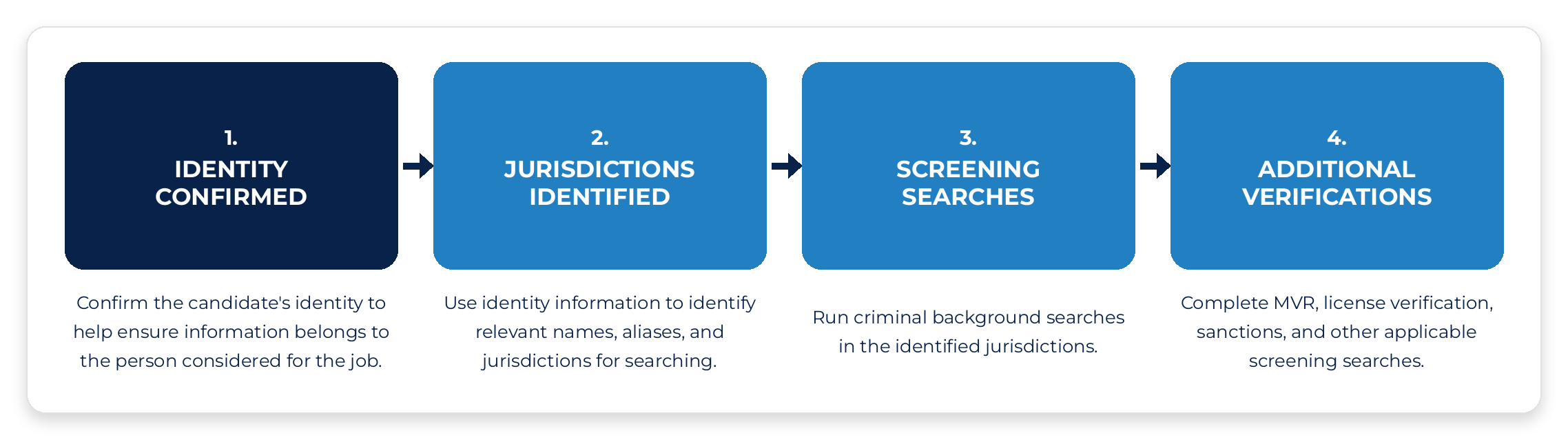
An employment identity check helps confirm that a candidate is the person they claim to be. Depending on the check, it may use Social Security information, address history, government-issued identification, or biometric facial comparison.
The check covers two types of identifiers:
- Attributed identity: The name, date of birth, and Social Security number the candidate presents
- Biographical identity: The address history, alias names, and residency timeline attached to those identifiers over time.
A complete identity check covers both. Address history and associated names can identify additional jurisdictions or names that may need to be considered during a background check.
A Social Security trace surfaces prior addresses and alias names, and those addresses determine which county courts get searched for criminal records. Order the criminal search without the trace, and you search only the jurisdictions the candidate chose to disclose.
Why Employers Are Paying More Attention to Identity Verification
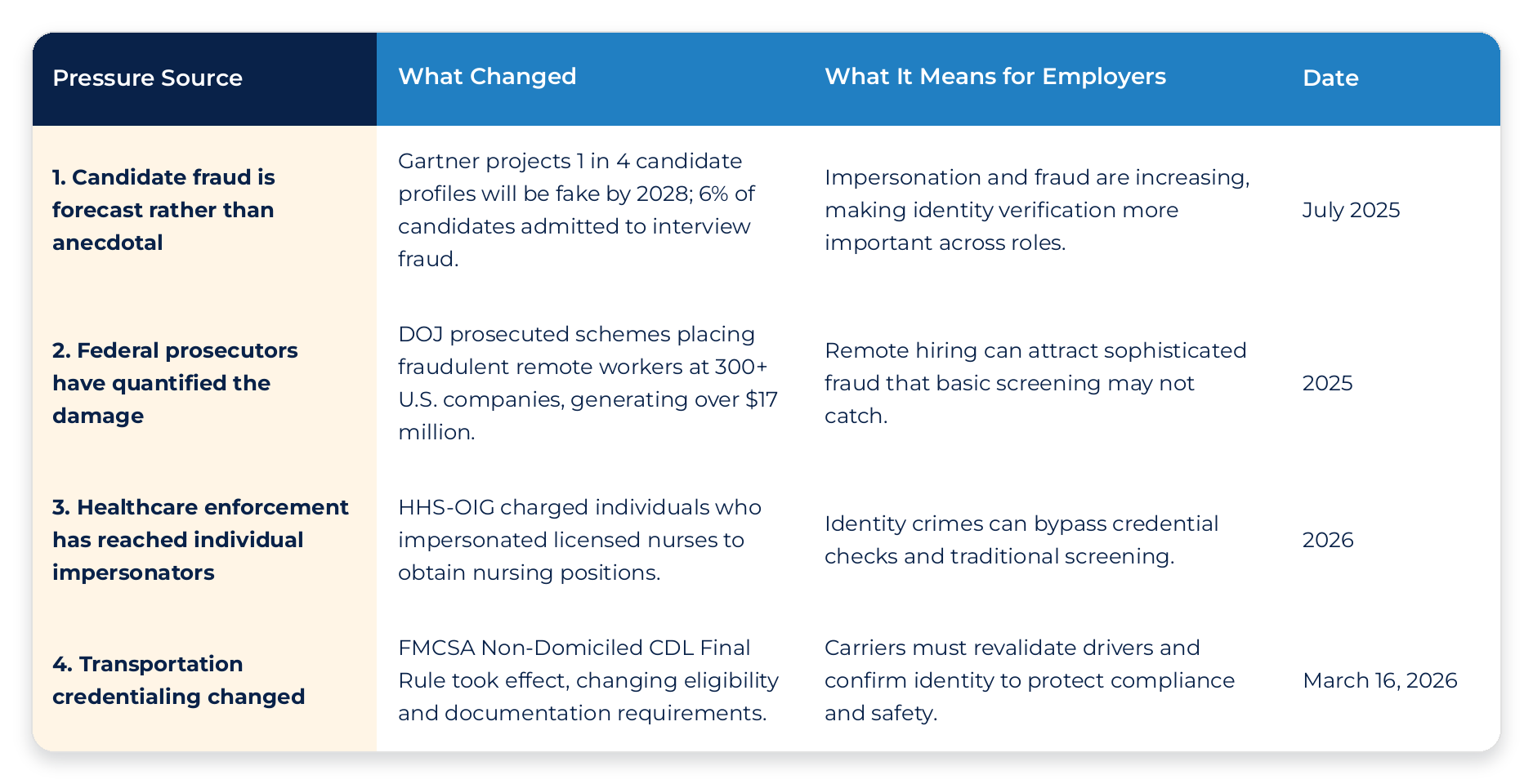
Identity verification has received greater attention as employers contend with impersonation, identity theft, fraudulent documents and other forms of candidate fraud.
The following scenarios illustrate why identity verification is important:
1. Candidate fraud is now forecast rather than anecdotal
Gartner projects that by 2028, one in four candidate profiles worldwide will be fake. In its second-quarter 2025 survey of 3,000 job candidates, 6% admitted to interview fraud, either posing as someone else or having someone pose as them.

2. Federal prosecutors have quantified the damage
The U.S. Department of Justice prosecuted several schemes in which fraudulent workers obtained remote employment with U.S. companies using stolen identities and other deceptive methods.
One 2025 case involved a scheme that placed fraudulent workers at more than 300 U.S. companies and generated more than $17 million. Another federal case involved facilitators who helped foreign IT workers obtain remote jobs at U.S. companies.
These cases do not establish that ordinary background checks routinely fail to identify impersonators. They do show why employers hiring remotely may need controls beyond relying solely on information supplied during an application.
3. Healthcare enforcement has reached individual impersonators
The HHS Office of Inspector General’s 2026 National Health Care Fraud Takedown includes charges against defendants who obtained nursing positions by impersonating licensed registered nurses. These were not credential errors but identity crimes that cleared employer screening.
4. Transportation credentialing changed under carriers
The FMCSA Non-Domiciled CDL Final Rule took effect on March 16, 2026, restricting eligibility and requiring an unexpired passport plus Form I-94 at every issuance action. States are encouraged to audit all unexpired non-domiciled credentials, which means carriers are revalidating drivers they already hired.
5. The background volume keeps rising too
The FTC reported more than 1.1 million identity theft reports in 2024. Stolen identifiers are abundant, cheap, and increasingly paired with generated documents.
The Four Common Types of Identity Checks for Employee Screening
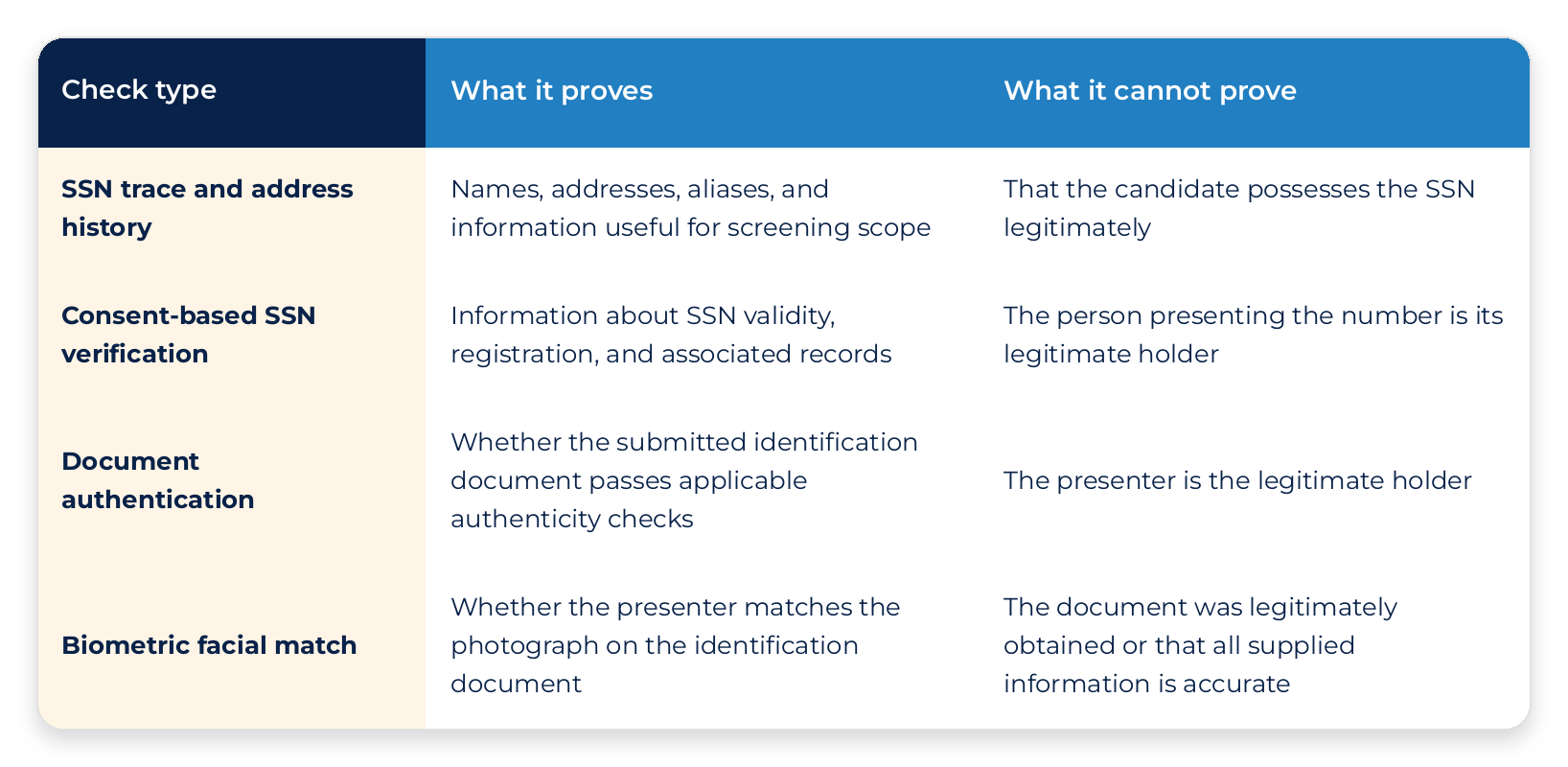
Employers typically use four identity checks, each addressing a different verification need. Selecting a check that does not address the specific identity risk can leave the underlying gap unresolved.
1. Social Security trace and address history validation
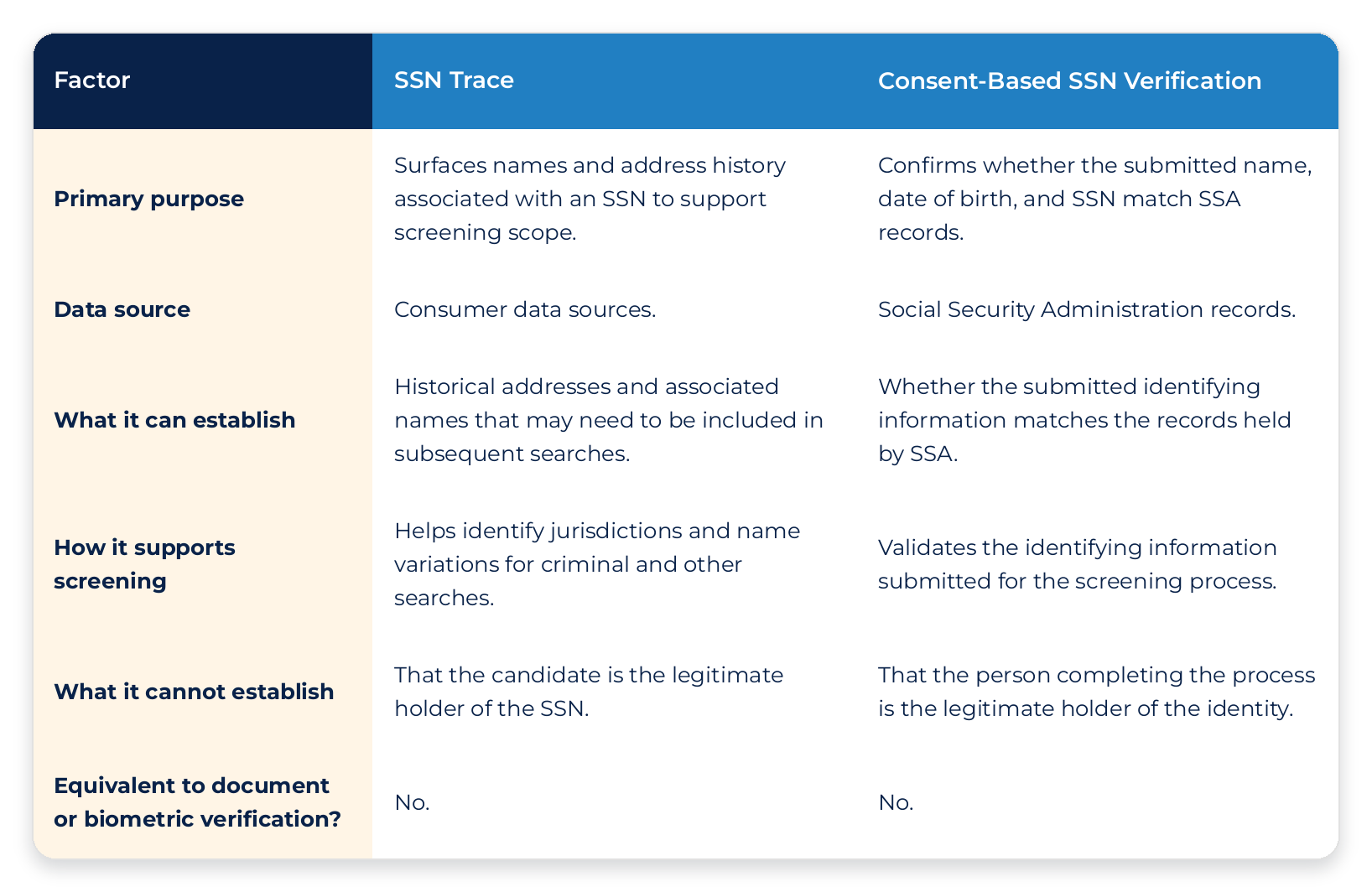
A Social Security trace uses consumer data sources to identify names and addresses associated with an applicant's Social Security number (SSN). AccuSourceHR's trace provides up to seven years of address history and can identify associated names, including misspellings, nicknames, and maiden names.
2. Consent-based Social Security number verification
Consent-based SSN verification compares identifying information against Social Security Administration records with the required consent.
The Social Security Administration’s (SSA) Consent-Based Social Security Number Verification service, or CBSV, verifies whether the submitted name, date of birth, and SSN match SSA records. It returns a yes/no match and, where applicable, a death indicator. SSA expressly states that CBSV does not itself verify an individual's identity.
3. Document authentication
Document authentication examines a government-issued identification document for signs of tampering, reproduction, or fabrication. Optical character recognition can extract information from the document, while technology-based checks assess the submitted image.
4. Biometric facial match with liveness detection
Biometric verification compares a live image of the candidate with the photograph associated with an identification document. Liveness technology can assess whether the person completing the process is physically present rather than presenting a static image or replayed media.
AccuSourceHR provides this capability through IdentitySource™, which uses AI technology to assess government-issued identification documents and compare a live image of the subject with the image on the document.
|
Note: The table is best understood as a progression from record resolution to evidence validation to person-to-evidence verification. Employers may use one method or combine several, depending on what they need to establish. |
SSN Trace vs. Consent-Based SSN Verification
How Should Employers Choose an Identity Check?
The appropriate identity check depends on what an employer needs to verify, how the hiring process works, and the requirements that apply to the organization and its workforce.
The framework below is illustrative, not a legal requirement or an AccuSourceHR screening policy:
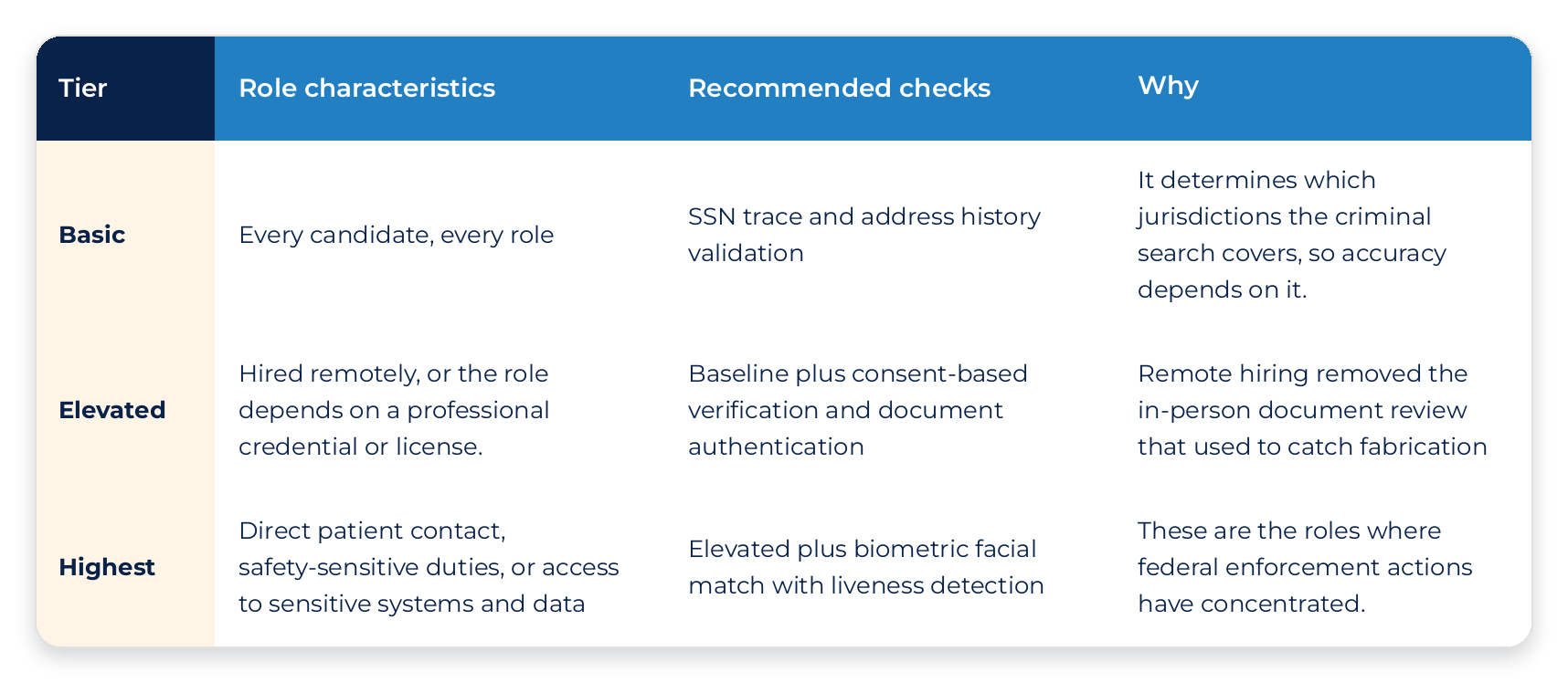
Employers should also consider whether the identity information required for a particular service is available through the ATS, HCM, HRIS, or other systems involved in the hiring process. If an ATS does not pass all required information to the screening provider, a candidate-facing workflow may be used to collect missing information.
The objective is to obtain the level of verification the role requires without creating unnecessary candidate friction or applying a more intrusive process than the employer's screening program calls for.

What Employers Should Know About FCRA Requirements
When an employer obtains an employment screening report from a consumer reporting agency (CRA), the Fair Credit Reporting Act (FCRA) sets requirements for how the report is obtained and used.
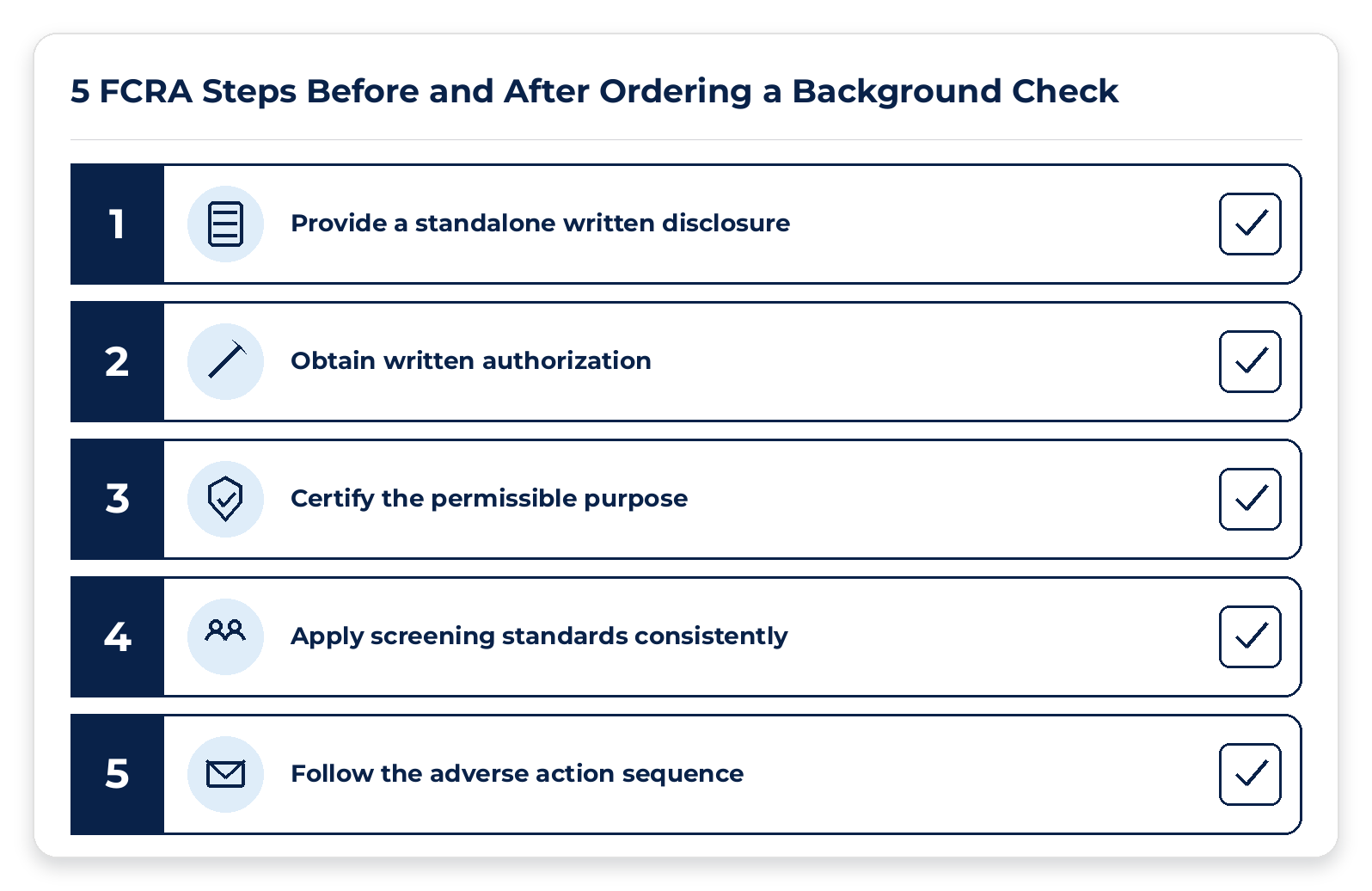
Before ordering an identity check or other employment screening report through a CRA, employers should understand these key requirements:
- Provide a standalone written disclosure: The document must state clearly that a consumer report may be obtained for employment purposes, and it must consist solely of that disclosure.
- Obtain written authorization: The FTC and EEOC jointly advise that employers need written permission from the candidate before obtaining background reports from a company that compiles background information.
- Certify the permissible purpose: The employer must certify to the CRA that the report is being obtained for a permissible purpose and that it will be used in accordance with applicable law.
- Apply the screening standards consistently: Requesting or using background information differently based on race, color, national origin, sex, religion, age, disability, or genetic information is unlawful.
- Follow the adverse action sequence: If the result contributes to a decision not to hire, send a pre-adverse action notice with a copy of the report and the summary of rights, allow reasonable time to respond, and then send the final adverse action notice.
Employers should review their disclosure, authorization, and adverse action procedures with qualified legal counsel to confirm that their process meets applicable federal, state, and local requirements.
Why Form I-9 Is Not an Employment Screening Identity Check
Form I-9 is part of the federal employment eligibility verification process. It requires employers to examine acceptable documentation establishing identity and employment authorization.
That makes I-9 an identity-related process, but it serves a different purpose from an employment screening identity check.
Employees cannot complete Form I-9 Section 1 before accepting an offer of employment. Employers generally complete Section 2 within three business days of the employee's first day of work. The documents presented must reasonably appear genuine and relate to the person presenting them.
An employment screening identity check can serve a different purpose: helping connect the person being screened with the identifying information and evidence used to conduct criminal, driving, licensing, sanctions or other screenings.
I-9 and employment identity verification should therefore be treated as separate processes. Completing an I-9 does not replace the identity controls an employer may use as part of its background screening program. Likewise, an identity check does not replace the employer's Form I-9 obligations.
What Employers Should Know About Biometric Privacy Laws
Facial comparison and other biometric methods can create obligations that do not arise with a basic SSN trace. Employers using facial matching or other biometric verification should understand the requirements that apply where candidates or employees are located.
The Illinois Biometric Information Privacy Act (BIPA) imposes requirements around collecting, using, and retaining biometric information. Depending on the process, employers may need to provide specific disclosures, obtain written consent, and maintain policies governing the retention and destruction of biometric information.
Statutory damages run at $1,000 per negligent violation and $5,000 per intentional or reckless violation, plus attorneys’ fees.
Illinois SB 2979, signed August 2, 2024, limits recovery to a single violation per person rather than per scan. On April 1, 2026, the Seventh Circuit held in Clay v. Union Pacific that the amendment is remedial and procedural and applies retroactively to cases pending when it took effect.
Other states maintain their own biometric statutes with different consent and notice standards, so multi-state employers should treat this as a jurisdiction-by-jurisdiction question rather than a single national policy.
|
Build the identity program layered by role risk, not maximized across the board:
|
What Identity Checks Look Like in Transportation, Healthcare, and Staffing
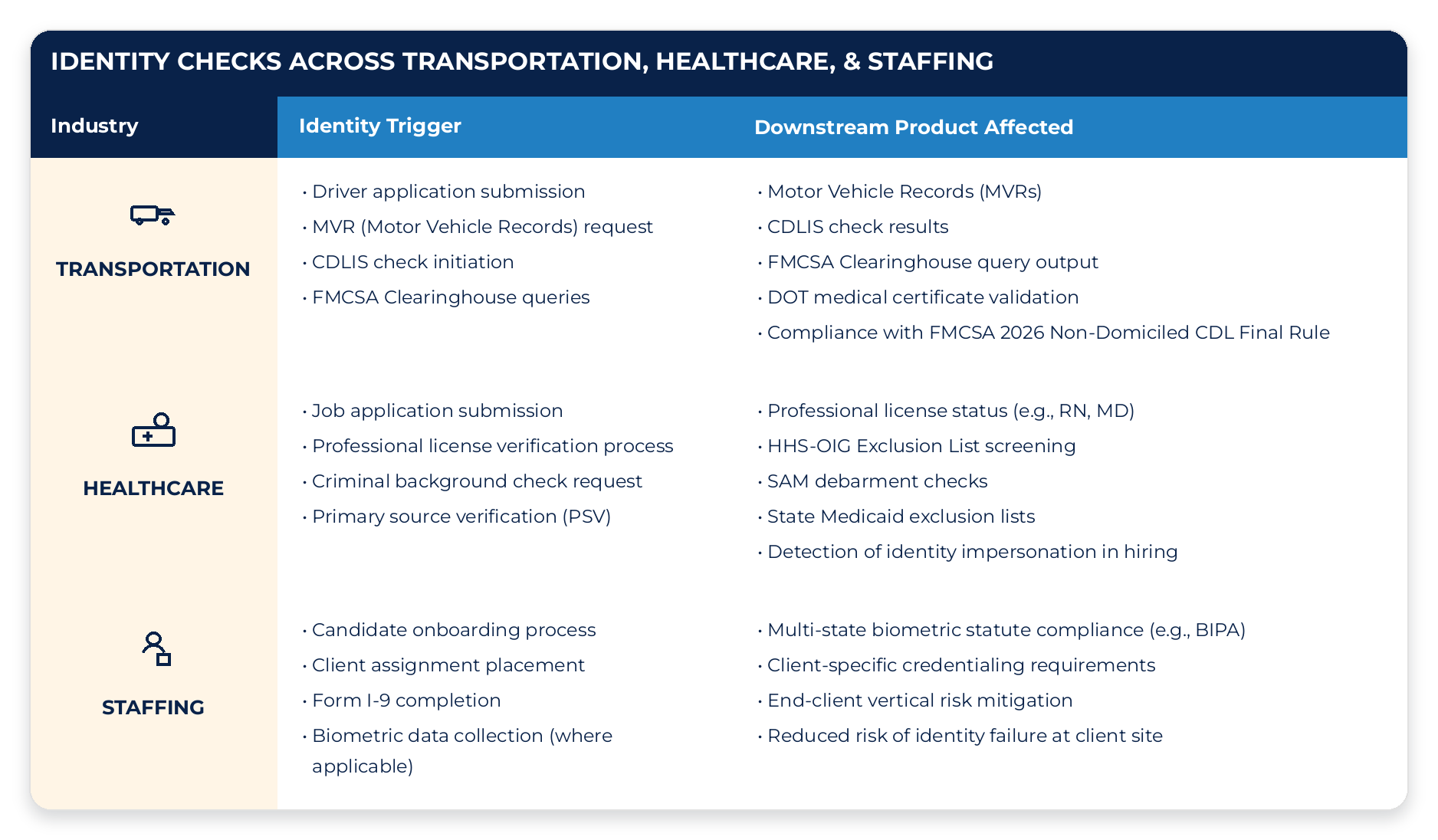
The identity gap breaks each regulated industry in a different place, which is why a single national screening template rarely holds up under audit.
Transportation
Transportation employers use identifying information when ordering Motor Vehicle Records (MVRs), CDLIS checks, and FMCSA Clearinghouse queries. Accurate identifying information helps connect those screening results to the correct driver.
The FMCSA's 2026 Non-Domiciled CDL Final Rule also changed requirements affecting certain commercial driver's licenses. Employers should account for these changes when reviewing their driver screening and credentialing processes.
The practical implication for carriers: Identity verification belongs upstream of the DOT program workflow, not alongside it. Confirm the driver before you query the credential.
Healthcare
Healthcare employers rely on identifying information when verifying professional licenses and screening against federal and state sanctions lists. If those identifiers belong to someone else, the resulting checks may not reflect the person being hired.
The 2026 HHS-OIG National Health Care Fraud Takedown included cases involving individuals accused of obtaining nursing positions by impersonating licensed registered nurses. The cases illustrate why identity verification can be an important part of a broader healthcare screening program.
The practical implication for providers: Identity confirmation should precede credentialing, and continuous sanctions and debarment monitoring should run against a verified identity rather than a claimed one.
Staffing
Staffing agencies carry a displaced version of the risk. The identity failure surfaces at the client site, not the agency, and the contract is what gets lost. Multi-state placement also means multi-state biometric statute exposure that rarely gets priced into the margin.
The practical implication for agencies: Tier verification by end-client vertical rather than applying one standard across every placement, and keeping the identity step fast enough that it does not extend bench time.
How to Run Identity Verification at Scale Without Slowing Hiring
At higher hiring volumes, identity verification needs to fit into the screening workflow without creating additional manual steps for recruiters or candidates.
- Connect identity verification to the screening workflow: Identity information can support downstream searches by helping confirm the names and jurisdictions relevant to the screening process.
- Use existing ATS, HCM, or HRIS workflows: AccuSourceHR integrates with 50+ ATS, HCM, and HRIS platforms, allowing employers to connect screening processes with their existing hiring systems.
- Make candidate consent easy to complete: A candidate-facing process should allow applicants to complete required information, document capture, consent and verification steps without unnecessary desktop-only requirements.
- Keep results and status information in one workflow: Centralized screening information gives recruiters better visibility into pending checks, completed results, and items that need attention.
AccuSourceHR's SourceDirect™ platform supports identity verification alongside other screening services, with candidate-facing workflows through the MySource™ portal and integrations with existing hiring systems.
What to Do When an Identity Check Returns a Discrepancy
A discrepancy is not automatically a finding of fraud. The first step is separating a data-quality mismatch from a genuine fraud indicator, because the two require completely different responses.
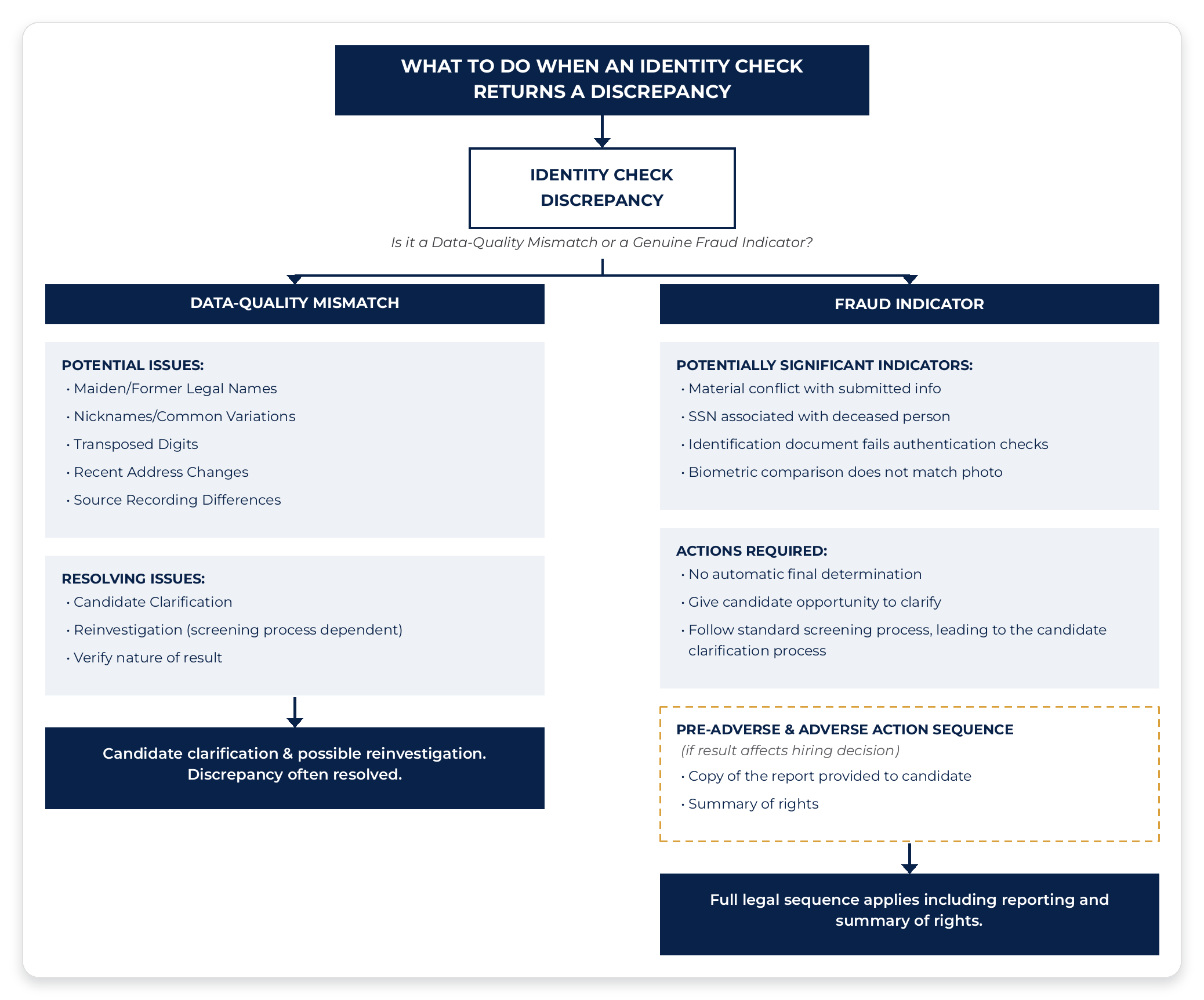
Possible data-quality issues include:
- Maiden or former legal names
- Nicknames or common name variations
- Transposed digits
- Recent address changes
- Differences in how information is recorded across sources
These issues may be resolved through candidate clarification or reinvestigation, depending on the screening process and the nature of the result.
Potentially significant indicators of fraud may include:
- Information that conflicts materially with the candidate's submitted information
- An SSN associated with a deceased person
- An identification document that does not pass applicable authentication checks
- A biometric comparison that does not match the document photograph
None of these should automatically be treated as a final determination of fraud. Give the candidate the opportunity to clarify in either case. If the result contributes to a decision not to hire, the pre-adverse and adverse action sequence applies in full, including the copy of the report and the summary of rights.
How AccuSourceHR Runs Identity Verification
AccuSourceHR offers several identity verification services that can support different screening requirements:
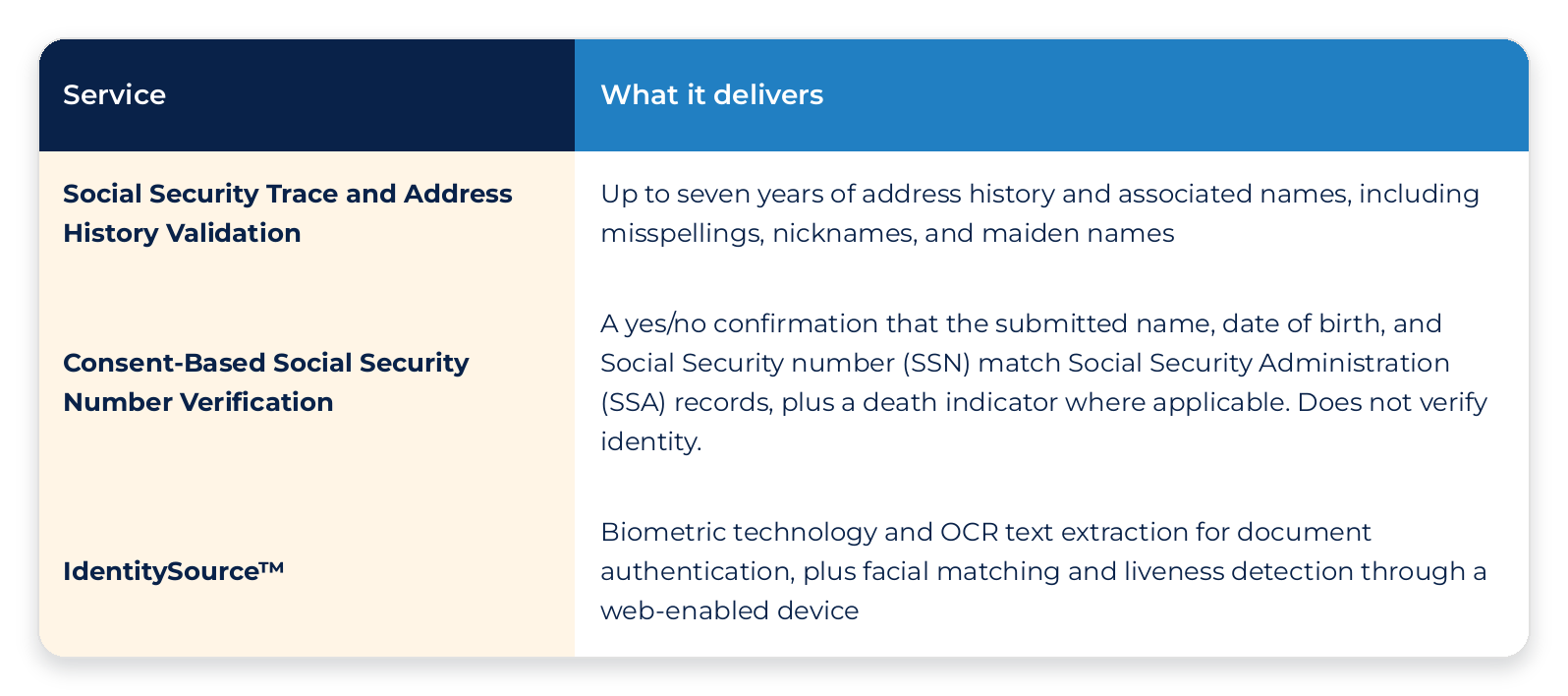
It supports these services through its broader screening infrastructure, with an attorney-led, in-house compliance team and FCRA-certified operations staff.
Client support is U.S.-based, with a 95% live-answer rate and a named account representative for every account. That gives employers a direct point of contact when questions arise during the screening process.
Identity verification can also be connected to existing hiring workflows through AccuSourceHR's SourceDirect™ platform and its ATS, HCM, and HRIS integrations.

Frequently Asked Questions
What is an identity check for employment?
An identity check is a screening service that verifies a candidate is who they claim to be. It validates the name, date of birth and Social Security number against authoritative sources and may add document authentication or a biometric facial match depending on role risk.
Do background checks automatically verify identity?
No. A standard background check runs against the identifiers the candidate supplied. Identity verification is a separate service that confirms those identifiers belong to the candidate, which is why it should be ordered ahead of criminal and court records searches.
What is the difference between an identity check and Form I-9?
Form I-9 establishes authorization to work in the United States and is completed after the offer. An identity check establishes that the person is who they claim to be, can run pre-offer, and can produce a consumer report that the candidate can dispute under the FCRA.
Does the FCRA apply to identity checks?
Yes. An identity check ordered through a consumer reporting agency is a consumer report. Employers must provide standalone written disclosure, obtain written authorization, certify a permissible purpose, and follow the pre-adverse and adverse action process if the result affects the decision.
What should employers do when an identity check returns a mismatch?
Separate data-quality mismatches, such as maiden names or transposed digits, from fraud indicators, such as a number issued to a deceased person. Give the candidate the chance to clarify and apply the full adverse action sequence if the result drives the decision.