
 Jon Daniel

Key Takeaways
- Under 49 CFR §391.25, FMCSA requires an annual MVR review. However, annual motor vehicle record checks leave a 364-day blind spot where new violations such as DUI or license suspensions go undetected
- The gap creates direct negligent entrustment exposure, as courts evaluate reasonable care and not Federal Motor Carrier Safety Administration minimum compliance
- Non-DOT employers (e.g., home health agencies, manufacturers with driver fleets, field service companies) face identical legal exposure with no regulatory nudge to act.
- Continuous motor vehicle record monitoring replaces annual snapshots with real-time alerts when new violations are reported by state agencies
- It closes the timing gap between incident and employer awareness, reducing the window where risk goes unmanaged
- AccuSourceHR’s MVRSource integrates real-time monitoring with SourceDirect documentation, creating a single audit trail that supports both compliance and litigation defense.
An annual MVR check can keep you compliant and still leave you exposed.
Most employers follow the standard process. They check a driver’s record at hire, review it once a year, and file the report. On paper, that meets regulatory requirements. In practice, it leaves long gaps where risk goes unchecked.
When an incident happens, the question is not whether you met the minimum. It is whether you acted reasonably given the risk, and as such, a twelve-month blind spot becomes difficult to defend.
In this guide, we explain what MVR monitoring is, why annual checks fall short, and how to build a driver compliance program that holds up in both audits and litigation.
What Is MVR Monitoring?
Motor vehicle record (MVR) monitoring is the continuous, automated process of tracking an employee’s driving record throughout employment, not just at hire.

A motor vehicle record is an official report from a state Department of Motor Vehicles (DMV). It includes license status, license class, endorsements, violations, suspensions, DUI/DWI convictions, and accident history. Most states report three to ten years of history.
A one-time motor vehicle record check provides a snapshot as of the date it is pulled. Continuous MVR monitoring checks replace that snapshot with ongoing updates. Employers are notified when events such as suspensions, new convictions, or license changes are reported.
The distinction matters because driving records change on any given day. Violations do not wait for annual review cycles.
What the Annual Check Actually Covers
Under 49 CFR §391.25, Federal Motor Carrier Safety Administration (FMCSA) regulated carriers must request an updated motor vehicle record from every state where a driver holds or has held a commercial driver’s license (CDL) at least once every twelve months.
The employer must review the record, confirm the driver meets minimum safety requirements, and document who conducted the review and when.
In August 2025, the FMCSA clarified that third-party continuous monitoring systems can satisfy §391.25(a), provided they deliver a complete motor vehicle record at enrollment and issue real-time updates when new information is reported. The documentation requirement under §391.25(b) and (c) still applies. A manager must review and record the findings.
That clarification signals something important: the FMCSA itself now recognizes continuous monitoring as the modern mechanism for meeting the annual requirement. Annual-only programs are not wrong; they are the floor.
The floor, however, does not protect you from what is above it.
The Gap Annual Checks Leave Open
Annual MVR programs share a structural flaw: they create a blind spot of up to 364 days between reviews. A driver who picks up a DUI conviction, a license suspension, or a reckless driving charge the day after the annual pull can continue operating a company vehicle until the next cycle, unless the employer finds out another way.
Most employers do not find out any other way. Self-reported violation disclosures were removed from the FMCSA regulatory framework in May 2022 when §391.27 was rescinded, precisely because the agency concluded the annual MVR pull made them redundant.
The MVR is now the primary mechanism, and in an annual program, it is checked once.
What the Data Shows
The American Transportation Research Institute’s 2022 Crash Predictor study, based on more than 580,000 truck driver records, shows how strongly past behavior predicts future risk. A prior crash increases the likelihood of another crash by 113%. Reckless driving raises that risk by 104%. Improper lane changes increase it by 78%.
A driver’s record is not just history. It is a forward-looking risk signal. The issue for employers is timing. Post-hire violations remain invisible in annual review programs until the next check.
The liability exposure is significant. A 2023 Embark Safety analysis found that up to 79% of employers lose negligent hiring cases. In one case, a Texas jury assigned $75 million in liability to a carrier that failed to follow its own safety policies and did not adequately supervise the driver.
Transportation also carries the highest occupational risk. The Bureau of Labor Statistics reported 1,391 fatal work injuries in transportation and material-moving roles in 2024. This accounted for 28% of all workplace fatalities that year. The risk is measurable and ongoing.
Annual vs. Continuous MVR: What Each Covers
.png?width=632&height=692&name=Frame%2029%20(5).png)

What Continuous MVR Monitoring Detects
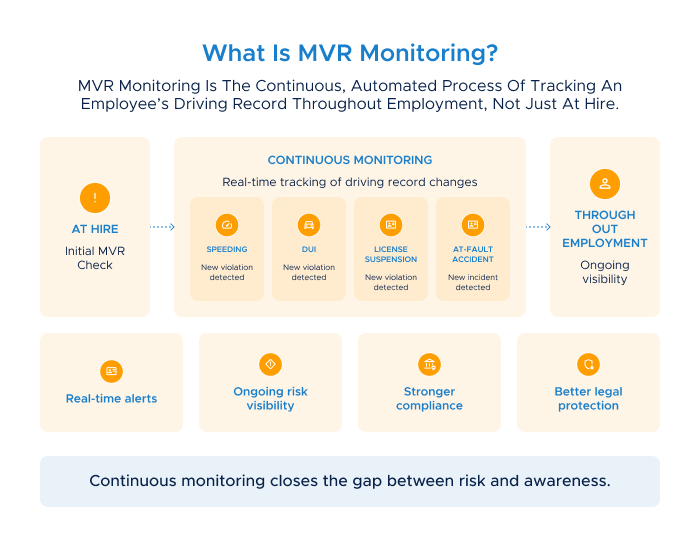
Continuous MVR monitoring watches for any change to the official state record and triggers an alert when a qualifying event is reported. The categories below represent the most common triggers across employer programs.
.png?width=632&height=709&name=Frame%2029%20(7).png)
These alerts integrate directly into AccuSourceHR's SourceDirect™ platform, where they surface alongside the driver's existing screening file and adjudication documentation. The compliance record stays in one place, and the review trail is audit-ready.
MVR Monitoring Is Not Just for CDL Fleets
The annual FMCSA requirement applies specifically to commercial motor vehicle operators under 49 CFR Part 391. It does not apply to home health aides, visiting nurses, field service technicians, pharmaceutical sales representatives, or manufacturing employees who drive as part of their jobs.
The legal exposure, however, applies to all of them.
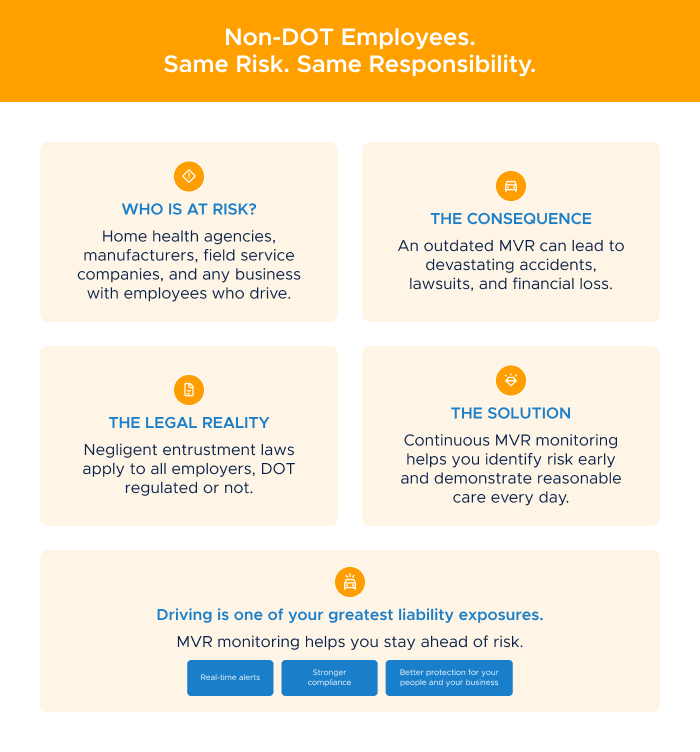
Negligent entrustment is not a Department of Transportation (DOT) doctrine. It is a common law tort. Any employer that provides a vehicle to an employee or allows use of a personal vehicle for work can be held liable if harm occurs.
The standard is reasonable care, which means knowing who is driving and whether they are qualified to do so. Failure to verify that risk exposes the employer, regardless of industry or fleet size.
Two Sectors with a Documented Blind Spot
The screening gap appears in sectors where driving is essential to the job but is not treated as a formal risk category. When driving is seen as incidental, screening often stops at hire or is skipped entirely. Two sectors with document blind spots include the following:
Healthcare: Home health aides and visiting nurses drive to patient homes daily. Many healthcare employers classify these roles as clinical rather than transportation and skip the MVR entirely. One at-fault accident during a patient visit creates direct employer liability, and the employer has no documentation showing it exercised any post-hire diligence on the driver's record.
Manufacturing: Manufacturers often operate driver fleets alongside production, including delivery runs, final-mile distribution, and maintenance vehicles.
These drivers may not hold commercial licenses and receive no ongoing record review unless the employer builds a voluntary program. The negligent entrustment risk is the same as that of a regulated carrier.
The absence of a regulatory requirement is not a liability shield. Courts look at what a reasonable employer should have known, not what a specific agency required them to check.
The Compliance Layer: FCRA and DPPA
Employer access to driving records is governed by two overlapping federal frameworks. Both must be satisfied simultaneously.
The Fair Credit Reporting Act (FCRA) classifies MVRs obtained through a Consumer Reporting Agency (CRA) as consumer reports. Before pulling an MVR on an applicant or employee, the employer must provide a clear and conspicuous standalone disclosure, obtain written authorization, and certify the permissible purpose.
If the MVR informs an adverse employment decision, pre-adverse and adverse action notices are required.
The Driver's Privacy Protection Act (DPPA) governs how state DMVs release personal information from motor vehicle records. Employers must qualify under a permissible use.
The two most relevant are § 2721(b)(3) for use by employers to verify CDL-related information and § 2721(b)(9) for use in connection with motor vehicle or driver safety. Without a qualifying permissible use, access is not permitted.
The Authorization Language Gap
This is the compliance detail most employers miss when moving from annual to continuous monitoring. A vague or one-time authorization obtained at hire may not cover post-hire re-screening under the FCRA. Employers adding continuous MVR monitoring to an existing program need to review their disclosure and authorization language with compliance counsel to confirm it explicitly covers ongoing monitoring throughout employment.
AccuSourceHR's attorney-led compliance team and FCRA-certified operations staff handle this dual-compliance requirement in every MVR engagement. The SourceDirect™ platform captures consent and generates documentation in a format that satisfies both frameworks.
For more on the full FCRA and DPPA compliance walkthrough, see AccuSourceHR's employer guide to driving record checks.
The Business Case for Continuous Monitoring
The argument for continuous MVR monitoring is usually framed in terms of risk avoidance. Although that framing is accurate, it is incomplete, as the data also show direct operational and financial returns.
ROI Snapshot
|
The 22% reduction in violations reflects what researchers call the Hawthorne Effect: drivers who know their records are being monitored change their behavior.
On the insurance side, the mechanism is straightforward. Insurers underwrite based on loss probability. A fleet that can demonstrate a documented monitoring program, year-over-year reductions in violations and incidents, and a clear escalation protocol for high-risk events presents a fundamentally different risk profile at renewal than one running annual-only checks. Proactive safety management is now part of the rate conversation.
The cost comparison is also not close. Continuous MVR monitoring programs cost a fraction of the exposure created by a single negligent hiring verdict or a single premium spike triggered by a preventable incident.
How to Set Up an MVR Monitoring Program
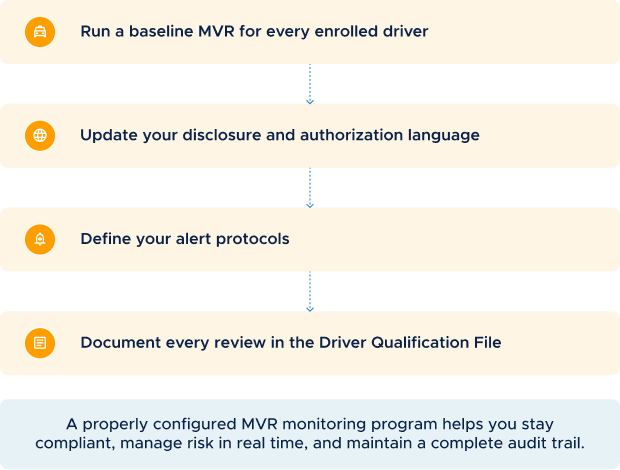
Implementing an MVR monitoring program does not require a separate technology stack or a new compliance team. Here are the 4 steps that cover the transition from annual pulls to continuous monitoring for most employers:
-
Run a baseline MVR for every enrolled driver
Continuous monitoring requires a complete, current record as the starting point. The best time to do this is when you would have run the annual pull anyway — those records become the monitoring baseline and satisfy the §391.25 review requirement simultaneously.
-
Update your disclosure and authorization language
Confirm that your existing FCRA disclosure and authorization documents explicitly cover post-hire, ongoing re-screening. If they were drafted for a point-in-time check, the language likely needs to be updated before you enroll current employees.
Review with compliance counsel or leverage your screening provider's attorney-led compliance support.
-
Define your alert protocols
Establish in advance what each alert type requires: which events trigger immediate removal from driving duties, which trigger a coaching conversation, and who in the organization receives the notification. An alert without a defined response protocol is an unresolved liability.
-
Document every review in the Driver Qualification File
Under 49 CFR §391.25(c)(2), the name of the reviewer and the date of review must be retained in the driver's qualification file for three years.
A third-party monitoring system satisfies the inquiry requirement; the employer must still record the review. AccuSourceHR's SourceDirect™ platform generates audit-ready documentation automatically.
Why Annual MVR Checks Fall Short and How AccuSourceHR Solves It
Annual motor vehicle record checks meet regulatory requirements but leave gaps that expose employers to risk. Courts evaluate reasonable care, not minimum compliance. A twelve-month gap between checks leaves employers without visibility into new violations.
AccuSourceHR addresses this directly with MVRSource monitoring. Instead of periodic checks, employers receive real-time alerts when new activity is reported, closing the visibility gap left by annual programs.
MVRSource integrates with SourceDirect to maintain a single, audit-ready record of both pre-hire and post-hire activity. The program is supported by an attorney-led compliance team that manages Fair Credit Reporting Act and Driver’s Privacy Protection Act requirements as part of the core service.
The result is not just compliance with Federal Motor Carrier Safety Administration expectations but a defensible, continuous monitoring program aligned with how risk is evaluated in practice.

Frequently Asked Questions
-
What is MVR monitoring for employers?
MVR monitoring is the continuous, automated tracking of an employee's motor vehicle record throughout employment. Unlike a one-time check at hire or an annual review, monitoring alerts the employer when a qualifying event — a license suspension, DUI conviction, or moving violation — is reported by the state licensing agency. It replaces the annual snapshot with ongoing visibility.
-
How often should employers check driving records?
FMCSA requires CDL drivers to be reviewed at least once every twelve months under 49 CFR §391.25. For employers managing meaningful liability exposure (transportation, healthcare, manufacturing, or any role where employees drive), continuous monitoring is the emerging standard. Annual-only programs leave gaps that courts have found insufficient in negligent entrustment cases.
-
What does continuous MVR monitoring detect?
Continuous MVR monitoring detects any change reported to the state licensing agency. This includes license suspensions and revocations, DUI and DWI convictions, reckless driving charges, accumulations of moving violations, CDL class downgrades, DOT medical certificate expirations, and out-of-state license activity. Employers receive near-real-time alerts when a qualifying event is recorded.
-
Is an annual MVR sufficient for DOT compliance?
Annual MVR reviews satisfy the FMCSA requirement under §391.25. In August 2025, FMCSA confirmed that third-party continuous monitoring systems also satisfy §391.25(a) when properly implemented (source).
DOT compliance and negligent entrustment defensibility are different standards. Annual checks satisfy the former. Continuous monitoring is more defensible against the latter.
-
What is the difference between an MVR check and MVR monitoring?
An MVR check is a point-in-time report pulled from a state DMV on a specific date. It reflects the driver's record as of that moment. MVR monitoring is an ongoing enrollment that produces automated alerts whenever the record changes. For a full breakdown of what appears on an MVR, see AccuSourceHR's motor vehicle report guide.
-
Does continuous MVR monitoring replace the annual FMCSA review?
Yes, with conditions. FMCSA's August 2025 clarification confirmed that a third-party monitoring system satisfies the §391.25(a) inquiry requirement if it delivers a complete MVR at enrollment and provides real-time updates from state agencies. The employer must still satisfy the review and documentation obligations under §391.25(b) and (c). In addition, a manager must review the record and note the date and their name in the driver qualification file.
-
Can non-DOT employers benefit from MVR monitoring?
Non-DOT employers carry the same negligent entrustment exposure as regulated carriers whenever an employee drives for work purposes. Home health agencies, manufacturers with delivery or service fleets, field service companies, and corporate fleets all face this exposure without a regulatory requirement forcing an annual review. Continuous monitoring fills that gap. AccuSourceHR's driving record checks guide covers the compliance framework for both DOT and non-DOT employers.