
 Jon Daniel

- OIG exclusion screening verifies whether employees, contractors, and other covered parties remain eligible to participate in federally reimbursed healthcare activities.
- The federal List of Excluded Individuals and Entities (LEIE) is the core exclusion database, but organizations may also need to check applicable state Medicaid exclusion lists.
- A single onboarding check cannot identify later exclusions, so recurring screening is important for ongoing compliance.
- Exclusion violations can trigger civil monetary penalties and repayment obligations when excluded individuals provide federally reimbursed services.
- AccuSourceHR combines federal and state exclusion monitoring with recurring screening, match verification, and documented results to help healthcare organizations maintain ongoing exclusion checks.
Healthcare organizations that bill Medicare, Medicaid, or other federal healthcare programs need to know whether the employees, contractors, and other parties involved in reimbursed services are excluded from federal program participation. The primary federal source for this check is the Office of Inspector General’s (OIG) List of Excluded Individuals and Entities (LEIE).
An OIG check is the process of screening individuals or entities against the LEIE and, where applicable, state Medicaid exclusion lists. A name that appears on an exclusion list can affect whether the organization can use that person’s services for federally reimbursed work and may create repayment or civil monetary penalty exposure.
Exclusion screening does not end with a pre-employment check. An individual who clears the LEIE when hired can be excluded months or years later. Healthcare organizations therefore need to determine who should be screened, which databases apply, how often to re-screen, how to verify potential matches, and how to document the results.
This guide explains what OIG means in healthcare, how exclusion screening works, who should be screened, what happens when an excluded individual is identified, and how to build a recurring screening process.
Important note: This guide is for informational purposes only and should not be construed as legal advice. Employers should consult qualified counsel for their specific requirements.
What Is an OIG Check?
An OIG check is the process of screening an individual or entity against federal (and, in practice, state) exclusion databases to confirm they have not been barred from participating in federal healthcare programs.
The List of Excluded Individuals and Entities (LEIE)
The core federal database is the List of Excluded Individuals and Entities, or LEIE, maintained by HHS OIG. The LEIE is a searchable record of every individual and organization currently excluded from federal healthcare program participation. Each entry typically includes the party's name and, where available, additional identifying information such as a date of birth or provider specialty that helps distinguish common names.
When you "run an OIG check," you are, at minimum, searching the LEIE to confirm that the person or entity you're evaluating does not appear on it. An active exclusion on the LEIE means that the party cannot be paid with federal healthcare funds for the duration of the exclusion.
What Triggers an OIG Exclusion?
OIG exclusions are categorized into two types:
- Mandatory exclusions: Required by law and generally stem from convictions related to healthcare fraud, patient abuse or neglect, or certain controlled-substance offenses.
- Permissive exclusions: Discretionary and can arise from a wider range of circumstances, such as license revocation, defaulting on health education loans, or other program-related misconduct.
An active exclusion, regardless of category, means that an individual or entity cannot be part of your federally reimbursed operations.
Federal OIG Exclusions vs. State Medicaid Exclusion Lists
The federal LEIE and state Medicaid exclusion lists serve different screening purposes. Healthcare organizations may need to check both, depending on the states and programs they operate in.
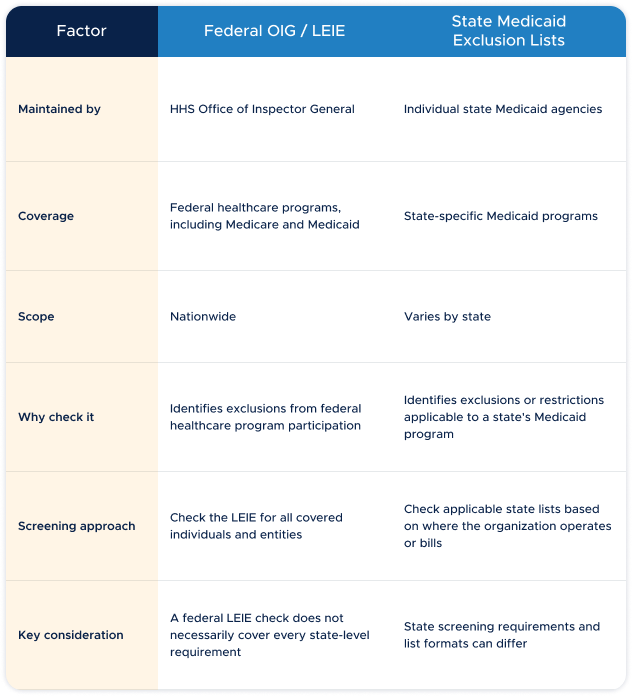
Screening only the LEIE may leave gaps when state Medicaid requirements also apply. Organizations should identify the states and programs relevant to their operations and include the applicable exclusion lists in their screening process
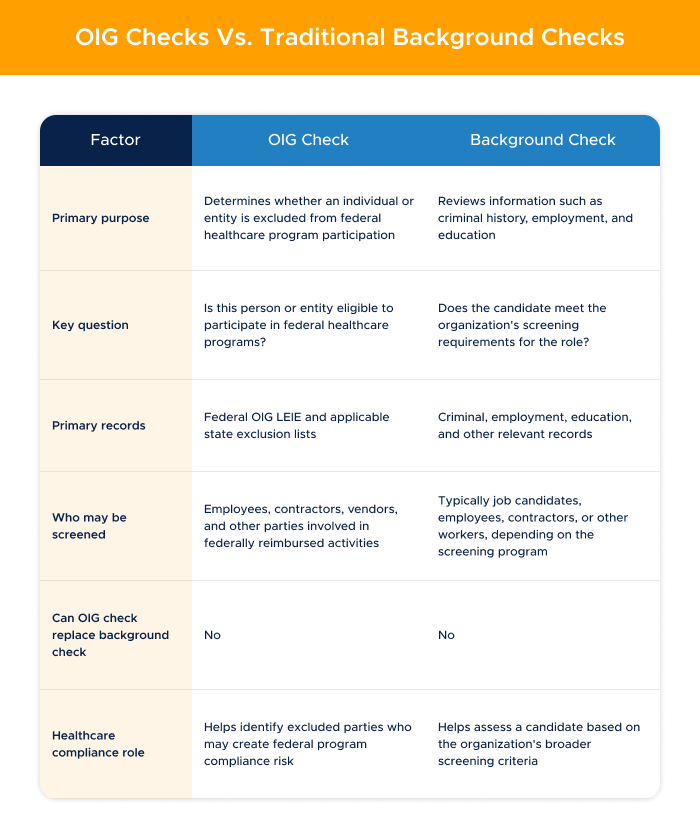
Is an OIG check the same as a background check?
No. An OIG check and a traditional background check serve different purposes and should be treated as separate screening steps
What is OIG's Role in Healthcare Fraud Prevention and Program Integrity?
- Protects federal healthcare programs: OIG uses audits, investigations, evaluations, and enforcement actions to protect program integrity and identify fraud, waste, and abuse.
- Excludes individuals and entities: HHS OIG can exclude individuals and organizations from participating in federal healthcare programs when they meet statutory or regulatory grounds for exclusion.
- Prevents federal payment for excluded services: Federal healthcare programs generally cannot pay for items or services furnished by an excluded individual or entity.
- Creates compliance exposure for employers: Organizations that employ or contract with excluded parties for federally reimbursed work may face civil monetary penalties and repayment obligations.
- Supports ongoing exclusion screening: Employers can use exclusion screening to check whether employees, contractors, and other covered parties remain eligible to participate in federally reimbursed healthcare activities.
- Creates a compliance record: Documenting screening results provides evidence of who was checked, when the check occurred, and whether the individual or entity was eligible.
Who Is Required to Conduct OIG Exclusion Checks?
Exclusion screening obligations extend further than many employers assume, reaching beyond direct patient-care staff to a broad range of roles and relationships.
1. Healthcare Organizations
Organizations that receive payment from Medicare, Medicaid, or other federal healthcare programs have a compliance obligation to conduct exclusion screening. This includes hospitals and health systems, skilled nursing facilities, home health agencies, hospices, physician practices, pharmacies, laboratories, durable medical equipment suppliers, managed care organizations, and healthcare staffing agencies.
If federal healthcare funds help pay for the services or items your organization provides, exclusion screening should be part of your compliance program.
2. Contractors, Vendors, and Temporary Staff
Exclusion screening can extend beyond an organization's direct employees to independent contractors, temporary and agency staff, locum tenens providers, and certain vendors.
The relevant consideration is generally the person's or entity's role in providing items or services reimbursed by a federal healthcare program, not simply whether they are classified as an employee. For staffing agencies, this can create a shared compliance responsibility. Both the agency and the healthcare organization may need to confirm that placed workers are not excluded.
3. Roles and License Types that Trigger a Screening Obligation
Licensed clinical professionals such as physicians, nurses, therapists, pharmacists, and other practitioners. It can also extend to non-clinical personnel whose work supports federally reimbursed services, including billing and coding staff, administrators, executives, and certain information technology personnel.
Since coverage can depend on the individual's function and the applicable federal or state program, organizations should define their screening candidates based on their specific compliance requirements rather than relying solely on job titles.
What Does Federal and State Guidance Say?
The OIG has encouraged healthcare providers to check the LEIE when screening employees and contractors. The Centers for Medicare & Medicaid Services (CMS) has also directed state Medicaid programs to conduct provider screening against exclusion databases. States may impose additional requirements, including checks against state exclusion lists and recurring screening.
The specific requirements can differ by state, program, covered population, database, and screening frequency. Organizations should therefore confirm the requirements that apply to their operations with qualified compliance or legal counsel rather than assuming that one national screening standard applies in every case

What Happens If You Employ or Contract with an Excluded Individual?
Employing or contracting with an excluded individual can create financial and compliance liability when that person's services are paid for by a federal healthcare program. The consequences can include:
1. Civil Monetary Penalties
The OIG can impose CMPs, as laid out in 42 CFR 1003.210, when an organization employs or contracts with an excluded individual and the person provides items or services paid for by a federal healthcare program.
The amount depends on the applicable law and circumstances of the case. OIG enforcement actions show that the financial exposure can be significant. For example, Advanced Health Care of Colorado Springs agreed to pay $500,019.53 in 2026 to resolve allegations that it employed an excluded nurse whose services were billed to federal healthcare programs.
2. Medicare and Medicaid Payments May Have to Be Repaid
Federal healthcare programs generally cannot pay for items or services furnished by an excluded individual. This can create repayment or overpayment liability for the organization that received the payment.
The rule can apply even when the excluded person's services were not separately billed. OIG gives the example of a hospital receiving a bundled Medicare payment that includes services provided by an excluded nurse. The hospital may still be responsible for the resulting overpayment.
3. The Risk Applies to Contractors and Staffing Agency Workers
The exclusion rules can apply when an organization obtains services from an excluded individual through a contractor or staffing agency.
For example, a hospital that uses a staffing agency may face liability if an excluded temporary nurse provides services to federal healthcare beneficiaries and those services are paid for by a federal healthcare program. Organizations should therefore consider employees, independent contractors, temporary workers, and other personnel who provide federally reimbursed services when defining their screening population.
Can an Excluded Person Still Work for a Healthcare Organization?
An exclusion does not automatically prevent a person from performing every type of work for a healthcare organization. OIG explains that an excluded individual may perform certain services when federal healthcare programs do not pay, directly or indirectly, for those services.
Whether an excluded person can continue working depends on the service they provide, who receives those services, and whether a federal healthcare program pays for them. When an exclusion is identified, document these details and consult your compliance or legal team before allowing the individual to perform federally reimbursed work.
How to Conduct an OIG Exclusion Check: A Step-by-Step Guide
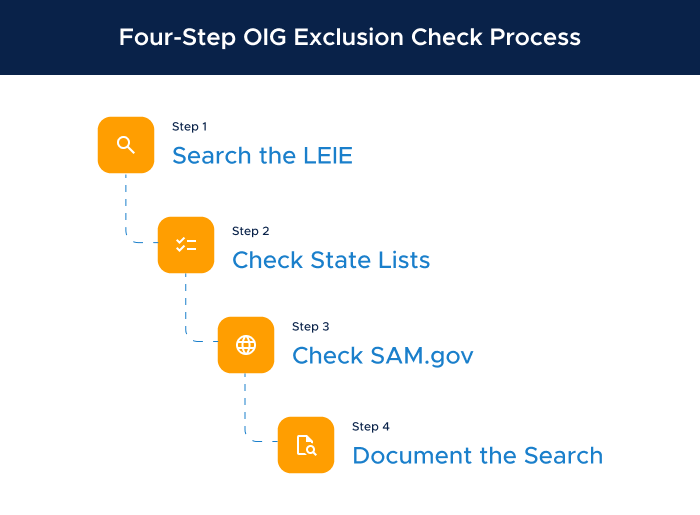
A proper OIG exclusion check involves checking the applicable databases, verifying potential matches, and documenting the search and outcome. Follow these steps to build a consistent screening process:
Step 1: Search the OIG LEIE Database
The LEIE is publicly searchable through the U.S. Department of Health and Human Services (HHS) Office of Inspector General website at no cost.
Enter the individual's or entity's name and review any results. If a potential match appears, compare the identifying information in the record, such as date of birth or other available identifiers, to determine whether it is the same person or entity. OIG's search tool also provides a verification function for potential matches.
Organizations can conduct LEIE searches themselves, but the search is only one part of an effective exclusion screening program. Working with a PBSA-accredited background screening provider such as AccuSourceHR can help organizations establish a consistent, documented process for screening, verifying potential matches, maintaining records, and demonstrating how results were handled.
Step 2: Check Applicable State Medicaid Exclusion Lists
If your organization operates or bills in multiple states, determine which state exclusion lists apply and screen against them. State requirements and list formats vary, so a federal LEIE search may not satisfy every state or program requirement.
Step 3: Check System for Award Management (SAM) When Relevant
SAM.gov contains records of parties excluded from federal contracts and certain other federal activities. This is separate from an OIG healthcare exclusion. Organizations may include SAM.gov screening in their vendor or entity screening programs when federal contracting or grant eligibility is relevant.
Step 4: Record the Search
Keep a record of the person or entity screened, databases searched, search date, and result. For a potential match, retain the information used to verify or clear the match. A consistent record gives your compliance team evidence of when the check occurred and what it found.
What to do When a Match Appears?
A search result is not automatically a confirmed exclusion. Compare the record with the individual's or entity's identifying information before taking action.
If the match is confirmed, stop the excluded party from providing items or services payable by a federal healthcare program and follow your organization's response procedure. Document how the match was verified and how it was resolved.
If the exclusion information came from a third-party screening provider and you take adverse employment action based on that information, the FCRA’s pre-adverse and adverse-action requirements may also apply. Coordinate those steps with your exclusion response and documentation.
How Often Should You Conduct Exclusion Screening?
A check at hiring or contracting does not establish that an individual will remain eligible throughout the relationship. OIG guidance supports screening at the start of employment or a contract and periodic re-screening thereafter.
1. Choosing a Screening Frequency
OIG does not mandate a single universal screening and re-screening frequency for all organizations. Your policy should account for the candidates you screen, applicable state or program requirements, and the organization's use of federally reimbursed services.
42 CFR 455.436 requires state Medicaid agencies to conduct monthly screenings because it reduces the time between an exclusion taking effect and its detection. If you use a different interval, document the basis for that decision.
2. Use Trigger-Based Checks
Run an additional check when someone enters or moves into a covered role. Relevant events can include a new hire, new contractor, role change, contract renewal, or new vendor relationship. This supplements scheduled re-screening rather than replacing it.
Why Onboarding Screening is Insufficient
An individual who clears an exclusion check on their start date can later appear on an exclusion list. Without recurring checks, the organization may continue employing the same person for federally reimbursed services after the exclusion takes effect.
Healthcare employers should therefore treat exclusion screening as an ongoing compliance process, alongside other healthcare onboarding and screening requirements.
What to Evaluate in a Monitoring Solution
Check which databases the service covers, how often it can run searches, how potential matches are verified, and what records it produces.
Integration with your applicant tracking system (ATS) or human capital management (HCM) system can also reduce manual data entry.
AccuSourceHR's SourceDirect™ platform provides a RESTful application programming interface (API) and integrations with ATS and HCM systems. Its exclusion screening can therefore be connected to existing workforce systems rather than maintained as a separate process.
Building an OIG Exclusion Monitoring Program
An effective program should establish who is screened, who owns the process, when checks occur, and what happens after a potential match.
- Assign ownership: Give one function clear responsibility for the program. Compliance may oversee the policy and screening schedule, while Human Resources (HR) manages workforce information and Legal reviews confirmed matches or questions about federal program exposure. Document these responsibilities.
- Define who must be screened: Document the groups that must be screened, including employees, independent contractors, temporary and agency workers, locum tenens providers, vendors, and other parties whose work may involve federally reimbursed items or services.
- Set the schedule and trigger events: Document your recurring screening schedule and the events that require an additional check. New hires, new contracts, role changes, contract renewals, and new vendor relationships are examples of events that may warrant an off-cycle search.
- Establish a response procedure: Your procedure should state how staff verifies a potential match, who reviews a confirmed exclusion, when the individual or entity must be removed from federally reimbursed work, and how affected claims are reviewed. Record the final outcome.
- Set documentation requirements: Retain the name screened, databases checked, date, result, match-verification details when applicable, and final resolution. Set a documented retention period that aligns with your compliance requirements.

OIG Exclusion Monitoring: Best Practices
A reliable OIG exclusion program needs to maintain consistent screening, document results, and respond quickly when an exclusion is identified. Here are a few best practices:
- Check state databases: The LEIE is the federal healthcare exclusion database. Depending on your state and program requirements, you may also need to check state Medicaid exclusion lists. SAM.gov can provide additional information about federal debarment and exclusion relevant to vendors or entities.
- Build screening into onboarding: Make exclusion screening part of the onboarding or credentialing process so new employees and contractors are checked before they begin covered work.
- Train the people responsible for screening: HR, compliance, and contracting staff should know who must be screened, which databases apply, how to handle potential matches, and when to escalate a confirmed exclusion.
- Keep searchable screening records: Retain dated records showing who was screened, which databases were checked, and the outcome. For potential matches, document the information used to clear or confirm the result.
- Review the program periodically: Review your screening group, databases, frequency, response procedure, and documentation requirements as federal and state requirements change.
Build Recurring OIG Checks Into Your Compliance Process
A person who clears screening at onboarding can become excluded later, which is why organizations should determine recurring screening and trigger-based checks for relevant workforce and vendor changes.
A documented process makes it easier to identify exclusions before they affect federally reimbursed work and gives your compliance team a clear record of how each result was handled.
If managing federal and state exclusion checks manually is becoming difficult, automated monitoring can help centralize searches, match verification, and screening records.
AccuSourceHR can help healthcare organizations manage ongoing exclusion screening across federal and state sources. Talk to AccuSourceHR's compliance team to review your current screening process and coverage.
Frequently Asked Questions
Is an OIG check required by law?
Not always. Federal law does not require every healthcare employer to check the OIG exclusion list. However, organizations that employ or contract with excluded individuals can face civil monetary penalties when those individuals provide services reimbursable by federal healthcare programs. OIG recommends screening new hires and current employees routinely to reduce this risk.
How do I search the OIG exclusion list?
Search the List of Excluded Individuals/Entities (LEIE) through the HHS OIG online database. You can search up to five individuals or entities at a time and verify an individual using a Social Security number when needed. OIG also provides a downloadable database for larger screening volumes.
Organizations can conduct these searches themselves, but working with a PBSA-accredited screening provider like AccuSourceHR can help establish a consistent, documented screening process and support the ongoing management of exclusion checks and potential matches.
What is the penalty for employing an OIG-excluded individual?
A healthcare provider may face civil monetary penalties of up to $25,595 for each item or service furnished by an excluded individual and claimed from a federal healthcare program. OIG may also impose an assessment of up to three times the amount claimed and program exclusion.
How often does OIG update the LEIE?
OIG updates the LEIE monthly, with information generally updated by the middle of each month. OIG recommends healthcare entities routinely check the list because exclusion status can change after hiring. Monthly screening can help organizations identify new exclusions sooner and reduce potential liability.
What's the difference between OIG exclusion and SAM.gov debarment?
OIG exclusion bars individuals or entities from participating in federal healthcare programs such as Medicare and Medicaid. SAM.gov contains federal exclusion records covering a broader range of government contracting and assistance activities. The systems serve different purposes, so checking one does not necessarily address every federal eligibility issue relevant to a healthcare organization.
What Is OIG in Healthcare?
OIG refers to the Office of Inspector General housed within the U.S. Department of Health and Human Services (HHS OIG). It is the oversight body charged with protecting the integrity of HHS programs and with rooting out fraud, waste, and abuse across the federal healthcare system.