
 Jon Daniel

Key Takeaways
- CDLIS, the Commercial Driver's License Information System, is a nationwide database that tracks every CDL a driver has held across all 50 states. It does not show violations but shows where to find them.
- CDLIS works as a prerequisite: run it first, then pull MVRs from each state it returns to get a complete driving history
- Under 49 CFR §383.37, carriers are responsible for ensuring a driver does not hold multiple CDLs, skipping CDLIS makes that requirement impossible to verify
- Improper hiring or onboarding significantly raises risk, with jury awards increasing by 272.3% (ATRI, December 2025)
- The best practice is to run CDLIS at pre-hire and alongside annual MVR reviews as part of a continuous compliance program
- AccuSourceHR includes CDLIS within its MVRSource™ and DOT Program Management bundle, so it’s handled as part of a single, audit-ready workflow
A Motor Vehicle record shows a driver’s history in a single state. Most carriers understand this and run MVRs at pre-hire and annually. What often gets missed is that the report may only reflect part of the driver’s record.
If a driver previously held a Commercial Driver’s License (CDL) in Texas but now holds one in Ohio, an Ohio Motor Vehicle Record (MVR) will only show activity tied to that state. Any violations, suspensions, or accidents from Texas remain outside the view unless specifically requested.
That’s the gap the Commercial Driver's License Information System (CDLIS) is designed to close.
A CDLIS check doesn’t replace the MVR. It identifies every state where a CDL has been issued, so you know exactly which records to pull. Without it, screening relies on a single-state snapshot for what is often a multi-state driving history.
Let’s start with understanding CDLIS first.
What Is CDLIS?
The Commercial Driver's License Information System is a nationwide database that tracks every commercial driver’s current and prior CDLs across all 50 states. Its core purpose is simple: ensure that no driver holds more than one valid CDL at any time.
The system is operated by the American Association of Motor Vehicle Administrators on behalf of state licensing agencies. Each state updates CDLIS in real time whenever a CDL is issued, transferred, renewed, or revoked. Today, the system maintains records for more than 11 million commercial drivers across U.S. jurisdictions, and is governed by regulations from the Federal Motor Carrier Safety Administration (FMCSA) under 49 CFR Parts 383 and 384.
Employers cannot access CDLIS directly. Data must be obtained through an authorized screening provider or the driver’s state licensing agency.
What Does a CDLIS Report Show?
A CDLIS report returns a focused set of identifiers, not a full driving history. It typically includes the driver’s current CDL state and license number, as well as up to three previously held CDLs in other states. It also includes basic identity markers, such as SSN and date-of-birth validation, as well as any known aliases.
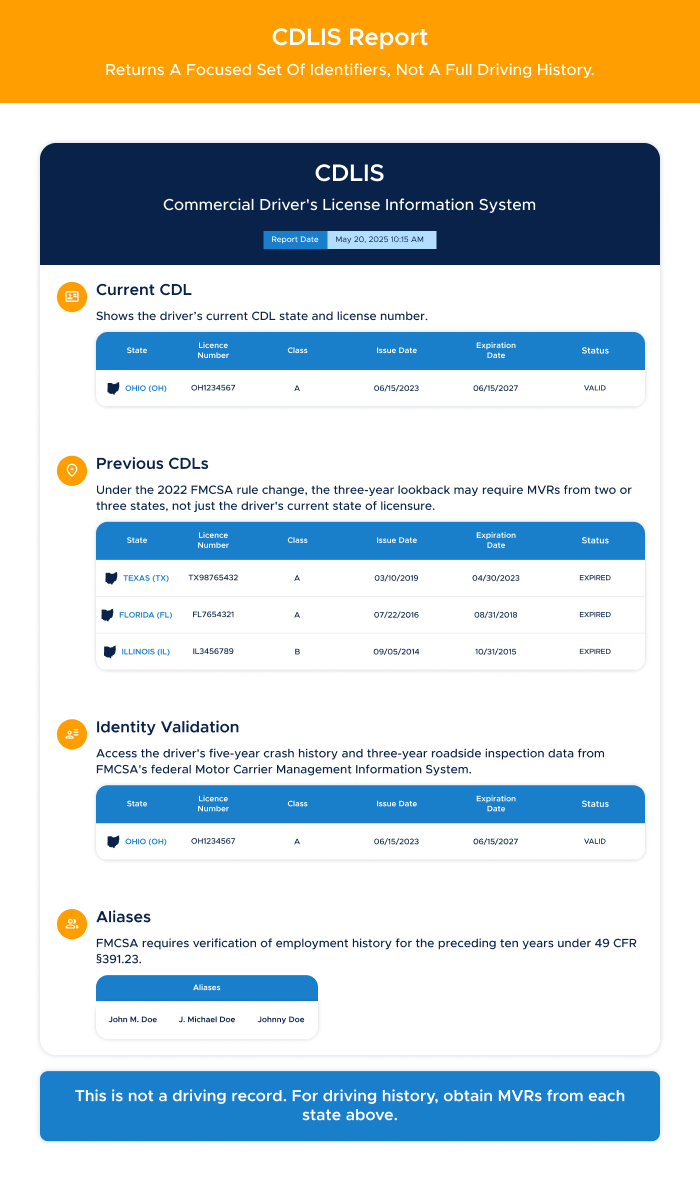
What it does not show is equally important. CDLIS contains no violation history, accident data, suspensions, DUIs, or roadside inspection results. Those records live on state MVRs and in the FMCSA Pre-Employment Screening Program (PSP) report. CDLIS tells you where to look. The MVR and PSP tell you what to look at.
This is the pointer-system mechanic that most carriers miss. Many assume CDLIS and MVR are interchangeable or that one duplicates the other. They do not. They answer entirely different questions, and both are necessary to build a complete, compliant view of a driver’s history
A side-by-side comparison of CDLIS and MVR
The table below clarifies exactly what each report covers and where its limits are:
.png?width=632&height=583&name=Frame%2029%20(4).png)
What Does FMCSA Actually Require?
The regulation that grounds CDLIS is 49 CFR § 383.37. It states that no employer may "allow, require, permit, or authorize" a driver to operate a CMV during any period in which that driver holds more than one CDL. The duty falls on the employer, not the driver, to verify this before a single mile is driven.
That obligation ties directly to pre-hire screening. Under updated FMCSA requirements, carriers must review a driver’s licensing history over the past 3 years, expanding the earlier 1-year standard. Meeting that requirement depends on knowing where the driver has held a CDL during that period.
That’s where the CDLIS becomes operationally necessary. It identifies every state tied to the driver’s CDL history so the correct MVRs can be pulled.
Running it is the prerequisite for every MVR that follows.
What Happens When Carriers Skip It?
The risk shows up in both audits and courtrooms.
Drivers have obtained CDLs in new states to distance themselves from prior violations or disqualifications. Without a CDLIS check, a carrier has no visibility into that multi-state history. That gap becomes negligent hiring exposure the moment something goes wrong on the road.
Under FMCSA's December 2024 civil penalty schedule, CDL-related violations can carry fines of up to $7,155 per violation. These penalties apply per driver and per instance. For a mid-sized fleet, repeated gaps can turn a routine audit into a meaningful financial event.
Improper hiring or onboarding increases expected jury awards by 272.3%
American Transportation Research Institute (ATRI) Trucking Litigation Report — December 2025
The litigation risk runs deeper than regulatory fines. ATRI's December 2025 analysis of trucking lawsuit data found that carriers facing improper hiring or onboarding claims see expected jury awards increase by 272.3%. The plaintiff's attorney does not need to prove malice, only that the carrier failed to take the reasonable steps a simple CDLIS check would have covered.
Case outcomes reflect that pattern. In 2021, a Florida jury awarded $1 billion in punitive damages against AJD Business Services after a fatal crash. The driver involved had been operating without a valid CDL. The carrier had not verified the driver's licensing history before putting him on the road.
The confusion often stems from how CDLIS is framed. The report itself is not listed as a standalone requirement, but the legal obligation under § 383.37, to ensure a driver does not hold multiple CDLs , is not optional.
A carrier cannot credibly claim they did not "knowingly" permit a driver with multiple licenses to operate if they never ran the check that would have told them.
How Does CDLIS Work With Your MVR?
The correct pre-hire driver qualification sequence runs like this:
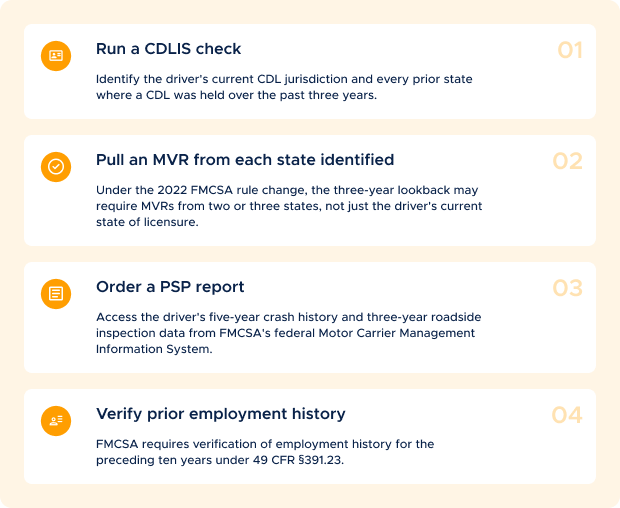
CDLIS is Step 1 because every step that follows depends on it. Without it, you do not know which MVRs to pull, and your driver qualification file has a structural gap before it is even assembled. A carrier that runs a single-state MVR without first running CDLIS has not completed pre-hire screening; it has completed a fraction of it.
How Often Should You Run a CDLIS Check?
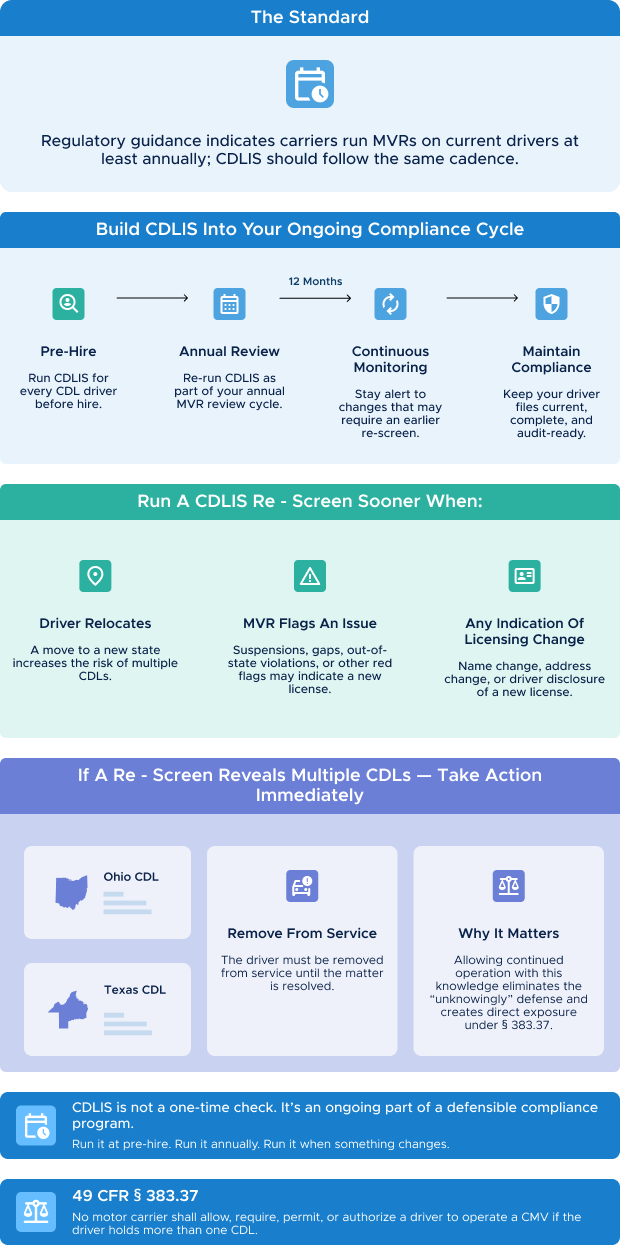
At pre-hire, CDLIS is essential for every CDL driver. For ongoing compliance, the prudent standard is to include a CDLIS re-screen as part of the annual MVR review cycle, particularly when a driver has relocated or when anything in their MVR flags a potential licensing change.
Regulatory guidance indicates that carriers run MVRs on current drivers at least annually; CDLIS should follow the same cadence.
If a re-screen reveals that a driver now holds licenses in multiple states — even if recently issued — the driver must be removed from service until the matter is resolved.
Allowing continued operation with that knowledge eliminates the "unknowingly" defense entirely and creates direct exposure under § 383.37.
How AccuSourceHR Handles CDLIS
For carriers managing driver compliance across a fleet, CDLIS should not be a separate order from a separate vendor.
AccuSourceHR includes CDLIS as part of its MVRSource Monitoring and DOT Program Management bundle. The same program covers continuous MVR monitoring, FMCSA Clearinghouse verifications, PSP Crash Report access, DOT physical exam coordination, and in-house C/TPA-accredited drug screening.
Instead of managing separate workflows, carriers operate within one system designed around the full driver lifecycle. Support is structured around named account management rather than ticket-based queues, backed by an attorney-led compliance team and FCRA-certified staff.
AccuSourceHR also holds Founding Member status with the Professional Background Screening Association (PBSA), a distinction held by a small percentage of screening providers.
The goal is straightforward: a driver qualification file that holds up under audit, litigation, or insurance review. CDLIS is not the entire file, but it’s the starting point that everything else depends on.
Running it through a bundled, attorney-backed program means no step is left to chance.
Ready to review your driver compliance program?Talk to an AccuSourceHR transportation specialist about the MVRSource + DOT Program Management bundle. |
Frequently Asked Questions
What does CDLIS stand for?
CDLIS stands for Commercial Driver's License Information System. It is a nationwide database managed by the American Association of Motor Vehicle Administrators (AAMVA) on behalf of all 50 U.S. states and the District of Columbia. Its purpose is to ensure each commercial driver holds only one valid CDL and one complete driver record across all jurisdictions.
Is a CDLIS check required by the FMCSA?
CDLIS is not listed as a mandatory standalone deliverable in FMCSA's pre-hire requirements. However, 49 CFR §383.37 prohibits employers from knowingly allowing a driver with more than one CDL to operate a CMV. CDLIS is the only practical tool to verify that a driver does not hold multiple licenses. The legal obligation exists regardless of whether the check appears on a formal required-documents checklist.
What is the difference between CDLIS and an MVR?
An MVR provides a driver's violation history within a single state. CDLIS identifies every state where a driver has held a CDL over the past three years, enabling carriers to pull the correct set of MVRs. CDLIS does not contain violations, accidents, or suspensions; that information lives on the state-level MVR. The two reports are complementary, not interchangeable.
Who can run a CDLIS check?
Carriers cannot access the CDLIS-Gateway directly. FMCSA requires employers to obtain CDLIS data through an authorized third-party background screening provider. AccuSourceHR provides CDLIS checks as part of its MVRSource + DOT Program Management bundle for transportation clients.
How often should carriers run a CDLIS check?
At a minimum, CDLIS should be run at pre-hire for every CDL driver. Periodic re-screening as part of the annual MVR review cycle is strongly recommended. If a driver has recently moved to a new state or obtained a new CDL, or if their MVR flags a potential licensing change, rescreen immediately. Allowing a driver with a known multiple-CDL situation to remain on the road removes the unknowing defense under §383.37.