
11 min read
Saliva Drug Test for THC: Detection Window, Accuracy & Employer Options in 2026
 AccuSourceHR, Inc.
:
Jun 7, 2026, 11:00:12 AM
AccuSourceHR, Inc.
:
Jun 7, 2026, 11:00:12 AM
Your hiring manager calls at 7:45 a.m. on a Monday. There was an incident on the warehouse floor over the weekend, and the company needs to conduct reasonable-suspicion drug testing on two employees before their shift ends. Sending them to an off-site collection facility means hours of lost productivity, chain-of-custody headaches, and the logistical challenge of transporting workers mid-shift.
This is exactly the scenario that has driven a growing number of employers toward the saliva drug test for THC as a faster, more practical alternative to urine-based screening. With marijuana laws shifting across states and the federal framework still catching up, understanding how a saliva drug test for THC actually works, what it can and can't detect, and how to build a compliant program around it has become essential knowledge for every HR professional managing a drug-free workplace policy.
Disclaimer: This content is provided for informational purposes only and should not be construed as legal advice. Employers should consult qualified counsel for their specific situation.
Key Takeaways
-Saliva drug tests detect recent THC use. Unlike urine tests, which can pick up metabolites from days or weeks prior, oral fluid testing is designed to identify THC consumed within a much narrower window, typically the preceding 24 to 72 hours depending on usage patterns.
- Detection windows are shorter but more targeted. For employers focused on identifying impairment-related risk rather than off-duty use from weeks ago, saliva testing offers a closer proxy to recent consumption.
- Accuracy rates are strong when proper protocols are followed. Modern oral fluid test kits that carry FDA approval and CLIA-waived status can achieve high accuracy rates, though collection technique and timing matter.
- Employer adoption is accelerating. A growing number of employers are adopting oral fluid screening, driven by convenience, reduced adulteration risk, and evolving state laws that now explicitly authorize oral fluid testing.
- Compliance is not optional. State marijuana protections, DOT regulations, and specimen-type restrictions all influence whether and how you can use saliva testing for THC. A one-size-fits-all approach is a magnet for litigation.
Understanding Saliva Drug Testing
Oral fluid drug testing has been around for decades, but it spent most of that time in the shadow of urine testing, which has long been the default specimen type for workplace programs. That's changing. Several factors are pushing saliva testing into the mainstream: it's less invasive, it can be observed without the privacy concerns of a urine collection, and it's harder to adulterate. For HR teams managing multi-site operations or post-accident testing protocols, the ability to collect a specimen on-site, under direct observation, and without a restroom facility is a meaningful operational advantage.
|
💡 Pro Tip If your organization conducts reasonable-suspicion or post-accident testing, saliva collection can be performed by a trained supervisor or designated employer representative at the worksite itself, reducing the time between the triggering event and specimen collection. That shorter gap matters for both safety and defensibility. |
From a compliance standpoint, the regulatory environment has changed significantly. The Substance Abuse and Mental Health Services Administration, known as SAMHSA, published its SAMHSA final rule authorizing oral fluid testing for federal workplace drug testing programs. The Department of Transportation published a final rule authorizing oral fluid as a specimen type for DOT-regulated testing, though implementation depends on the availability of SAMHSA-certified oral fluid testing laboratories. Employers should verify the current implementation status with their screening provider before using oral fluid for DOT-regulated tests. These federal developments signal broader acceptance, but employers still need to verify that their state permits oral fluid testing and understand any restrictions that apply.
How Saliva Drug Testing Works
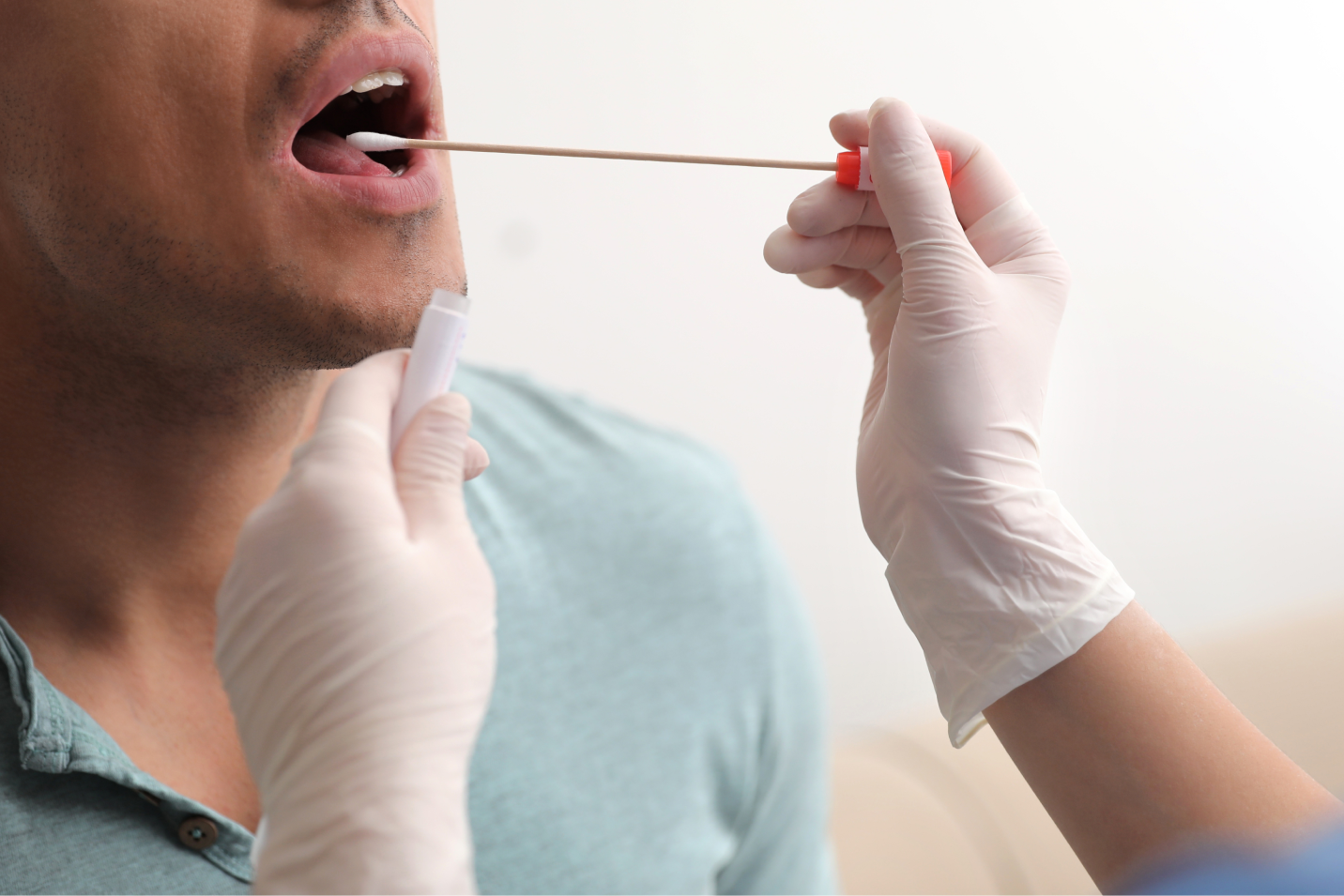
The collection process is straightforward. A trained collector places an absorbent pad or swab between the donor's cheek and lower gum. The donor holds the device in place for a specified period, usually two to five minutes, until a saturation indicator confirms that enough oral fluid has been collected. The specimen is then sealed in a tamper-evident container and sent to a certified laboratory for confirmation testing, or in some point-of-care scenarios, an initial screen is read on-site.
What the test actually measures is important to understand. Saliva drug tests for THC detect delta-9-tetrahydrocannabinol, the parent compound, rather than the THC-COOH metabolite that urine tests target. This distinction is significant. Because the parent compound is what's present during and shortly after cannabis use, oral fluid testing is better suited to identifying recent consumption.
It doesn't tell you whether someone used cannabis three weeks ago on vacation. It tells you whether THC was present in their system within a much more recent timeframe.
The observed collection also reduces one of the biggest headaches in urine testing: specimen substitution and adulteration. There's no trip to a private restroom, no opportunity to swap specimens, and no temperature-strip workarounds. For employers who have dealt with inconclusive or suspect urine collections, this is a practical benefit worth noting.
THC Detection Window in Saliva
Here's where the conversation gets nuanced, and where HR professionals need to pay close attention. The detection window for THC in a saliva drug test is significantly shorter than in urine, which is both its greatest strength and its most important limitation.
For occasional cannabis users, THC is typically detectable in oral fluid within minutes of ingestion. That window makes saliva testing particularly well-suited for scenarios where you need to determine whether someone used cannabis recently, such as post-accident or reasonable-suspicion situations.
|
📌 Did You Know? Because saliva tests detect the parent THC compound rather than a stored metabolite, a positive oral fluid result is a stronger indicator of recent use than a positive urine result. This distinction is increasingly relevant as more states pass laws protecting employees' off-duty cannabis use while still allowing employers to address on-the-job impairment. |
However, the detection window isn't a fixed number. Several variables influence how long THC shows up on a saliva drug test, including the frequency of use, the potency of the product consumed, individual metabolism, and oral hygiene habits. Understanding these variables helps HR teams set realistic expectations about what a saliva test can and cannot tell them.
How Long Does THC Stay Detectable?
For a single-use scenario, most research indicates that THC clears oral fluid within 24 hours for the majority of individuals. Chronic or heavy cannabis users present a different picture. THC from frequent use can occasionally linger in saliva for longer periods, and some studies have documented detection in heavy users under laboratory conditions.
|
📎 Key Detail Detection times published by test manufacturers and clinical studies represent ranges, not guarantees. A person who smoked cannabis 20 hours ago might test negative on one device and positive on another, depending on the cutoff concentration used. The SAMHSA-recommended screening cutoff for THC in oral fluid is 4 ng/mL, with a confirmation cutoff of 2 ng/mL. Some point-of-care devices use different thresholds. |
|
📎 Compliance Note If your drug testing policy relies on saliva testing and you're operating in a state with off-duty cannabis protections, the shorter detection window actually works in your favor. You're less likely to flag an employee for legal, off-duty use that occurred days ago, which reduces the risk of a discrimination or wrongful-termination claim. But you need to document your cutoff levels, your testing protocols, and the rationale behind your specimen-type selection in your written policy. |
How Far Back Can a Saliva Drug Test Detect THC?
This is one of the most common questions employers ask, and the answer depends on context. In practical terms, a saliva drug test is not designed to look back weeks or months. Its effective detection window for THC is measured in hours, not days. For most individuals, the realistic lookback period is 24 to 48 hours. Contrast that with urine testing, where THC metabolites can be detected for extended periods, and you can see why the two specimen types serve fundamentally different purposes.
For employers whose primary concern is recent use or potential impairment at the time of testing, saliva is the more targeted tool. For employers who need a broader detection window, perhaps for pre-employment screening where the goal is to assess overall substance use patterns, urine may still be the more appropriate choice.
Accuracy of a Saliva Drug Test for THC
Accuracy is the question that keeps compliance managers up at night, and rightfully so. A false positive can derail a candidate's career and expose your organization to legal liability. A false negative can leave a safety risk unaddressed. So how reliable is a THC saliva drug test?
The good news is that modern oral fluid testing has matured considerably. According to testing industry data, the best oral fluid drug tests can achieve high accuracy when proper protocols are followed. FDA-approved, CLIA-waived point-of-care devices have demonstrated strong concordance with laboratory-based confirmation methods in published validation studies. Laboratory-based confirmation testing uses a method called liquid chromatography-tandem mass spectrometry (LC-MS/MS). This technique is considered the gold standard in forensic toxicology and provides a high degree of certainty.
That said, accuracy in the real world depends on more than just the test kit. It depends on proper collection technique, appropriate timing relative to the suspected use, correct storage and transport of the specimen, and the use of a certified laboratory for confirmation. A well-engineered test device can produce unreliable results if the collection was performed incorrectly or the specimen sat in a hot vehicle for hours before reaching the lab.
Factors Affecting Accuracy
Several factors can influence the accuracy of a saliva drug test for THC, and HR professionals should be aware of each:
- Collection timing: If the specimen is collected too soon after eating, drinking, or using a mouth rinse, the oral fluid may be diluted or contaminated. Most protocols require a 10 to 15 minute observation period before collection, during which the donor cannot eat, drink, smoke, or chew gum.
- Specimen volume: Insufficient oral fluid volume is one of the most common reasons for an invalid or rejected specimen. Some donors, particularly those who are nervous or dehydrated, produce saliva slowly. Patience during collection is important.
- Cutoff thresholds: Different test devices and laboratories use different cutoff concentrations. A test with a lower cutoff will detect smaller amounts of THC but may also increase the risk of detecting residual environmental exposure. Aligning your program's cutoffs with SAMHSA guidelines provides a defensible standard.
- Confirmation testing: Any presumptive positive from a point-of-care screen should be confirmed by a certified laboratory. Skipping confirmation testing to save time or money is a compliance risk that no employer should take.
Saliva vs. Urine Drug Test for THC
The saliva vs. urine drug test debate isn't about which method is "better" in the abstract. It's about which method is better for your specific use case.
Detection window: Urine testing casts a wider net. Urine captures metabolites that persist in the body long after the parent drug has cleared. For THC specifically, urine can detect use from days to weeks prior, while saliva is limited to roughly the preceding 24 to 72 hours.
Specimen integrity: Saliva testing has a clear advantage in observed collection. Because the swab is placed in the donor's mouth under direct observation, the opportunities for adulteration or substitution are minimal. Urine collections, particularly unobserved ones, are more vulnerable to tampering.
Convenience and speed: Saliva collections can be performed virtually anywhere, including a job site, a supervisor's office, or a mobile testing unit. Urine collections typically require a restroom facility that meets specific standards.
|
💡 Pro Tip Many employers are adopting a hybrid approach, using saliva testing for post-accident and reasonable-suspicion scenarios where recent use is the primary concern, and urine testing for pre-employment and random programs where a broader detection window is preferred. This strategy aligns the testing method with the purpose of the test, which strengthens both the program's effectiveness and its legal defensibility. |
Employer Options for Saliva Drug Testing
The growing acceptance of oral fluid testing has expanded the options available to employers. Whether you're building a drug testing program from scratch or updating an existing one, understanding the current landscape helps you make informed decisions.
At the federal level, SAMHSA's authorization of oral fluid testing for federal workplace programs was a landmark development. It validated the science behind oral fluid testing and established standardized procedures, cutoffs, and laboratory certification requirements. The Department of Transportation's final rule authorizing oral fluid as a specimen type has opened the door to saliva testing for safety-sensitive positions, though full implementation is contingent on laboratory certification infrastructure. As of this writing, confirm current DOT oral fluid testing availability with your screening provider.
At the state level, the picture is more complex. Some states have explicitly authorized oral fluid testing in their workplace drug testing statutes. Others are silent on the topic, which creates ambiguity. A handful of states have restrictions on when or how oral fluid testing can be used. And with the ongoing wave of marijuana legalization and employee-protection laws, the rules are shifting frequently.
Our drug and alcohol screening services can help you work through these requirements.
Choosing the Right Test for Your Workplace
Selecting the right saliva drug test for your workplace involves more than picking a product off a shelf. Consider these factors:
- Regulatory requirements: If you have DOT-regulated employees, your testing program must comply with 49 CFR Part 40, which currently mandates urine testing. Non-regulated employees may be tested using oral fluid where state law permits.
- Testing scenarios: Map your testing triggers (pre-employment, random, post-accident, reasonable suspicion, return-to-duty) to the specimen type that best serves each purpose. Not every trigger needs the same specimen.
- Point-of-care vs. laboratory-based: Point-of-care devices provide rapid preliminary results, which can be valuable in post-accident situations. However, any non-negative result should always be confirmed by a SAMHSA-certified or state-certified laboratory.
- Workforce demographics and geography: If your employees are spread across multiple states, you need a testing protocol that accounts for varying state laws on specimen types and marijuana protections. Make sure your protocol also addresses differences in allowable testing triggers by jurisdiction.
For more information, refer to our State Marijuana Legislation page.
Implementing Saliva Drug Testing Policies
Rolling out a saliva drug testing program requires more than purchasing test kits. Your written drug testing policy should clearly identify the specimen types authorized for each testing scenario, the cutoff levels used, the confirmation process, and the consequences of a positive result. The policy should also address how results will be reviewed by a Medical Review Officer, (MRO, before any employment action is taken.
Training is equally important. Supervisors who may be called upon to initiate reasonable-suspicion testing need to understand the signs of impairment, the documentation requirements, and the proper collection procedures. Collectors need hands-on training specific to oral fluid devices, because the technique differs from urine collection in important ways.
Finally, communicate the policy to your workforce. Employees should understand what substances are tested, what specimen types are used, and what happens if a test comes back positive. Transparency builds trust and reduces the likelihood of disputes.
How Candidates and Employees Try to Beat Saliva Drug Tests
Let's address the elephant in the room. A significant volume of online search traffic around saliva drug testing for THC comes from individuals looking for ways to pass or beat the test. As an employer, understanding these attempts helps you build a more robust program.
The most frequently discussed tactics include excessive brushing and mouthwash use before the test, consuming large amounts of water to dilute oral fluid, chewing gum or mints, and using commercially marketed "detox" mouth rinses that claim to temporarily mask drug metabolites. Some individuals attempt to abstain for 24 to 48 hours before a scheduled test, banking on the shorter detection window of oral fluid.
Here's what employers need to know: the 10 to 15 minute observed waiting period before collection is specifically designed to counteract most of these tactics. During this window, the donor cannot eat, drink, smoke, or place anything in their mouth. This allows the oral cavity to return to its natural state and reduces the effectiveness of pre-test rinses or dilution attempts.
Additionally, laboratory confirmation testing using LC-MS/MS is highly specific and can distinguish between genuine THC presence and artifacts from adulterants. No testing method is completely immune to evasion, but oral fluid testing's observed collection protocol and the difficulty of adulterating saliva in real time make it more resistant to cheating than unobserved urine collection. For employers, the best defense is a well-designed program with trained collectors, proper observation periods, and mandatory laboratory confirmation of all non-negative results.
Actionable Steps for HR Professionals
- Audit your current drug testing policy for specimen-type flexibility. Review whether your policy authorizes oral fluid testing alongside or in place of urine testing. If it doesn't, work with your legal counsel and screening provider to determine whether adding oral fluid as an option makes sense for your workforce and your state(s) of operation.
- Map your testing triggers to the most appropriate specimen type. Consider using saliva testing for post-accident and reasonable-suspicion scenarios where recent use is the primary concern, and urine testing for pre-employment or random programs where a broader detection window is needed. Document the rationale for each decision.
- Verify state-by-state compliance. If you operate in multiple states, confirm that oral fluid testing is permitted in each jurisdiction where you plan to use it. Pay particular attention to states with marijuana-protection laws that restrict testing for THC or limit the circumstances under which testing is allowed.
- Select FDA-approved, CLIA-waived test devices. Not all oral fluid test kits are created equal. Insist on devices that carry FDA approval and CLIA-waived status, and ensure that all non-negative results are confirmed by a SAMHSA-certified or state-certified laboratory.
- Train your collectors and supervisors. Proper collection technique is the single biggest factor in the reliability of your results. Invest in hands-on training for anyone who will collect oral fluid specimens or initiate reasonable-suspicion testing.
- Require MRO review of all positive results. A Medical Review Officer should review every confirmed positive result before any adverse employment action is taken. This step protects both the employee and the employer by ensuring that legitimate medical explanations are considered.
- Communicate your policy clearly to all employees. Publish your updated drug testing policy, provide training or informational sessions, and ensure that every employee acknowledges receipt. Clear communication reduces disputes and demonstrates good faith.
The AccuSourceHR Advantage
Balancing drug testing science, shifting marijuana laws, and workplace safety obligations is genuinely complex work. You shouldn't have to figure it out alone. At AccuSourceHR, our PBSA-certified, NDASA-C-TPA Accredited, and FCRA-certified team works alongside an in-house counsel-led compliance team to help employers design drug testing programs that are both effective and defensible. Whether you're evaluating oral fluid testing for the first time or restructuring a multi-state program to account for new marijuana protections, we bring the regulatory knowledge and operational experience to guide you through it.
Our SourceDirect™ platform integrates with major ATS and HCM systems, and our 100% US-based support team is known for answering calls live, responding to inquiries within two hours, and resolving issues within six hours. We've been recognized as an HRO Baker's Dozen award winner for Quality of Service, Breadth of Service, and Overall Screening Provider, and our G2 Spring 2026 awards include High Performer Enterprise, Best Usability Enterprise, and Easiest to Do Business With Enterprise. Those recognitions reflect what our clients already know: we're built to make your screening program work better.
Has your organization started using oral fluid testing, or are you still weighing the switch? We'd love to hear how you're handling THC testing in your workplace, especially if you're managing multi-state compliance. Share your experiences by commenting on this post on LinkedIn, or contact our team directly to talk through your program's specific needs.