
 Jon Daniel

Key Takeaways
- An Office of Inspector General (OIG) background check screens the U.S. Department of Health and Human Services (HHS) exclusion list to determine whether a person or organization is barred from participating in federal health care programs.
- A name match is not automatically an exclusion hit. Verify identifying information, document the resolution, and distinguish true matches from false positives before taking action
- Monthly screening is OIG’s recommended approach for minimizing exposure, but organizations may also need state Medicaid exclusion lists, licensing-board actions, and other sources based on their obligations
- A confirmed exclusion can create significant financial and compliance exposure, including civil monetary penalties, repayment obligations, and the need to investigate potentially affected claims
- AccuSourceHR extends exclusion screening beyond one-time LEIE checks with continuous federal and state sanctions monitoring, consistent adjudication, audit-ready documentation, and attorney-led compliance support
In June 2026, an Arizona eye care practice agreed to pay $175,513.11 to settle allegations that it employed someone excluded from federal health care programs. The practice had identified the issue and disclosed it to the United States Department of Health and Human Services (HHS) Office of Inspector General (OIG).
The outcome could have been far worse, but the real risk with an excluded worker is failing to catch the matched name on the list, verify it, and act before excluded services generate claims.
An OIG background check is the starting point, but it does not end with a database search. In this guide, we will cover who should be screened, how to verify a potential match, what to do when a match is confirmed, and how to calculate the resulting financial exposure.
What is an OIG Background Check?
An OIG background check is a search for individuals and organizations excluded from participating in federal health care programs, including Medicare, Medicaid and TRICARE. It is also known as an OIG sanction check.
The United States Department of Health and Human Services (HHS) Office of Inspector General maintains the List of Excluded Individuals and Entities (LEIE), the primary federal exclusion database.
An exclusion check addresses a different issue than a criminal background check. A criminal search looks for criminal history. An exclusion check determines whether an individual or entity is barred from receiving payment from federal health care programs.
The difference is crucial for health care employers. Federal program payments generally cannot be made for items or services furnished, ordered, or prescribed by an excluded individual. The restriction can also apply to administrative and other services that contribute to services payable by a federal health care program.
How the LEIE Differs From SAM
Compliance teams often treat the LEIE and the System for Award Management (SAM) as interchangeable, but they serve different purposes, and the OIG is explicit about which one should lead.
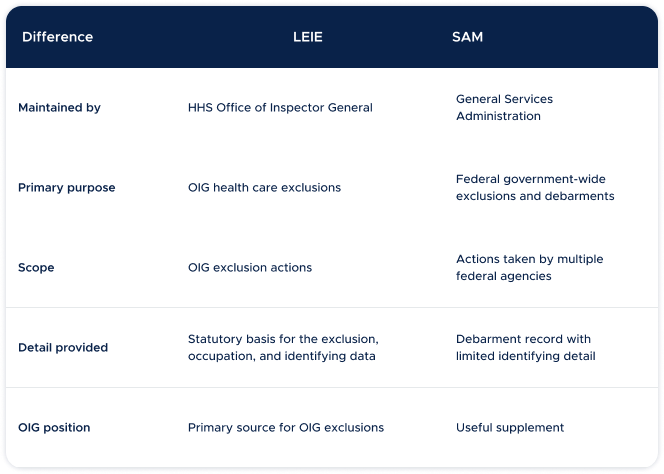
OIG states that the LEIE contains only exclusion actions taken by OIG, while SAM contains debarment actions taken by various federal agencies, including OIG exclusion actions.
For a health care exclusion program, the LEIE should therefore remain the core source. Organizations with broader federal contracting or eligibility obligations may also need SAM screening.
Who Appears on the OIG Exclusion List?
The LEIE is larger and more varied than a provider-only screening program might suggest.
An analysis of the 2026 LEIE downloadable database identified 83,842 active records, including 80,396 individuals and 3,446 entities. The same analysis found that nurses and nurses' aides accounted for 34,702 records, while physicians accounted for 3,253.
The occupational distribution explains why a screening program limited to physicians and other licensed providers can overlook a much larger population of workers.
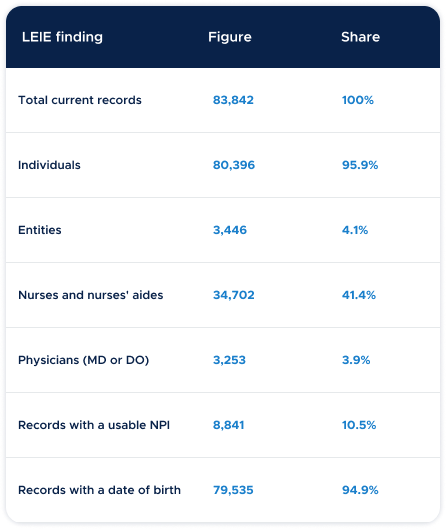
Geography concentrates the exposure, as per the aforementioned data. California carries 9,713 records, Florida 9,093, Texas 5,934, and New York 4,423. Multi-state operators in those four markets are screening against a denser population than the national average suggests.
The License-Related Exclusion Pathway
The single largest route onto the exclusion list is not a federal fraud conviction. Section 1128(b)(4) covers exclusion following the revocation, suspension, or surrender of a state health care license, and it accounts for 33,355 records, or 39.8% of the list.
Section 1128(a)(1), conviction of a program-related crime, accounts for 25,981 records, or 31%. This is the scenario every compliance program is designed around, but program-related crimes are the second most common pathway.
It creates an important limitation for a federal-only screening program, where the LEIE identifies the federal exclusion, but the underlying licensing event may originate with a state licensing authority.
Organizations that need broader sanctions coverage should determine whether their compliance program also needs to include state Medicaid exclusion lists, licensing board actions, or other state-specific sources.

How to Run an OIG Background Check
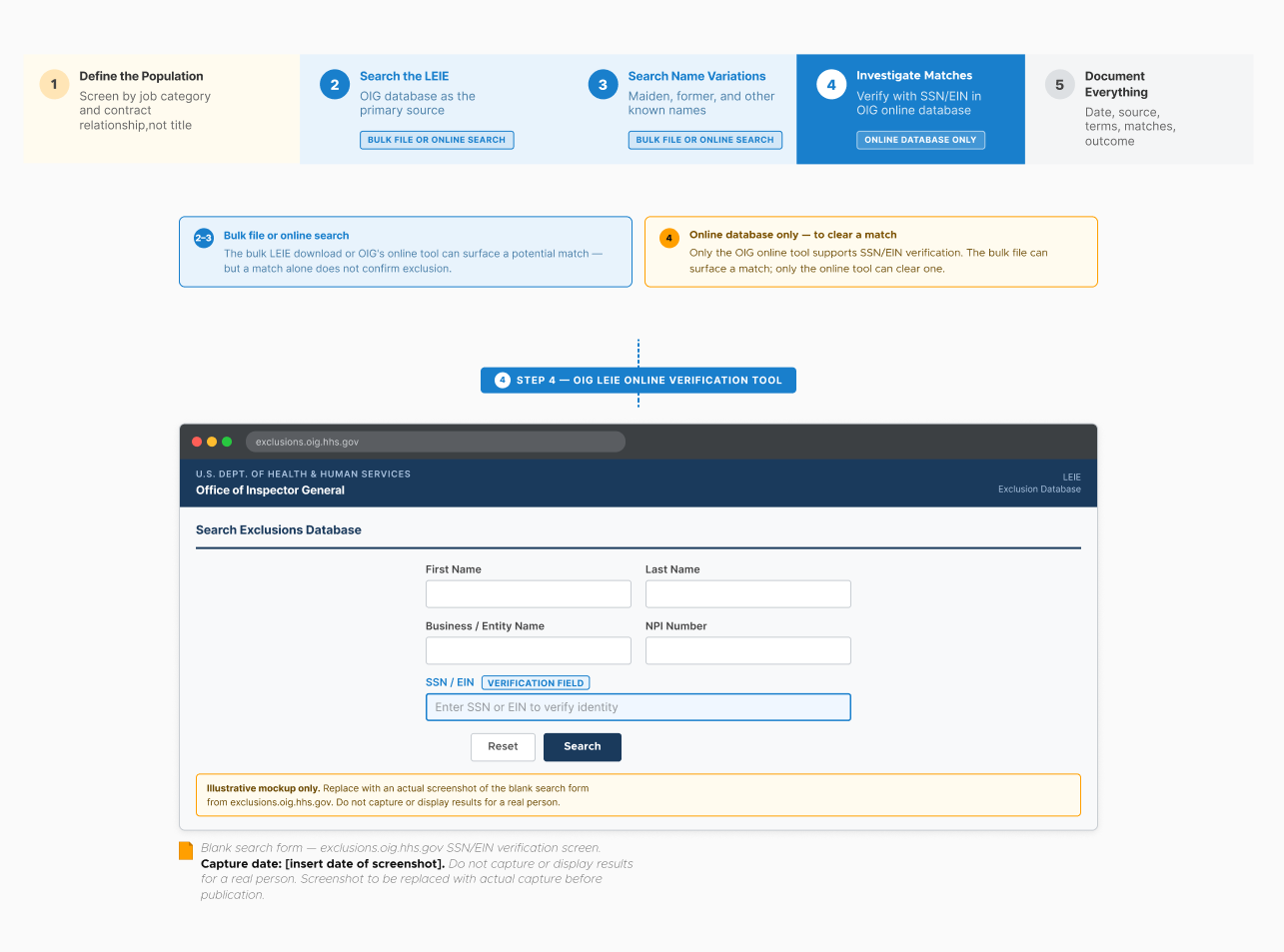
An OIG exclusion list search runs through one of two OIG resources, and the choice between them determines whether the search can actually clear a person. The online searchable database verifies individuals using a Social Security number (SSN) or an Employer Identification Number (EIN). The downloadable file contains neither.
Teams download the bulk file, match it against their roster in a spreadsheet, and treat a clean run as proof of compliance. The bulk file can surface a potential match, but closing that match requires the online database.
A defensible LEIE search follows five steps:
1. Define the population to be screened
Review employees, contractors, subcontractors, and other relationships based on the work performed and whether federal health care programs may pay for the resulting items or services. OIG recommends evaluating each job category and contractual relationship rather than relying solely on job titles.
2. Search the LEIE
Use the current Office of Inspector General database as the primary source for identifying federal health care exclusions.
3. Search relevant name variations
Search names associated with the individual, including maiden names, former names, and other known names. Using relevant variations reduces the chance of missing a record because of a name difference.
4. Investigate potential matches
A matching name does not, by itself, establish that the individual is excluded. Compare available identifying information and use the OIG's online search tools to determine whether the record belongs to the person being screened.
5. Document the search and resolution
Keep the date searched, database used, search terms, potential matches, verification steps, and final disposition.
OIG specifically recommends retaining documentation of the initial name search and additional searches used to resolve potential matches.
Which Workers Should Be Screened?
The 2013 Special Advisory Bulletin guidance asks providers to evaluate each job category or contractual relationship and determine whether the services provided are directly or indirectly payable by a federal health care program. If the answer is yes, OIG recommends screening the people performing that work.
Depending on the organization, that analysis may include:
- Physicians and other licensed clinicians
- Nurses and nursing assistants
- Therapists and other clinical personnel
- Billing and claims personnel
- Certain administrative or management personnel
- Transportation workers
- Independent contractors and vendors
- Staffing agency personnel
- Other workers whose services contribute to federally reimbursable items or services
The correct population depends on the organization's services, payment arrangements, and the work performed. The Self-Disclosure Protocol reinforces the same scope by requiring a disclosing party to screen its entire current roster before submitting.
What to Do When a Name Matches
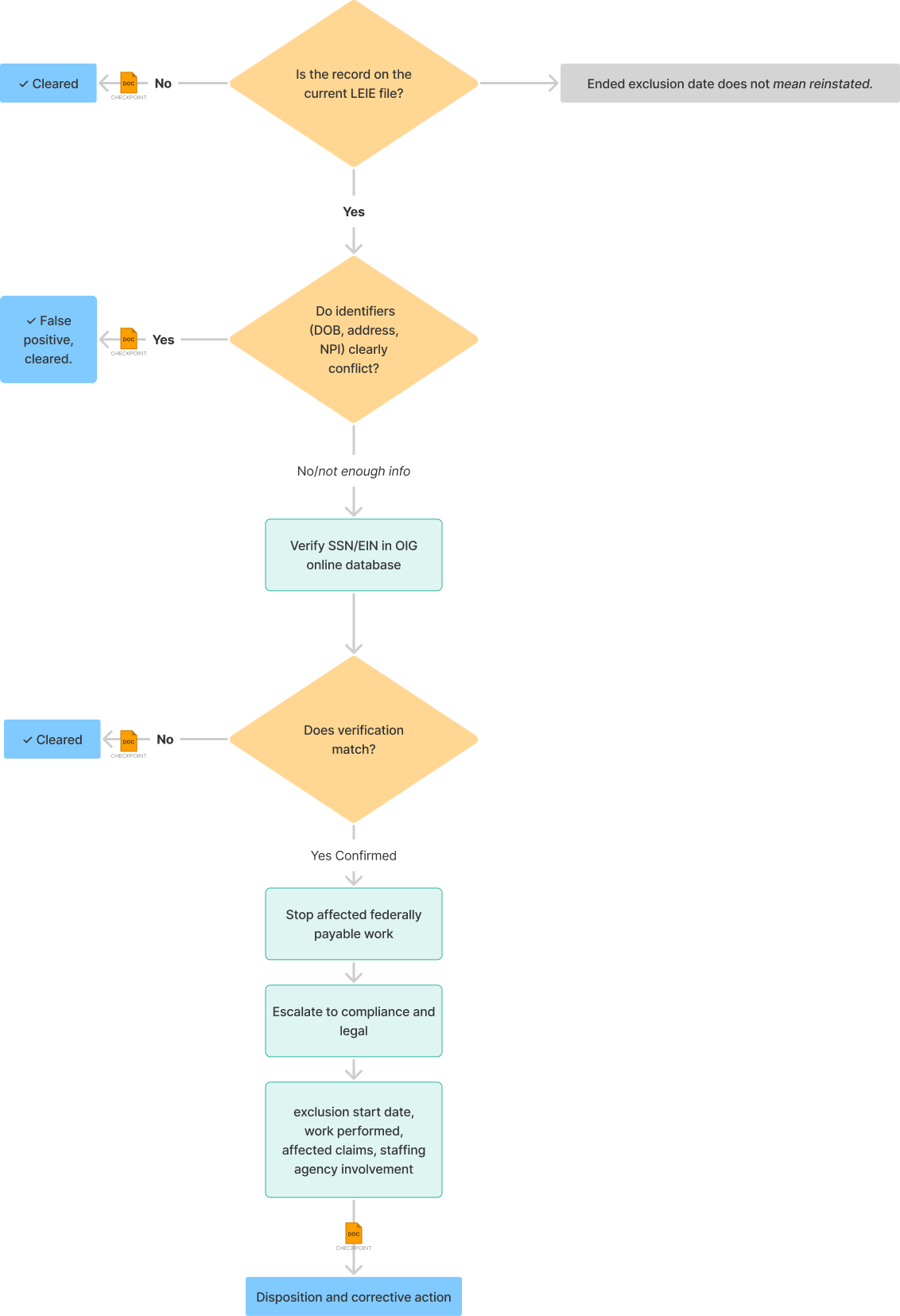
A potential match should trigger verification, instead of an immediate finding of exclusion.
The LEIE can contain common names or dates of birth, and OIG's guidance recognizes the need for additional searches and identifying information to determine whether a potential match is actually the excluded person.
Use a consistent resolution process:
1. Verify the identity
Compare the potential match against available identifying information, such as date of birth, address, provider information, and other lawful identifiers.
Wherever appropriate, use the OIG online search to verify the person or entity.
2. Do not treat a name match as a confirmed hit
A common name can produce a false positive. The decision should be based on the evidence linking the individual or entity to the LEIE record.
3. If the exclusion is confirmed, stop affected work
If the person is confirmed to be excluded and is performing services that may be reimbursed by a federal health care program, the organization should stop the affected activity and promptly involve appropriate compliance and legal personnel.
OIG's guidance states that providers may have overpayment and civil monetary penalty exposure when excluded individuals furnish federally reimbursable items or services.
4. Investigate the lookback period
Determine when the exclusion began, what work the individual performed during that period, which claims or payments may have been affected, and whether the person worked through a staffing agency or contractor.
5. Document the resolution
Record the evidence reviewed, the decision made, the date of resolution, and any corrective action. OIG recommends maintaining documentation of the searches used to resolve potential matches.
Adjudication drift is the failure mode that follows. Two identical matches reviewed by two managers produce different outcomes, and the inconsistency itself becomes evidence. AccuSourceHR's DecisionSource adjudication matrix codifies the employer's policy into a consistent decisioning framework with traceable decision logs, supported by identity verification where a match hinges on confirming who the person actually is.
The Fair Credit Reporting Act (FCRA) requirements may also come into play when exclusion information is obtained through a third-party screening provider, and the result could lead to an adverse employment action. Employers should coordinate the resolution of potential OIG matches with any applicable FCRA requirements, including required notices and procedures.
See “Where the Fair Credit Reporting Act (FCRA) May Apply” below for more detail.
What Does an OIG Exclusion Violation Cost?
Civil monetary penalties (as of 2026) for employing or contracting with an excluded individual are set out in 42 CFR 1003.210.
Each figure is per item or service, not per employee. An assessment of up to three times the amount claimed applies on top. A single excluded worker contributing to routine daily billing generates violations that compound quickly.
Enforcement runs steadily. Recent settlements for employing an excluded individual include Seven Hills Health and Rehabilitation Center at $167,712.87 in March 2026, Castle Biosciences at $112,917.55 in February 2026, and McKenzie Health at $80,342.12 in May 2026. Each of those organizations self-disclosed.
The population feeding these cases keeps growing. The OIG excluded 1,212 individuals and entities in the six months ending March 31, 2026, according to its Spring 2026 Semiannual Report to Congress.
How OIG may calculate damages for non-separately billed work
The financial analysis can become less intuitive when an excluded employee's work is not separately billed.
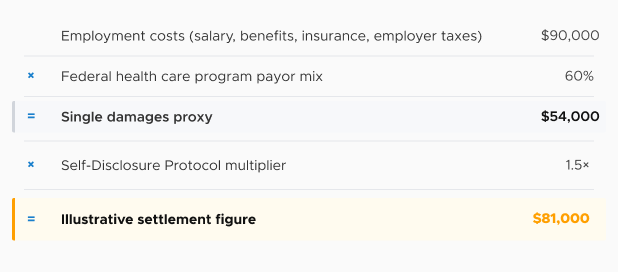
OIG's Self-Disclosure Protocol explains that, for certain non-separately billable services, the organization may use the excluded individual's employment or contracting costs as a proxy for the value of the services. Those costs can include salary, benefits, insurance, and employer taxes. OIG then applies the organization's federal health care program payor mix to calculate a proxy for single damages.
For example, if qualifying employment costs were $90,000 and the applicable federal payor mix were 60%, the resulting proxy for single damages would be $54,000 before any applicable settlement multiplier.
OIG's general practice for matters resolved through the Self-Disclosure Protocol is to apply a 1.5 multiplier to single damages and a minimum settlement amount of $20,000 for non-kickback matters and $100,000 for kickback-related matters. Those are Self-Disclosure Protocol settlement practices, not universal statutory penalties for every exclusion violation.
Organizations that identify a potential violation should involve qualified health care counsel before deciding how to calculate damages or whether to self-disclose.
How Often Should You Run an OIG Background Check?
OIG recommends screening before hiring or contracting and periodically screening current employees and contractors.
The agency does not state that every private health care provider is subject to a federal regulation requiring monthly LEIE screening. Instead, OIG says that because the LEIE is updated monthly, checking employees and contractors each month best minimizes potential overpayment and civil monetary penalty liability.
Separate Medicaid requirements can impose monthly screening obligations on state Medicaid agencies and enrolled providers or other entities, depending on the applicable regulation, program, and contract.
For example, 42 CFR 455.436 requires state Medicaid agencies to conduct specified exclusion checks at least monthly. Organizations should therefore review the federal requirements and the requirements attached to their state Medicaid participation and contracts instead of treating monthly screening as a universal rule for every employer.
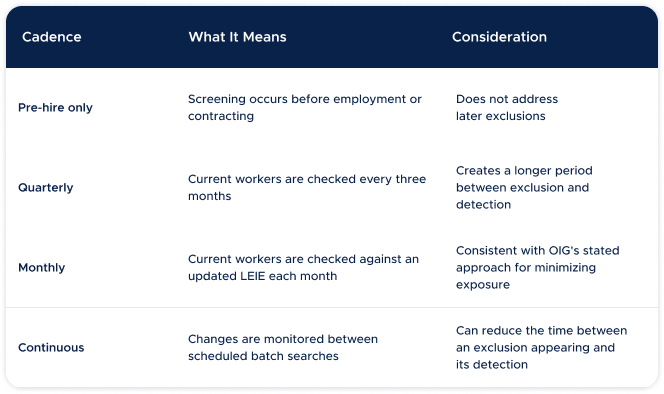 Monthly OIG exclusion screening against the federal list still misses the state license action. Depth is as important as cadence, which is why the source list should extend to state Medicaid exclusion lists and state licensing boards.
For a fuller breakdown of screening depth across sanctions databases, including Fraud and Abuse Control Information System (FACIS) levels and state-specific mandates, see our guide to medical background checks.
Reinstatement does not happen automatically
An exclusion period ending does not restore eligibility. Reinstatement requires an application and written notice from the OIG confirming it has been granted. There is no early reinstatement and no retroactive reinstatement.
The application window opens 90 days before the stated end date, and requests filed earlier are not considered. Processing generally takes up to 120 days, and longer where circumstances warrant.
Employers get this wrong in both directions. Some clear a candidate because the stated exclusion period has passed, which leaves them billing for an ineligible worker. Others reject a reinstated candidate whose record has already been removed from the list. Checking the current file, rather than reading the exclusion date, resolves both.
Where the Fair Credit Reporting Act (FCRA) may apply
OIG exclusion rules are only one part of the compliance analysis when screening is performed through a background-check provider.
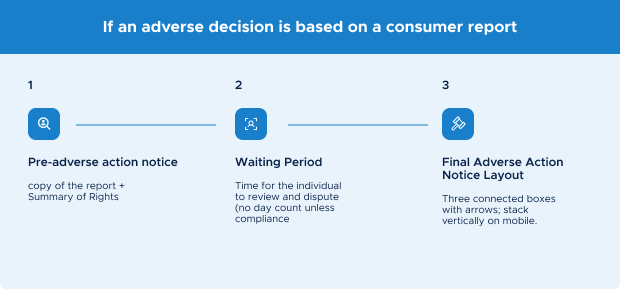
If an employer obtains a consumer report from a consumer reporting agency for employment purposes, the FCRA can impose separate requirements.
The Consumer Financial Protection Bureau states that employers generally must obtain the worker's permission before procuring an employment consumer report and must provide required notices before and after adverse action based on that report.
Depending on the screening arrangement and the decision being made, the employer may need to address:
- A clear disclosure that a consumer report may be obtained for employment purposes
- Written authorization before obtaining the report
- Pre-adverse action procedures when the report may lead to an adverse employment decision
- A copy of the report and the required Summary of Rights before adverse action
- Final adverse action notice requirements
- Dispute and accuracy procedures
The FCRA analysis depends on whether the information qualifies as a consumer report and how the employer uses it. Organizations using ongoing monitoring or sanctions information for current employees should have counsel review the specific program rather than assume that the rules for a pre-employment report apply unchanged.
What an Audit-Ready Exclusion Program Should Document
As stated earlier, a defensible screening program should be able to answer five questions:
- Who was screened?
- Which sources were searched?
- When was each search performed?
- How was each potential match resolved?
- What action followed a confirmed exclusion?
The value of screening software is largely in making those answers easier to produce and maintain. For example, AccuSourceHR treats healthcare exclusion screening as an eligibility control rather than a one-time database search. Its continuous healthcare sanctions and debarment screening covers federal lists and databases at Level 1, and federal and state lists plus state licensing databases at Level 3. State Abuse Registry integration is also available for roles involving direct contact with patients, residents, or other vulnerable populations.
It also provides audit-ready documentation and facilitates the compliance process through an attorney-led, in-house compliance department and FCRA-certified client care and operations staff. The company holds SOC 2 Type II certification and is a founding member of the Professional Background Screening Association (PBSA).
For organizations managing screening across multiple hiring systems, AccuSourceHR connects with approximately 50 applicant tracking systems (ATS) and human resources information systems (HRIS)
Additionally, staffing firms placing into client facilities get the same coverage across every vertical they serve.
OIG Exclusion Screening Is an Ongoing Eligibility Control
An OIG background check can identify whether a person or entity currently appears on the federal exclusion list. The larger compliance task is maintaining eligibility after that initial search.
A workable program, therefore, needs more than a one-time LEIE query. It needs:
- A defined screening population
- The current LEIE as the core OIG exclusion source
- Additional federal or state sources where the organization's obligations require them
- A documented screening cadence
- A consistent process for resolving potential matches
- A defined escalation process for confirmed exclusions
- Documentation of searches and decisions
- A process for investigating potentially affected claims and payments
- Appropriate legal and compliance review when a violation is identified
The result is a screening process that can demonstrate what was checked, when it was checked, and how exceptions were handled.
Frequently Asked Questions
What shows up on an OIG background check?
The search returns whether a person or entity currently appears on a federal exclusion list. A match shows the statutory basis for the exclusion, the person's occupation, and identifying details such as date of birth, address, and, where available, National Provider Identifier.
What happens if you hire someone on the OIG exclusion list?
The employer faces civil monetary penalties of up to $25,595 per item or service, an assessment of up to three times the amount claimed, and repayment of affected claims within 60 days. The standard applied is whether the employer knew or should have known.
Is the LEIE the same as SAM?
No. The LEIE contains OIG exclusion actions. SAM is maintained by the General Services Administration and contains debarment actions taken by various federal agencies, including OIG exclusions.
Does an OIG exclusion end automatically?
No. Reinstatement requires a written application and formal notice from the OIG that it has been granted. Applications may be filed 90 days before the exclusion period ends, processing generally takes up to 120 days, and retroactive reinstatement is unavailable.