
 Jon Daniel

Key Takeaways
- Identity verification confirms a candidate's identity before a background check investigates their history.
- Rising deepfake, synthetic identity, and impersonation fraud have made identity verification a critical first step in hiring.
- The most effective identity verification programs combine document, biometric, and database verification for stronger fraud prevention.
- When identity verification becomes part of a consumer report, FCRA disclosure, consent, and adverse action requirements generally apply.
- The best identity verification providers deliver documented, auditable results that integrate with the broader hiring workflow, not just fast pass/fail decisions.
- AccuSourceHR integrates identity verification into its SourceDirect™ screening platform, helping employers move seamlessly from identity verification to background screening and documented hiring decisions within a single workflow.
For years, employers could assume the person submitting a job application was who they claimed to be. That assumption no longer holds. Deepfakes, synthetic identities, and stolen credentials have made identity fraud one of the fastest-growing hiring risks, forcing employers to verify who a candidate is before verifying their qualifications.
Identity verification has become an increasingly important early safeguard in remote and high-risk hiring. But not every verification process works the same way, and speed alone does not guarantee compliance or fraud prevention.
This guide explains what identity verification is, how it differs from a background check, and why document, biometric, and database verification each play a different role. You will also learn where FCRA compliance fits into the process, what to look for when evaluating an identity verification provider, and how AccuSourceHR integrates identity verification into a compliant, end-to-end hiring workflow.
What Identity Verification Actually Means in Hiring
Identity verification is the process of confirming that a candidate is a real person and the same person named on their application before that identity moves into a background check or credentialing review.
Most hiring processes start in the wrong place. A recruiter reviews a resume, schedules an interview, and only orders a background check once an offer is close. Identity verification moves earlier in the sequence. It confirms that the candidate exists as claimed before any other checks begin, so every record pulled afterward is tied to the right person.
A background check and an identity check answer different questions. A background check investigates a verified person's history, including criminal records, employment, and education. An identity check confirms that the person behind the application is who they claim to be in the first place. Skipping identity verification does not just risk a bad hire. It risks running an accurate background check on the wrong person entirely.
That distinction matters more now than it did even two years ago, because the tools available to fake an identity have improved faster than most hiring processes have.
Why Identity Verification Has Become Urgent for Employers
Candidate fraud includes several separate risks. Identity verification can help address impersonation and false identity, but it does not independently detect fabricated skills, fake work samples, or false employment claims.
The scale is no longer theoretical. Gartner surveyed 3,000 job candidates in 2025 and found that 6% admitted to some form of interview fraud, either impersonating someone else or having someone else interview on their behalf. Gartner projects that by 2028, one in four candidate profiles worldwide will be fraudulent.
Generative AI has lowered the skill required to pull this off. Greenhouse's 2025 Workforce and Hiring Report found that 28% of candidates admit to using AI to generate fake work samples. Some of this activity is opportunistic. Some of it is organized: the Department of Justice and FBI have documented North Korean state-sponsored IT workers using deepfake identities and stolen credentials to gain employment at more than 136 US companies, funneling wages back to support weapons programs.
None of this means every applicant is a threat. It means the cost of skipping identity verification has changed. A hiring process built around trust and a resume review was reasonable when faking a convincing identity took real effort. It is a liability now that faking one takes a laptop and a subscription.
Understanding why identity verification matters is only half the picture. Choosing the right method for your risk profile is the other half.
How Do Document, Biometric, and Database Verification Compare?
Identity verification is not a single check. It is a process that combines three distinct methods: document verification, biometric verification, and database verification. Each serves a different purpose, and together they provide a more reliable way to confirm a person's identity.
Document verification confirms that the identity document itself is authentic. It examines security features, checks for signs of tampering or forgery, verifies that the document has not expired, and validates that the information matches the expected format. However, it only proves that the document is genuine. It does not verify that the person presenting it is the document's rightful owner.
Biometric verification addresses that limitation by comparing a live photo with the photo on the identity document. Advanced liveness detection distinguishes a real person from printed photos, replay attacks, masks, and increasingly sophisticated deepfake videos. As identity fraud becomes more advanced, biometric verification has become one of the most effective ways to prevent impersonation.
Database verification validates the identity information provided by the candidate, such as their name, Social Security number, date of birth, and address history, against trusted third-party data sources. It confirms that the information is accurate, consistent, and associated with a real individual before it is used for downstream screening, including criminal background checks and motor vehicle record searches.
.png?width=632&height=323&name=Frame%2029%20(10).png)
Higher-risk or remote-hiring programs may benefit from combining methods rather than relying on a single signal.
You can combine document and biometric verification for roles with elevated impersonation risk and layer in database checks to catch inaccurate or stolen identity data before it moves downstream.
Does FCRA Apply to Identity Verification
The Fair Credit Reporting Act (FCRA) does not classify identity verification as a standalone screening category. However, when identity verification is included in a consumer report used to make an employment decision, it becomes subject to the same FCRA requirements as the rest of the report.
Employers must provide candidates with a clear, standalone disclosure and obtain written authorization before requesting a consumer report that includes identity verification. If the verification process uncovers information that could influence a hiring decision, employers must follow the FCRA's pre-adverse and adverse action procedures.
That means giving the candidate an opportunity to review the report and dispute any inaccuracies before a final employment decision is made.
Compliance extends beyond obtaining a successful identity match. Employers and screening providers should maintain detailed records of how the verification was performed, what evidence supported the result, and when it was completed. An identity verification process that cannot be documented or audited may create compliance risks if the results are later challenged.
When evaluating identity verification providers, accuracy and defensibility matter as much as speed. A verification completed in seconds delivers little value if the employer cannot demonstrate that the process met legal and procedural requirements during an audit, regulatory review, or candidate dispute. The strongest solutions combine fast verification with comprehensive audit trails, documented evidence, and workflows designed to support FCRA compliance.
.png?width=620&height=429&name=Frame%2079%20(1).png)
Five-step FCRA workflow for identity verification and employment background screening.
How to Evaluate an Identity Verification Company
.png?width=620&height=711&name=Frame%2059%20(3).png)
Choosing an identity verification company involves more than comparing accuracy rates or demo performance. The right provider should fit your hiring workflow, support compliance requirements, and deliver consistent results at your actual hiring volume.
Here are the key factors to evaluate:
- Method coverage: Does the provider support all three verification methods, including document, biometric, and database verification, or does it rely on a single approach? A layered verification process offers stronger protection against identity fraud than any one method alone.
- ATS and HRIS integration: Does it connect to the systems your recruiters already use, or does it require a separate workflow?
- Turnaround under real volume: Demo speed and production speed are not the same thing. Ask for turnaround data at your actual hiring volume, not a controlled test.
- Adjudication and documentation: Does the verification result become part of a documented screening workflow, complete with supporting evidence and an audit trail, or does the system simply return a pass-or-fail status?
- Support model: Will you reach a named person when something goes wrong, or a ticket queue?
Most providers now offer fast verification and biometric matching. Those capabilities have become table stakes. The real differentiator is what happens next: whether identity verification becomes part of a documented, auditable hiring workflow or remains an isolated pass/fail result.
A provider that verifies identity quickly but hands you a disconnected result has only solved half the problem. The fourth criterion, adjudication, is where AccuSourceHR built its approach differently.
How AccuSourceHR Connects Identity Verification to Background Screening
AccuSourceHR treats identity verification as the first step in a connected screening workflow rather than a standalone service. IdentitySource™ is built into the SourceDirect™ platform, allowing verified identities to move directly into the background screening process without requiring recruiters to switch between systems.
Verified identities then move into AccuSourceHR's adjudication workflow, helping employers apply consistent hiring criteria and maintain a documented decision trail.
The workflow is supported by an attorney-led, in-house compliance team and PBSA FCRA-certified staff, helping employers maintain the documentation needed for compliant hiring decisions.
AccuSourceHR also integrates with more than 50 ATS and HRIS platforms and provides 100% U.S.-based customer support with a 95% live-answer rate.
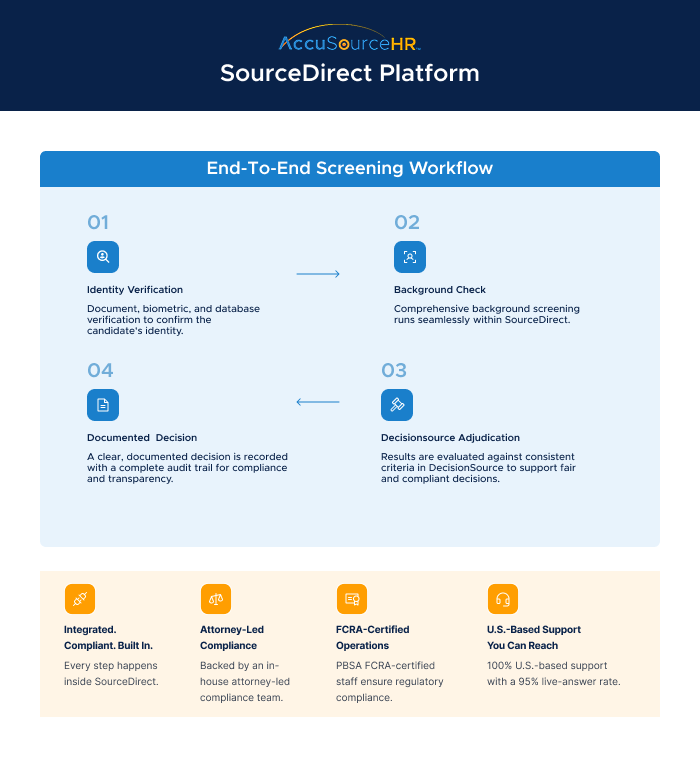
AccuSourceHR: Integrating Identity Verification into a Compliant Workflow
Identity verification companies increasingly look alike on paper. Many offer document scanning, a version of liveness detection, and a turnaround time measured in hours or days. The differences that matter show up later, in whether a result holds up under audit, whether it slowed down a hiring manager who needed to fill a seat, and whether it caught the candidate who was never who they claimed to be.
Start with the method that your risk profile actually requires, confirm the compliance documentation is built in rather than bolted on, and ask how a verified identity connects to the rest of your hiring decision. That is the evaluation that protects a hiring process, not just a resume.

Frequently Asked Questions
What is identity verification in the hiring process?
Identity verification confirms a candidate is a real person and the same person named on their application before that identity moves into a background check. It typically uses a government-issued ID, a live biometric match, or a database cross-check, and often combines multiple methods.
What is the difference between identity verification and a background check?
Identity verification confirms who someone is. A background check investigates the verified person's history, including criminal records, employment, and education. Running a background check without first verifying identity means an accurate report could still be tied to the wrong person.
Is identity verification required under the FCRA?
The FCRA does not list identity verification as its own category. But once a verification result becomes part of a broader consumer report used for an employment decision, it inherits the same disclosure, consent, and adverse action requirements as the rest of that report.
How long does employee identity verification take?
Most modern identity verification returns an automated result within minutes, though manual review can extend the timeline to a few hours, depending on document quality. Employers should ask providers for turnaround data at real production volume rather than relying on demo-speed claims alone.
What is the most secure method of identity verification for employers?
No single method is complete on its own. Combining document verification with biometric likeness detection catches both forged documents and deepfake impersonation, while a database check confirms the underlying identity data is accurate before it feeds into further screening.
Can identity verification integrate with an existing ATS or HRIS?
Most established providers offer pre-built connectors to major ATS and HRIS platforms, allowing identity verification to run within a recruiter's existing workflow rather than in a separate system. AccuSourceHR supports roughly 50 such integrations.
Does identity verification slow down the hiring process?
A well-integrated identity check typically returns results within minutes and does not meaningfully delay hiring. The bigger risk to the timeline is a disconnected tool that requires manual review or does not feed directly into the rest of the screening workflow.
Is Identity Verification the Same as Form I-9 Verification?
No. Identity verification confirms that a candidate is the person they claim to be. Form I-9 verifies identity and authorization to work in the United States under a separate federal process. An employment-screening identity check does not replace the employer’s I-9 obligations.