
 Jon Daniel

Your County Search Came Back Clean. That Doesn't Mean You Ran a Federal Background Check. Consider a hypothetical that mirrors a common gap. You are hiring a controller for a mid-sized manufacturer. The candidate interviews well, references check out, and the county criminal search in the two jurisdictions where they have lived comes back clear. You extend the offer. Eighteen months later, you discover the same person pleaded guilty to federal wire fraud in a district three states away. The case was tied to an employer that never appeared on the resume.
Nothing went wrong with your county search. It simply looked in the wrong courthouse. No federal background check was ever run. Federal crimes are prosecuted in U.S. District Courts, and those records live in an entirely separate system from the state and county courts most background checks touch. If your screening package does not include a federal criminal records search, you have a gap, and for roles involving money, data, interstate commerce, or federal contracts, gaps like these are where the real exposure tends to sit.
What follows is an explanation of federal background checks: what they cover, what they leave out, how long they take, and how to fit them into a screening program you can defend.
Disclaimer: This content is provided for informational purposes only and should not be construed as legal advice. Employers should consult qualified counsel for their specific situation. This article is not intended to represent services provided by AccuSourceHR
Key Takeaways
- A federal criminal records search covers only U.S. District Court filings. It does not reach state or county convictions, arrests without federal charges, or sealed and expunged matters.
- Private employers generally cannot access the FBI's fingerprint-based Identity History Summary unless a specific federal or state statute authorizes it for that occupation.
- A name-only match on a federal docket is a lead, not a finding. Federal filings are redacted under privacy rules, so a responsible provider routes potential matches to a researcher before reporting anything.
- The FCRA's seven-year limit on non-conviction reporting does not apply when a position's expected annual salary is $75,000 or more, though several states apply their own limits regardless of salary.
- Most federal criminal records searches return within one to three business days, and the federal component is rarely the bottleneck in a full screening package.
- A defensible package commonly pairs additional elements such as an SSN trace, county or statewide searches, a multi-jurisdictional database search, and a federal district court search, since each layer covers the others' blind spots. Consult counsel to determine the right checks for your roles.
Federal Background Checks Explained: What They Cover
A federal background check is a search of criminal case records filed in the United States District Courts, the trial-level courts of the federal judiciary. According to the Administrative Office of the U.S. Courts, there are 94 federal judicial districts covering all states and territories, and each one maintains its own docket. A federal criminal records search for employment queries those dockets for cases matching your candidate's identifiers.
The phrase "federal background check" gets used for four very different things:
- A federal criminal records search. This is what a consumer reporting agency runs as part of an employment screening package. It covers criminal filings in federal district courts and is governed by the Fair Credit Reporting Act.
- An FBI fingerprint-based criminal history check. This searches the FBI's Identity History Summary, a repository built from fingerprint submissions by state and federal agencies. Private employers generally cannot access it unless a specific federal or state statute authorizes fingerprint-based screening for that occupation.
- A federal employment suitability or security clearance investigation. This is the background investigation conducted when someone is hired into a federal government position or needs access to classified information. It involves a standard form questionnaire, an investigation conducted by the Defense Counterintelligence and Security Agency for most federal agencies, and an adjudication handled by the hiring or sponsoring agency under standards that sit entirely outside the FCRA.
- A NICS firearm purchase background check. This is the FBI's National Instant Criminal Background Check System check run by licensed firearms dealers. It has no role in employment screening, but it is what many candidates picture when they hear the term.
When an HR team asks us about a federal background check for employment in the private sector, they almost always mean the first one. Candidates asking the same question are often thinking about one of the others. Being precise in your job postings and candidate communications prevents avoidable back-and-forth.

What Does a Federal Criminal Records Search Consist Of?
A federal criminal records search returns case-level information from district court dockets, typically including:
- Case number and filing district
- Charges and statutory citations
- Case status (pending, disposed, dismissed, transferred)
- Disposition and, where available, sentencing information
- Filing and disposition dates
The offenses you will see are the ones the federal government prosecutes. Think mail and wire fraud, bank fraud, embezzlement from federally insured institutions, securities fraud, tax evasion, money laundering, healthcare fraud, identity theft, large-scale drug trafficking, firearms offenses, child exploitation, immigration violations, offenses that cross state lines, crimes committed on federal property, and certain serious offenses in Indian country prosecuted under the Major Crimes Act.
Federal dockets are not always built for identity verification. Many entries include a name and little else. Unlike most state court indexes, federal filings are redacted under federal privacy rules. Identifiers are limited to partial data at most, typically a year of birth or the last four digits of a Social Security number, and often a name alone. That means a name-only "hit" is a lead, not a finding.
If your provider reports a federal record based on a name match alone, you risk a false positive on a common name and a serious FCRA accuracy problem. A responsible screening process routes potential matches to a researcher. That researcher reviews the underlying docket documents, indictment, plea agreement, or judgment for corroborating identifiers before anything gets reported to you.
What a Federal Search Will Not Tell You
This is the part that trips up otherwise well-designed screening programs. A federal criminal records search does not include:
- State and county convictions. The overwhelming majority of criminal prosecutions in the U.S. happen in state courts. Assault, most DUIs, theft, domestic violence, and the bulk of drug possession cases are state matters and will not appear in a federal search.
- Arrests without federal charges. If a case never resulted in a federal filing, there is no docket.
- Sealed or expunged federal matters. Restricted records are not accessible.
- Sex offender registry data. This is a separate search against state registries and the Dru Sjodin National Sex Offender Public Website. Some jurisdictions restrict how registry data may be used in hiring.
- Civil federal matters, unless you specifically order them. Federal civil court searches are a distinct product and are relevant in certain executive and financial services contexts.
Federal and county searches are complements, not substitutes. A defensible package for most professional roles includes multiple layers, which may include:
- A Social Security number trace to develop address history.
- County or statewide criminal searches in the developed jurisdictions.
- A multi-jurisdictional criminal database search is used as a pointer tool rather than a reportable source, meaning it is used to point toward jurisdictions worth searching directly. The FCRA requires a CRA to report public record information for employment either to notify the consumer at the time of reporting or to verify that the information is complete and up to date.
- A federal search of the relevant district courts.
Each layer covers the others' blind spots. Every role is different and may come with different screening requirements. Make sure to design your screening package with your compliance or legal team.
How Long Does a Federal Background Check Take?
Most federal criminal records searches are returned within one to three business days, and many clear the same day, based on AccuSourceHR fulfillment data. Actual turnaround depends on the factors below.
- Potential name matches requiring verification. When a possible hit surfaces, a researcher has to pull and review case documents. That is the right thing to do, and it adds time.
- Court access issues. Electronic access to federal dockets is broad but not universal across all record types or eras. Older cases may be archived and require retrieval.
- Volume of districts searched. A nationwide federal search touches all 94 districts; a targeted search of three districts moves faster.
- Court closures. Holidays, weather events, and system maintenance windows all show up in turnaround data.
If you are asking how long a federal search takes as part of a full screening package, the federal component is rarely the bottleneck. Employment verifications waiting on an unresponsive former employer are a more common source of delay. So are education verifications during a university's winter break and county courts that still require in-person retrieval. Across the turnaround data we see, the federal search is almost never the delay.
If you mean the federal government’s own suitability investigation for a civil service position, the answer is completely different. Those timelines range from weeks to many months, depending on the investigation tier and clearance level, and are outside any private employer’s control. For current AccuSourceHR service turnaround times, contact an AccuSourceHR representative.
Common Questions About Federal Background Checks
How Far Back Does a Federal Background Check Go?
Two separate questions hide inside this one, and conflating them causes real compliance trouble.
How far back the records exist. Electronic availability of federal dockets varies by district and record type. Many districts have electronic coverage dating to the 1990s, while older matters sit in the National Archives and require retrieval.
How far back you are permitted to consider. This is the question that matters. The Fair Credit Reporting Act limits the reporting of most adverse non-conviction items, including arrests, to seven years. Convictions have no federal time limit on reporting. The FCRA's seven-year limits on non-conviction items also do not apply when the position's annual salary is expected to be $75,000 or more, though several states apply their own limits regardless of salary. State law may impose additional restrictions, and some Fair Chance ordinances add their own lookback restrictions and individualized assessment requirements on top of those.
Your provider should apply jurisdiction-specific filtering based on where the candidate will work, rather than returning everything the court index contains. Reporting a 12-year-old conviction in a state that caps conviction reporting at seven years can expose both the employer and the screening company to claims under state law and the FCRA. Multistate employers who run a single uniform package across every location are the ones most likely to face potential liability.
Does a Warrant Show Up on a Federal Criminal Search?
Sometimes, and inconsistently. An active federal arrest warrant may be reflected in a district court docket if charges have been filed, particularly in a pending case. Sealed indictments and warrants that have not been docketed publicly will not appear. There is no comprehensive public warrant database that private employers can search nationally.
More importantly, an outstanding warrant is not a conviction. It represents an allegation. Several states also restrict or prohibit the reporting and consideration of pending or non-conviction matters, so what you can lawfully receive and use varies by work location. Before you act on warrant information, involve counsel and consider whether the EEOC's guidance on arrest records applies to your situation. The EEOC has long taken the position that an arrest alone does not establish that criminal conduct occurred.
What Disqualifies You From a Federal Criminal Records Search?
Candidates ask this constantly, and the answer depends entirely on which of the checks they mean.
For a private employer running a federal criminal records search, nothing is automatically disqualifying unless a statute or regulation says so. EEOC guidance recommends an individualized assessment rather than a blanket exclusion, and a number of state and local fair chance laws require one. Your obligations depend on where the role sits. The EEOC's 2012 Enforcement Guidance on the consideration of arrest and conviction records recommends weighing the nature and gravity of the offense, the time elapsed since the offense or completion of the sentence, and the nature of the job. A 15-year-old federal drug conviction has a different bearing on a warehouse role than a recent embezzlement conviction has on a treasury position.
Where the analysis changes is in regulated industries with statutory bars:
- Financial institutions. Section 19 of the Federal Deposit Insurance Act restricts FDIC-insured institutions from employing individuals convicted of certain offenses involving dishonesty, breach of trust, or money laundering without prior consent. The FDIC has since broadened its exemptions, so a covered conviction is not always a permanent bar.
- Transportation. The Federal Motor Carrier Safety Administration and the Transportation Security Administration each maintain disqualifying-offense lists for specific credentials and safety-sensitive functions.
- Healthcare. Exclusion from federal healthcare programs, administered by the HHS Office of Inspector General, functions as a practical bar for many provider roles. These exclusion lists are separate from a federal criminal search, although certain convictions may indicate that an individual is also included on an exclusion list.
- Federal contracting. Contract terms and agency-specific suitability standards can impose requirements beyond what the employer would otherwise apply.
For federal civil service positions and security clearances, adjudicators apply suitability and national security guidelines. Those guidelines consider financial irresponsibility, foreign influence, drug involvement, criminal conduct, and personal conduct, including a lack of candor on the application itself. Falsifying the questionnaire is frequently a bigger problem than the underlying issue would have been.
How Much Does a Federal Criminal Records Search Cost?
For employers, a federal criminal records search is typically one of the lower-cost line items in a screening package. Pricing varies by scope, search volume, and whether the search is nationwide or limited to selected districts. Nationwide searches across all 94 districts cost more than targeted district searches. Verification of potential matches may carry a research fee. Individuals requesting their own FBI Identity History Summary pay a set federal fee plus any channeler charge.
The more useful comparison is against the cost of missing something. For roles with signature authority, access to funds, or exposure to federal contracts, the search is a small line item next to the risk it addresses.
How Do I Get a Federal Criminal Record Check on Myself?
Candidates and employees ask HR this question all the time, and a clear answer builds goodwill. Point them to the right channel depending on what they actually need:
- For their FBI Identity History Summary, individuals can request a copy directly from the FBI or through an FBI-approved channeler, typically involving fingerprint submission and a modest fee.
- For federal court records, the judiciary's PACER system lets individuals search dockets in which they are named. The PACER Case Locator searches across districts nationally. Page fees apply, with a waiver below a quarterly threshold.
- For a copy of a consumer report an employer ordered, the FCRA entitles them to request their file directly from the consumer reporting agency that prepared it.
None of these produces the "clearance" candidates sometimes think they are getting. There is no self-service federal certificate that an employer can accept in lieu of running its own compliant screening process.
How to Vet a Federal Background Check Provider
Screening is only as reliable as the quality controls behind it, and quality controls are invisible unless you ask about them. Screening quality varies, and the differences are not visible on a price sheet. Before you select or renew with a provider, ask these questions and hold out for specific answers.
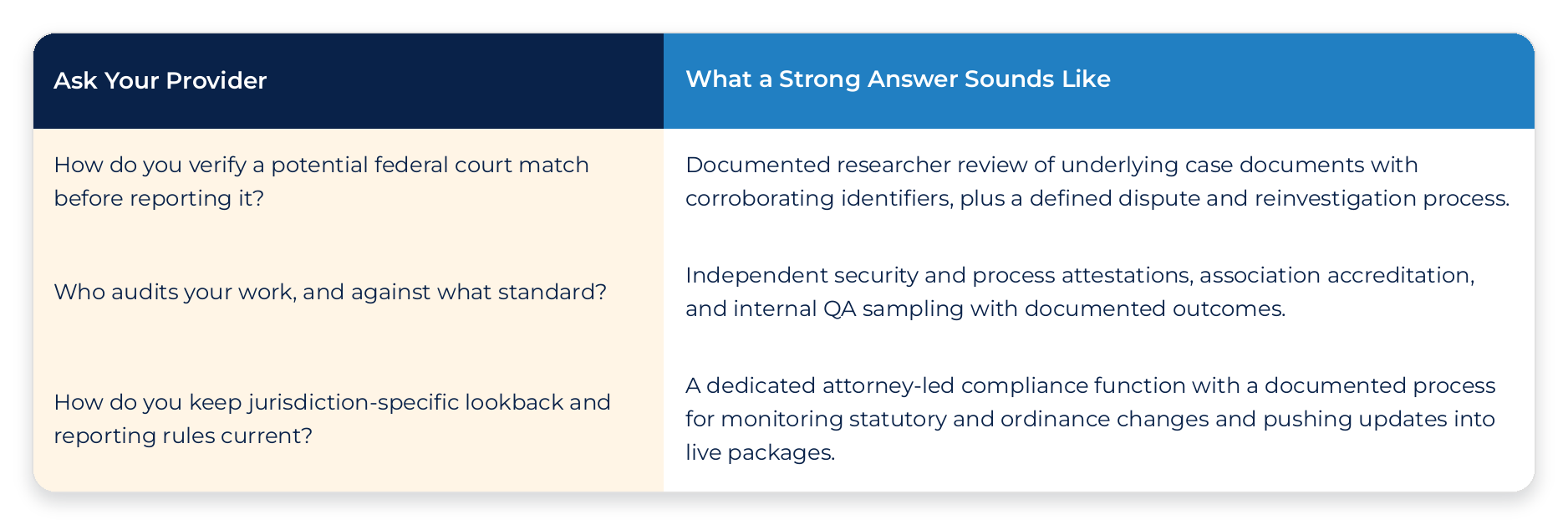
Actionable Steps for HR Professionals
1. Confirm your disclosure and authorization documents are clean. Before any federal search is ordered, the FCRA requires a clear, standalone written disclosure and the candidate's written authorization. Extraneous language in that document, including liability waivers, is one of the most frequently litigated defects in screening programs.
2. Audit your current screening packages for federal coverage. Pull your three most-used packages and confirm whether a federal criminal records search is included in each.
3. Match search scope to role risk and document why. Decide deliberately whether a role warrants a nationwide federal search or a targeted search of districts tied to the candidate's address history. Write the rationale into your screening policy so your package design is defensible if challenged.
4. Confirm how potential matches are verified. Ask your provider, in writing, what happens between a name-only docket hit and a reported record. Name-only reporting is an accuracy risk you should not accept.
5. Align lookback periods with every state and city where you hire. Build jurisdiction-specific filtering into your program rather than applying one national standard. If you operate in California, New York, Massachusetts, or any Fair Chance city, have counsel review your package and your assessment criteria.
6. Tighten your adverse action workflow. A federal record surfacing late in the process is exactly when pre-adverse action notices get rushed. Confirm your process delivers:
-
The pre-adverse action notice
-
A copy of the report
-
The summary of rights
-
A reasonable waiting period before any final decision. The FCRA does not specify a number of days; five business days is a common practice, and some state and local laws set their own minimums.
Keep the whole sequence time-stamped in your system.
7. Train hiring managers on what a clear federal search does and does not mean. Managers who believe "the background check came back clean" means every court in America was searched will make decisions you cannot support. Ten minutes of context prevents that.
8. Give candidates accurate self-service guidance. Prepare a short internal answer for candidates asking how to obtain their own federal criminal records, so recruiters are not improvising. It reduces anxiety and cuts down on delays.

The AccuSourceHR Advantage
Federal court records reward careful work. At AccuSourceHR, our federal court record searches are built into packages with jurisdiction-aware reporting rules, and potential matches go to trained researchers who confirm identity against case documents before anything reaches your report.
You will also see the difference in how the process runs day-to-day. Our SourceDirect™ platform connects to the ATS and HCM systems your team already uses, so ordering a federal search is part of your existing workflow rather than a separate errand. When a record needs discussion, a U.S.-based support team answers the phone, backed by an in-house counsel-led compliance team that tracks lookback and reporting changes so your packages do not quietly fall out of date.