
 Jon Daniel

- Employment verification confirms critical work history details, including an employer's name, dates of employment, job title and other information relevant to the hiring decision.
- A consistent verification process starts with accurate candidate information, the right verification source, required authorization, and clear documentation of requests, responses, discrepancies, and follow-ups.
- Employers can verify employment manually or through a third-party screening provider, depending on hiring volume, internal resources, turnaround requirements, and the complexity of employment histories.
- Unresponsive employers and nontraditional work histories require documented alternatives, such as successor employers, staffing agencies, employment records, or candidate-provided supporting documents.
- AccuSourceHR provides commercial background screening services that include employment verification, SourceDirect™ integrations, compliance support, human-led research, and United States-based customer support.
The employment verification process becomes complicated when a company changes its name, merges with another business, outsources verification, or no longer maintains older personnel records. Job titles may also differ between a resume and an employer's records, creating discrepancies that need review rather than automatic correction.
Employment verification generally confirms facts such as employer name, dates of employment, job title and, where available, employment status or reason for leaving. It is different from a reference check, which examines performance or conduct, and from Form I-9 employment eligibility verification, which confirms authorization to work in the United States.
This guide explains how employers can verify employment history, handle discrepancies, choose verification methods, and meet applicable compliance requirements.
|
Note: This content is provided for informational purposes only and should not be construed as legal advice. Employment verification requirements vary by federal, state, and local law and by the purpose of the request. Employers should consult qualified counsel for their specific situation. |
What Employers Need Before Starting the Verification Process
Before contacting a former employer, collect enough information to identify the correct employment record and define what you need to verify. Missing or inconsistent details can lead to unnecessary follow-ups, particularly when an employer has changed names or uses a third-party verification provider.
Collect the following information:
- Full legal name: Include previous names used during the employment period, where relevant.
- Employer name: Record the company or legal entity named by the applicant, along with any known parent company, subsidiary, or former name.
- Employment dates: Record the applicant's reported start and end dates, preferably at least the month and year.
- Job title: Record each relevant title if the applicant held more than one position.
- Work location: Include the city, state, or facility where the applicant worked.
- Employment type: Note whether the role was full-time, part-time, temporary, seasonal or through a staffing company.
- Verification scope: Specify whether you are confirming dates and title only or also seeking other permissible information.
- Authorization and disclosures: Determine whether your method requires a disclosure and written authorization before the check begins.
Keeping the request limited to information relevant to the hiring decision also reduces unnecessary collection of personal information. The Equal Employment Opportunity Commission (EEOC) advises employers to limit pre-employment information requests to information relevant to determining whether an applicant is qualified.
Legal and consent requirements
The requirements depend partly on who conducts the verification and how the information is obtained.
When an employer contacts a former employer directly, the Fair Credit Reporting Act (FCRA) rules governing consumer reports from consumer reporting agencies do not automatically apply. Other federal, state, and local employment laws may still govern what the employer can request and how it can use the information.
When an employer obtains a consumer report from a consumer reporting agency (CRA) for employment purposes, the FCRA generally requires a clear, standalone disclosure and the applicant's written authorization before the report is obtained. Additional requirements apply if information in the report may contribute to an adverse employment decision.
State and local requirements can add restrictions, particularly around salary-history inquiries and the use of background information. Check the rules applicable to the employer, applicant, and position before sending the request.
How to Verify Employment History: A Step-by-Step Guide
The verification method can change, but the core process stays the same. Define what needs to be confirmed, collect the applicant's employment details, obtain any required authorization, contact the appropriate source, compare the response with the applicant's records, investigate discrepancies, and document the outcome.
The three channels below cover the most common approaches. They are not necessarily sequential. Start with the channel most appropriate for the employer being verified and use another route if the first source cannot provide the required information.
Step 1: Contact the employer or its verification provider
Start by finding out who handles employment verifications. The employer may use an internal Human Resources (HR) or payroll team, a shared-services department, or an external verification provider. Check the company's official website or contact its HR department for the correct submission channel.
Send a written request that identifies:
- The applicant and their reported employment dates
- The position or positions being verified
- The specific information you want confirmed
- Your organization and contact details
- Any required authorization or supporting documentation
Ask the recipient to confirm specific facts against its records rather than providing an open-ended request. Record the date, recipient, submission method, response, and information confirmed. If there is no response, follow the employer's stated escalation process before moving to another source.
Step 2: Use a government or public-sector verification portal
Public employers may use dedicated verification systems instead of responding to individual requests. State agencies, public universities, school systems, and other government employers may direct verifiers to a central payroll office, comptroller, agency portal, or contracted verification service.
These systems are not universal employment-history databases. Coverage is generally limited to employees of the participating agency or organization. Some portals also serve specific legal or administrative purposes, such as wage reporting or child support enforcement, and may restrict access to authorized users.
Before submitting a request, check:
- Which employees or agencies the system covers
- Whether commercial verifiers can use it
- What authorization or registration is required
- Which employment details it can provide
- Whether the information may be used for hiring purposes
Using a portal outside its stated purpose may produce unusable information or create compliance concerns.
Step 3: Verify the record when the initial source cannot respond
A former employer may be unable to verify an older record, may have transferred its personnel files after a merger, or may direct all requests to a third-party provider. A staffing assignment can create another complication because the company where the candidate worked may not be the employer that maintained the employment record.
When the first source cannot provide a usable response, identify who actually employed and paid the worker during the period in question. This may be a staffing agency, parent company, successor organization, payroll provider, or contracted verification service.
Document why the original source could not complete the verification and what alternative source was used. Keep the alternative evidence tied to the specific employment period being checked so that a later reviewer can understand how the employment history was established.

Manual vs. Third-Party Employment Verification: Which Approach Fits?
Manual verification means your HR or recruiting team contacts former employers directly, follows up on unanswered requests, reviews supporting records, and documents each result internally.
Third-party verification uses a commercial screening provider to obtain employment information through electronic databases, employer contacts, manual research, or a combination of these methods.
The right approach depends on hiring volume, verification complexity, internal capacity, turnaround requirements, and the level of documentation your process requires.
Use manual verification if:
- Your team has time to contact employers and follow up on unanswered requests
- You conduct a relatively small number of employment checks
- Most candidates have straightforward employment histories
- You already have a documented process for consent, record-keeping, and discrepancy resolution
- You need to investigate a small number of unusual employment histories individually
Use third-party verification if:
- You conduct employment checks regularly or at high volume
- Hiring spans multiple countries, employers, or employment types
- Recruiters or Human Resources (HR) staff spend significant time chasing responses
- You need electronic results, centralized documentation, or system integrations
- Your process needs a defined escalation path when automated records are unavailable
- You want a screening partner to handle research and follow-up alongside technology
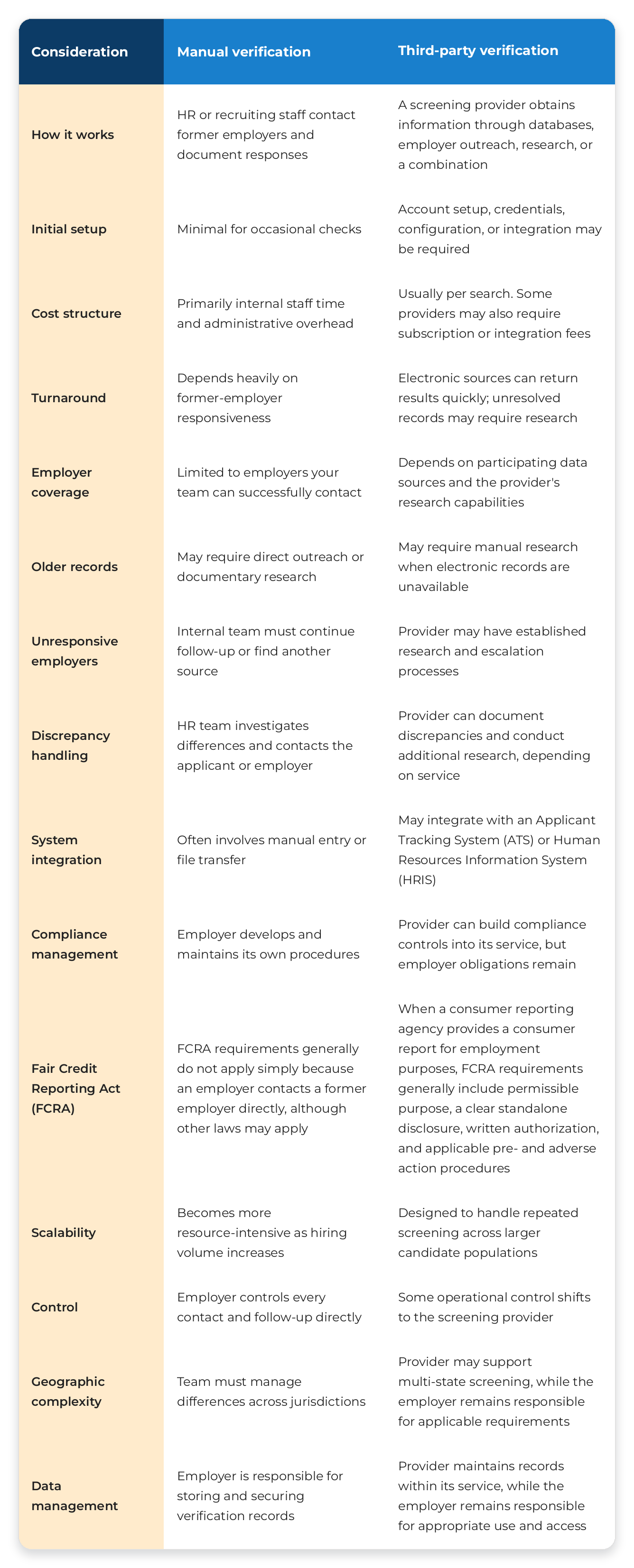
Here’s a side-by-side comparison:
What to evaluate in a third-party verification service
An automated database should not be the only consideration when comparing screening providers. Some third-party screening providers use automated databases to verify employment information, but a database result may not be enough when electronic records are unavailable or incomplete. The more important question is what happens when the database does not produce a usable result.
Before choosing a provider, ask:
- What sources are covered? Find out which employers and employment periods the service can verify.
- What happens when there is no electronic record? Determine whether the provider conducts employer outreach or additional research.
- How are discrepancies handled? Ask who investigates differences in dates, titles, employer names, or employment status.
- What documentation is provided? Confirm whether you receive the source, response, verification status, and relevant activity history.
- Does it integrate with your hiring systems? Check whether results can move into your ATS or HRIS without unnecessary manual handling.
- How are FCRA requirements supported? Ask what the provider handles and what remains the employer's responsibility.
- How are state-specific requirements addressed? This is particularly relevant for employers hiring across multiple jurisdictions.
- Who handles exceptions? A database result is only one part of the process. Find out who researches records that require additional work.
How AccuSourceHR approaches third-party verification
For a commercial screening provider such as AccuSourceHR, the relevant capability is the combination of technology and human handling when a verification does not return a clean automated result.
AccuSourceHR's SourceDirect™ platform supports application programming interface (API) connectivity and integrations with applicant tracking and human resources systems. This can reduce manual transfer of candidate information and verification results between systems.
Employer Responsibilities and Compliance Considerations
Employment verification involves collecting, transmitting, reviewing, and retaining personal information. The compliance requirements depend on the source, purpose, information requested, and jurisdictions involved.
1. Employee consent and privacy requirements
No single rule governs consent for every employment-verification request. The requirements can change depending on whether the employer is contacting a former employer directly or obtaining a consumer report from a consumer reporting agency.
When a consumer reporting agency provides a background report for employment purposes, the FCRA generally requires a standalone disclosure and written authorization before the report is obtained. If the report may contribute to an adverse employment decision, additional pre-adverse and adverse-action requirements apply.
Employers should also limit the information they request and provide access only to personnel who need it. A verification request for employment dates and title does not automatically require compensation, personal contact information, or unrelated personnel records.
2. State-specific verification laws
State and local requirements can affect what employers may request, particularly when verification includes prior compensation. Some jurisdictions restrict salary-history inquiries or inquiries into the applicant’s criminal history.
For a multi-state employer, the verification process should therefore separate standard operating steps from jurisdiction-specific questions. The organization can use a single basic process to identify the applicant, submit the request, document the response and store the result, while adjusting the requested information where local law requires it.
The Federal Trade Commission (FTC) and Equal Employment Opportunity Commission (EEOC) both advise employers to review applicable state and local requirements when using background information for employment purposes.
Record-keeping best practices
A verification record should allow another reviewer to reconstruct the check without relying on the memory of the person who performed it. Record:
- Applicant authorization, when required
- Date and method of the request
- Employer or verification provider contacted
- Information requested
- Response received
- Follow-up attempts
- Discrepancies identified
- Evidence used to resolve them
- Final verification status
An "unable to verify" result should be recorded as such. A former employer's failure to respond does not, by itself, establish that the applicant provided false information.
Protect the record after the verification is complete. Limit access to authorized personnel, use secure methods to transmit sensitive information, follow the organization's retention schedule, and dispose of records securely when the applicable retention period ends.
Common Challenges When Verifying Employment History
Most employment verifications are routine. Problems usually arise when the former employer cannot respond, the records conflict with the applicant's account, or the work was performed outside a conventional employer-employee relationship.
1. Unresponsive former employers
First, confirm that the request reached the correct verification channel. A former employer may route all requests through HR, payroll, a dedicated verification form, or an external provider. Follow the employer's stated process before trying alternate contacts.
If the company has closed or changed ownership, search for a successor organization or parent company that may hold its personnel records. State business filings can help establish whether another entity succeeded the original employer.
If independent confirmation remains unavailable, employers can consider supporting documents such as
- Form W-2
- Pay stubs
- Offer or employment letters
- Tax records or transcripts
- Other employer-issued documentation
These documents can support the employment claim but do not provide the same independent confirmation as a response from the employer or its authorized verification provider. Apply the same fallback standard to candidates in comparable circumstances.
2. Inconsistent or missing records
Employment discrepancies do not necessarily indicate intentional misrepresentation. Common explanations include rounding employment dates to the nearest month, using a functional title instead of the employer's internal title, reporting an offer date instead of the actual start date, or working through a staffing agency.
Set a consistent threshold for reviewing discrepancies. For example, a minor difference in the reported start date may require clarification, while a substantial difference in employment length warrants closer review.
When a discrepancy could affect the hiring decision:
- Compare the applicant's information with the source record
- Identify exactly what differs
- Ask the applicant to explain the discrepancy
- Review any supporting documentation
- Document the resolution
- Follow applicable Fair Credit Reporting Act (FCRA) procedures when the information came from a consumer report and may affect the employment decision
Assess differences in job-title wording separately from differences in employment dates or whether the employment occurred at all.
3. Verifying self-employed and gig workers
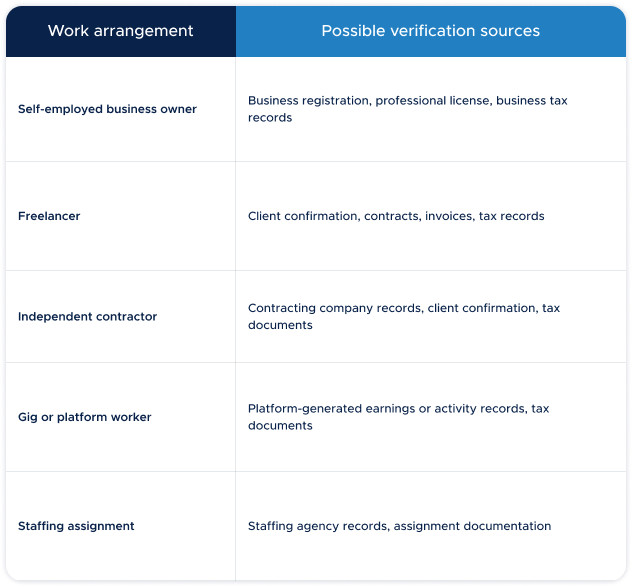
Self-employed workers, freelancers, business owners, and gig workers may not have a conventional employer record to verify. The verification approach should match the type of work performed.
Potential supporting sources include:
For staffing placements, verify with the staffing agency whether it was the legal employer, even if the candidate lists the company where they performed the work.
The same standard should apply throughout the process: an employment period that cannot be independently verified is a different finding from evidence that the applicant provided false information. Document the evidence available, the sources contacted, and why you couldn't complete the verification.
How AccuSourceHR Supports Employment Verification
For employers that want to move employment verification beyond individual emails and phone calls, the screening partner's operating model becomes as important as its technology.
AccuSourceHR combines employment verification with broader background screening capabilities, giving employers a single provider for multiple parts of the pre-employment screening process.
Key capabilities include:
- Employment verification: AccuSourceHR can verify employment history as part of its commercial background screening services, helping employers confirm information such as previous employers, dates of employment, and job titles.
- SourceDirect™ integrations: The platform provides API connectivity and integrations with Applicant Tracking Systems and Human Resources Information Systems, helping employers connect screening activity with their existing hiring systems.
- Human support for exceptions: Employment histories do not always produce a clean database result. AccuSourceHR provides United States-based customer support to help employers navigate questions, follow-ups and cases that require additional attention.
- Compliance support: AccuSourceHR has attorney-led compliance resources and FCRA-certified operations, supporting employers that need structured screening procedures and documentation. Our compliance support does not replace the employer's own legal responsibilities.
- Broader screening capabilities: Employers can combine employment verification with other screening services, including criminal searches, motor vehicle record checks, education and professional license verification, and sanctions or exclusion screening. This can reduce the need to coordinate separate screening providers for different checks.
- Dedicated account support: AccuSourceHR provides account representatives and United States-based customer support, giving employers a defined point of contact when a screening requires clarification or follow-up.
Looking for a more consistent way to verify employment history? Explore AccuSourceHR's employment verification services or contact the team to discuss your screening requirements.

Frequently Asked Questions
Can a former employer disclose why someone left?
A former employer may have its own policy limiting employment verifications to basic facts such as dates and job title. Whether it can disclose additional information, such as the reason for separation, can also depend on applicable state law and the employer's policies.
Employers requesting verification should therefore avoid assuming that a former employer will provide termination details. If the information is relevant to the hiring decision, determine whether it can lawfully be requested and whether the same inquiry will be made consistently for other candidates.
Can employers verify international employment history?
International employment verification may require different sources, documentation and procedures than a domestic check. The former employer may use a different verification provider, records may be maintained in another language, and privacy or employment laws in the country where the person worked may restrict what can be disclosed.
Employers should identify the country, legal employer, dates, and role before beginning the search and determine what documentation or authorization is required. For multinational hiring, use a consistent process while accounting for country-specific requirements.
Can an employer reject a candidate because employment history cannot be verified?
An inability to verify employment does not by itself establish that a candidate provided false information. Before relying on an unresolved verification result, employers should review the source, consider reasonable alternative documentation, and give the candidate an opportunity to explain material discrepancies or missing records.
Employers must also apply employment screening practices consistently and cannot use them in a discriminatory manner. The Equal Employment Opportunity Commission (EEOC) cautions employers to use background information consistently and in compliance with federal nondiscrimination laws.
How long should employers keep employment verification records?
Retention periods depend on the type of record and applicable federal, state, and local requirements. For example, EEOC rules generally require covered private employers to retain personnel and employment records for at least one year, with longer or different requirements applying to certain records and situations.
A discrimination charge can trigger additional retention obligations. Employers should therefore establish a documented retention schedule for verification requests, responses, authorization records, and related hiring documentation, rather than deleting records based on an informal timeline.