
 Jon Daniel

Key Takeaways
- Education background checks help employers confirm whether a candidate’s reported degree, field of study, graduation date, and other academic details match institutional records.
- Education verification is different from a candidate’s self-reported educational background and may involve primary-source verification, the National Student Clearinghouse, or other authorized sources.
- Employers should tailor verification to the role and industry, particularly where education is tied to licensing, credentialing, or specific job requirements.
- A compliant process should address Fair Credit Reporting Act (FCRA) requirements, candidate consent, consistent screening criteria, discrepancy handling, and documentation.
- AccuSourceHR provides education verification as part of a broader commercial background screening service, including domestic and international education checks, professional credential verification, and integration with applicant tracking and human resources systems.
Search “education background,” and most of the advice is written for job seekers: how to present a degree, what to include on a résumé, or how to explain a nontraditional path. Employers have a different question: does the candidate’s education claim check out?
A résumé records what a candidate says they earned. An education background check gives employers a way to verify it, from the degree and field of study to attendance dates and, where relevant, professional credentials.
For human resources (HR) teams, compliance officers, and staffing professionals, the process becomes more important when education is tied to licensing, credentialing, or a specific job requirement. This guide explains what employers can verify, how education checks work, when they are appropriate, and the compliance requirements to consider.
This content is provided for informational purposes only and should not be construed as legal advice. Employers should consult qualified counsel for their specific situation.
What Is Education Verification?
Education verification is the process of confirming a candidate’s education qualifications with the school, university, or other authorized sources. Depending on the position and the employer’s requirements, a verification may confirm the institution attended, dates of attendance, degree earned, field of study, and date the credential was awarded.
The information being verified typically comes from the candidate’s résumé, application, LinkedIn profile, or other hiring materials. The verification process checks those claims against institutional records or other authorized sources, such as the National Student Clearinghouse. Depending on the employer’s requirements, it may also verify details such as GPA, academic honors, or whether the candidate attended an institution without completing the reported degree.
Why Employers Verify Education
Gartner’s survey reports findings on candidate trust and the use of AI in hiring. Based on its research, Gartner predicts that by 2028, one in four candidate profiles worldwide will be fake. For employers, this makes independently verifying credentials increasingly important as fabricated or misleading candidate information becomes easier to produce.
Education is sometimes a mandatory job requirement. A degree or credential may be tied to professional licensing, contractual requirements, accreditation standards, or the qualifications an employer has established for a position. In those cases, employers have a practical reason to confirm that the credential exists and matches the candidate’s claim.
Education verification also gives hiring teams a documented basis for assessing qualifications. If a candidate reports a degree that cannot be confirmed, the employer can address the discrepancy before deciding whether to hire.
The Cost of Ignoring Education Verification
In September 2023, the U.S. Department of Justice reported that more than 7,600 fraudulent nursing diplomas had been distributed through three South Florida nursing schools. Applicants used the diplomas and transcripts to qualify for the national nursing board examination and, after passing, obtain nursing licenses and jobs with healthcare providers across the country.
When a degree, training program, or other educational credential is required for the role, verifying it before hiring gives the organization a chance to identify discrepancies before they become part of the employee’s hiring or credentialing record.
What Gets Verified in an Education Background Check?
An education background check, commonly called an education verification, can verify several details about a candidate’s academic history. The scope depends on mandatory requirements for the role:
1. Degree Type, Field of Study, and Graduation Date
Education verification typically confirms the degree or credential awarded, the field of study, and the date it was conferred. It can also verify whether a candidate attended an institution without completing the program.
These details can reveal discrepancies that an attendance check would miss. A candidate may have attended the right school but left without earning the degree listed on their résumé or may have earned a degree in a different field.
2. Institution Name and Accreditation Status
Employers may also check the institution’s accreditation or recognition status when it is relevant to the position or credential being assessed.
An institution can issue a diploma without that credential carrying the academic or professional recognition an employer expects. Checking the institution separately helps identify schools or programs whose credentials may not meet the stated requirement.
3. Grade Point Average (GPA) and Academic Honors
Employers may verify GPA, honors, or distinctions such as cum laude when academic performance is part of the hiring criteria. For example, an entry-level role or graduate recruitment program may require applicants to have a minimum 3.0 GPA.
If a candidate's GPA or honors helped them meet the stated hiring criteria, the employer may verify the claim along with the degree itself. If academic performance has no bearing on the position, there is usually little reason to include it in the education check.
4. Professional Certifications and Licenses Tied to Education
Some professional credentials require a specific degree, program of study, or other educational qualification. Verifying the professional certification or license does not necessarily confirm the education behind it.
For positions with formal education prerequisites, employers may therefore need to verify both the underlying education and the current professional credential. The appropriate source will depend on the credential and the relevant licensing or certifying body.
5. International Credentials
Education earned outside the United States can require additional verification. Institutions may use different degree structures, grading systems, recordkeeping practices, and accreditation frameworks.
How the Education Verification Process Actually Works
Once an employer knows what needs to be verified, the next question is how to obtain and assess the record. The verification method depends on the institution, the credential, and whether the record is available electronically.
1. Primary Source Verification
Primary source verification means confirming a candidate’s education with the institution that issued the credential or an authorized agent. The employer or screening provider submits the candidate’s identifying information and requested education details, then compares the response with the information provided by the candidate.
A database may facilitate the search, but employers should consider where its underlying information comes from and whether it meets the verification requirements for the position.
2. The National Student Clearinghouse
The National Student Clearinghouse provides enrollment and degree verification for participating U.S. institutions. When a candidate’s record is available, an employer can use the service to verify the information the candidate reported.
The Clearinghouse does not contain every education record. If no record is available, the employer may need to contact the institution or another authorized records custodian directly. An unavailable record does not by itself establish that a candidate did not attend or graduate.
3. Checking Accreditation
Accreditation is a separate check from verifying a candidate’s degree. The U.S. Department of Education maintains a database of accredited institutions and programs and information about recognized accrediting agencies. Employers can consult it when accreditation is relevant to the position.
Employers may also need to contact the institution directly or use an international credential-evaluation service to determine how a foreign qualification compares with the position's requirements.
4. Turnaround Times and Delays
Some verifications are completed electronically within a short period. Manual requests can take longer when an institution requires written authorization, charges a fee, or routes requests through its registrar.
Older records, international credentials, and records from institutions that have closed or merged, and holiday schedules or academic breaks may require additional time or research.
Red Flags and Discrepancies that Education Verification Can Uncover
Education verification may uncover discrepancies between a candidate’s claims and institutional records. Common findings include:
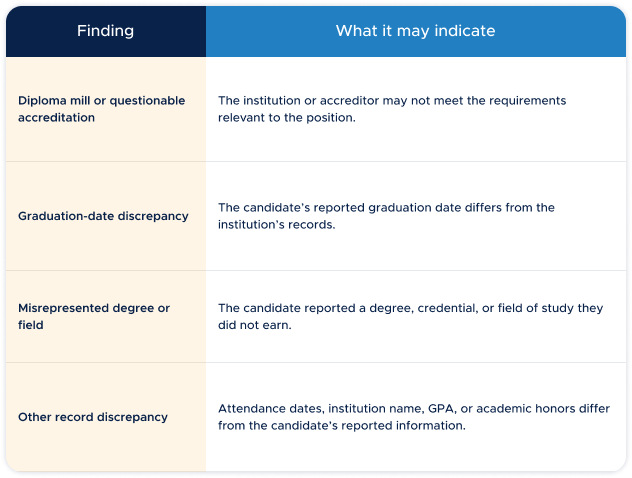
A discrepancy does not automatically indicate fraud. Employers should review the finding against the position’s requirements and follow their established screening and adverse action procedures.
Who Is Required to Run Education Background Checks, and Under What Rules
There is no general federal law requiring every U.S. employer to verify a candidate’s education. It depends on the position, industry, state law, licensing rules, accreditation standards, and the employer’s own hiring requirements.
1. K-12 and Higher Education
Schools may have specific credential and qualification requirements for teachers and other licensed personnel. State education agencies determine many of these requirements, so employers should check the rules applicable to the state and position.
For example, a public school hiring a teacher may need to confirm that the candidate meets the state's education and certification requirements before the individual can serve in a licensed teaching role. The school may verify the underlying degree with the issuing institution as part of that process.
Requirements for other school employees vary. A school may also impose its own screening requirements for staff, contractors, or other personnel who work with students.
2. Staffing and Recruiting Firms
Staffing firms generally do not face one federal rule requiring education verification for every candidate they place. Verification requirements often come from the client, the position, or applicable licensing rules.
For example, a staffing agency placing a nurse may need to verify the qualifications required for the assignment before presenting the candidate to a healthcare client. A client contract may also require the agency to document specific screening steps.
AccuSourceHR provides staffing firms with education verification alongside employment, license and credential, identity, criminal, and other screening services.
3. Healthcare
Healthcare employers should distinguish between education verification and professional credential verification.
The Joint Commission requires accredited organizations to use primary source verification for certain credentials, including licensure, certification, and registration when required by law or regulation. Its guidance also covers verifying education and other credentials through approved sources and requires organizations to document the verification process.
Employers can handle these checks internally or use a screening provider. AccuSourceHR offers healthcare screening that includes education verification, professional license verification, employment verification, criminal searches, and exclusion searches.
The scope should follow the position and the applicable credentialing requirements. A hospital credentialing a physician, for example, may need a different screening program from one hiring nonclinical administrative staff.
4. Financial services
Financial services employers should not assume that the Financial Industry Regulatory Authority (FINRA) or the Federal Deposit Insurance Corporation (FDIC) generally requires education verification for every employee.
FINRA rules address background information and qualification requirements for certain individuals in the securities industry. If a position requires a specific qualification, registration, license, or designation, the employer may need to verify the relevant credential.
For example, a securities firm hiring an individual for a role requiring FINRA registration must follow the applicable registration and qualification requirements. A separate education check may be appropriate when the employer has established a degree requirement for the position, but that does not make education verification a universal FINRA requirement.
5. Government and defense contractors
Federal background investigations vary by position. National security positions, public trust roles, law enforcement jobs, and contractor positions involving sensitive government work can require extensive vetting. Depending on the role, the investigation may support a suitability, fitness, or security determination.
For employers that need broader screening, providers such as AccuSourceHR combine education and credential verification with searches covering criminal history, employment, and identity.
Building a Compliant Education Verification Policy
A compliant education verification policy should define what gets checked, when checks occur, which roles require them, and how discrepancies are handled. Applying those rules consistently gives hiring teams a documented basis for their decisions.
- When to run education checks: Employers should define when education verification occurs, whether before an offer, after a conditional offer, or during credentialing. The appropriate timing depends on the role, applicable laws, and the employer’s screening policy.
- Fair Credit Reporting Act (FCRA) disclosure and consent: When a third-party consumer reporting agency conducts an education check for employment purposes, the FCRA generally requires the employer to provide the required disclosure and obtain the candidate’s authorization before ordering the report.
- Which roles require verification: Not every position requires an education check. Policies should identify roles where a degree, field of study, or credential is part of the established qualifications, licensing, or credentialing requirements. Comparable roles should be subject to the same standard.
- Handling credential discrepancies: A discrepancy does not automatically mean a candidate falsified their education history. Employers should give candidates an opportunity to identify or dispute inaccurate information. If a consumer report contributes to an adverse employment decision, employers must follow the Fair Credit Reporting Act’s required adverse action process.
- Documentation and retention: Employers should document what was verified, when it was verified, the result, and the records supporting the check. Retention periods should follow applicable legal and organizational requirements.

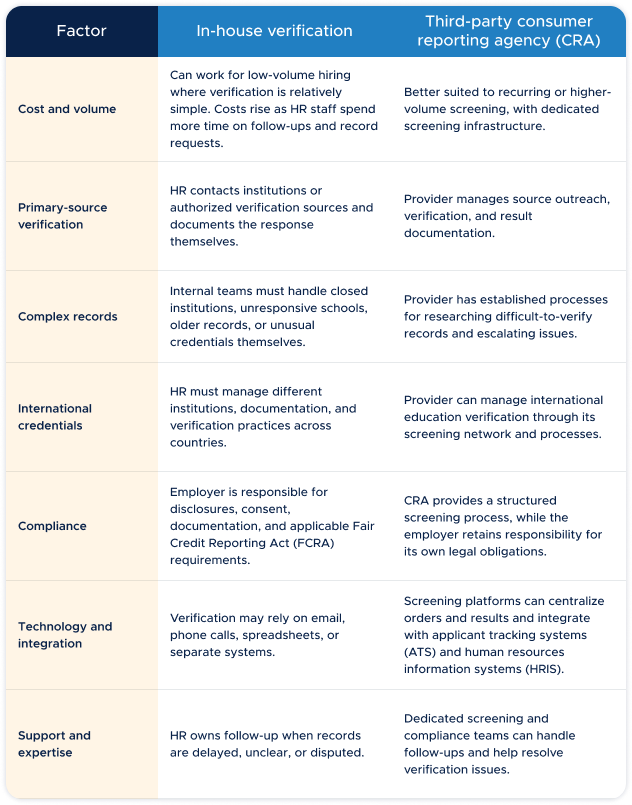
In-House Verification vs. Third-Party Consumer Reporting Agency (CRA): How to Choose
Once an organization commits to education verification, the practical question becomes whether to handle it internally or engage a specialized provider.
This is a genuine build-versus-buy decision, and the right answer depends on volume, complexity, and risk tolerance. Key differences between the two include:
Why Employers Choose AccuSourceHR for Education Verification
AccuSourceHR offers education verification as part of a broader commercial employment screening service, allowing employers to combine academic checks with other screening requirements. Key features include:
- International screening: Supports verification of education and other credentials earned outside the United States.
- Compliance support: AccuSourceHR is a Professional Background Screening Association (PBSA) accredited founding member and has an in-house counsel-led compliance team with PBSA Fair Credit Reporting Act (FCRA)-certified staff.
- Data security: AccuSourceHR maintains a SOC 2 Type II report covering controls relevant to security and data handling.
- Screening integration: Its SourceDirect™ platform connects screening with existing applicant tracking systems (ATS) and human resources information systems (HRIS), with more than 50 turnkey integrations.
- Broader screening: Employers can combine education verification with employment, professional license and credential, identity, criminal, and exclusion screening through the same provider.
Need education verification alongside your broader hiring checks? Explore AccuSourceHR’s education verification services and book a demo with the team.
Frequently Asked Questions
Can an employer verify a degree without the candidate's consent?
Yes, in limited circumstances. If an employer verifies a degree directly rather than through a third-party consumer reporting agency (CRA), the Fair Credit Reporting Act (FCRA) consent requirement does not apply.
Separately, under the Family Educational Rights and Privacy Act (FERPA), a school may disclose certain directory information, such as degrees earned and dates of attendance, without the student's consent if the school has designated that information as directory information and the student has not opted out.
Those conditions do not always apply. Verification services may also require authorization when a record is restricted. As a result, most employers obtain a signed release as part of the education verification process. State and local requirements may impose additional obligations.
Are online degrees and trade certifications verifiable the same way?
Not always. Online degrees are generally verified through the issuing college or university, using the same type of records as an on-campus degree. Trade certifications are typically verified through the organization that issued the credential, such as a licensing or certifying body. The verification may confirm the credential, issue date, status, expiration, or restrictions. The appropriate verification source depends on who issued the credential and the requirements of the position.
What happens when educational records are unavailable?
A closed institution may have transferred its academic records to another school, a state agency, or another designated custodian. Employers or screening providers may be able to identify the current record holder and request verification through that source.
If no authoritative record can be obtained, the employer should document the verification attempts and determine whether other documentation is appropriate for the position.
What are the key criteria for evaluating an education verification provider?
When comparing providers, employers should look beyond price to the factors that actually determine quality and risk: the depth of primary source verification, the ability to handle international and closed-institution records, the strength of the provider's compliance and adverse action support, data security posture, turnaround time and responsiveness, and how well the provider's technology integrates with existing systems.