
 Jon Daniel

A ground-level review for healthcare, transportation, and staffing employers evaluating Checkr as their screening provider.
Key Takeaways
- Checkr is built for high-volume, low-complexity hiring. Its core users are gig platforms and tech companies, and the product is optimized for that model.
- The interface and integrations are strong. Around 84% of checks are completed within 24 hours, and G2 rates ease of use at 9.4/10.
- Base pricing starts at $29.99 per check, but real-world costs are typically 40–70% higher once jurisdiction-based court fees are added.
- For DOT, healthcare, and staffing employers, the limitations are structural: no in-house C/TPA drug testing, no attorney-led compliance, no PBSA Founding Member status, and no named account management.
- Alternatives like AccuSourceHR are built for regulated environments, with pre-built ATS integrations, audit-ready compliance support, and named account management designed to handle complex hiring requirements.
Checkr is a widely recognized name in employment background screening, used by over 100,000 employers and generating more than $800 million in revenue in 2025, according to its official website. For organizations with straightforward hiring needs, it does what it’s known for: fast, automated checks paired with a smooth candidate experience.
This review is aimed at employers operating in more regulated environments.
If you’re subject to Federal Motor Carrier Safety Administration (FMCSA) oversight, managing healthcare credentialing, or placing workers into client-controlled worksites with strict compliance requirements, the real question is different. It’s not just about speed. It’s about whether those checks translate into a defensible, audit-ready compliance program. In this guide, we focus on that analysis.
What Is Checkr, and Who Is It Built For?
Checkr launched in San Francisco in 2014. It grew up on gig-economy screening, and its largest customers still reflect that origin: DoorDash, Lyft, Uber, Coinbase, and Instacart.
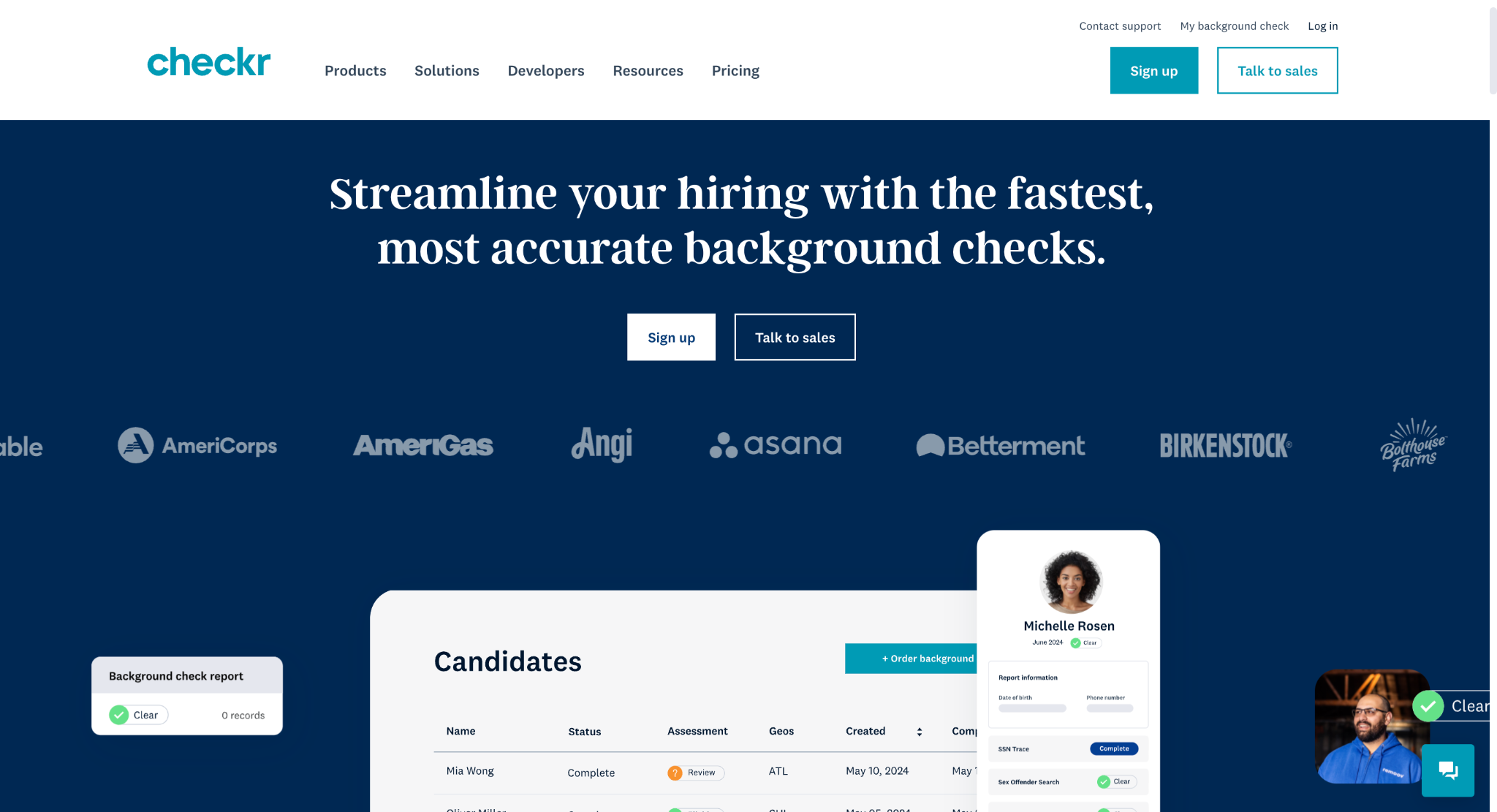
The background shows up clearly in how the platform is built. The workflows, automation, and candidate experience are all optimized for high-volume, fast-moving hiring environments. Looking at that design focus is the quickest way to decide whether it aligns with your own hiring model
- Founded: 2014, San Francisco
- Customers: 100,000-plus employers globally
- Revenue: $800M+ as of 2025
- Funding: $740M raised; most recent round May 2025
- Recognition: Forbes Cloud 100 for seven consecutive years
- Core market: High-volume, self-serve hiring: gig, tech, retail, hospitality
- Weakest fit: DOT-regulated transportation, multi-site healthcare, heavily regulated staffing
Safe to say, Checkr has a specific design philosophy. Gig-platform hiring and FMCSA fleet hiring are different compliance environments. A platform optimized for the first will always have structural gaps in the second.
How a Checkr Background Check Actually Works
The process is fast and mostly automated. An employer sets up a screening package and sends an invitation to a candidate, and the rest runs on its own. Here is what the workflow looks like step by step. For context on what affects turnaround across the industry, see how long a background check takes.
- The employer selects a screening package and invites the candidate through the Checkr dashboard.
- The candidate receives an email or text invitation, opens a mobile-friendly portal, and completes an authorization form.
- Checkr runs the check automatically across its data sources. Standard packages do not require manual intervention.
- Results populate in the employer's dashboard, color-coded by status: clear, consider, or pending.
- The employer reviews flagged results and takes adjudication action, either manually or through pre-configured automation rules.
Checkr reports that 84% of checks are completed within a 15-minute to 24-hour window, and that claim generally holds up in third-party testing. In one B2BReviews test, a check was returned in just 16 minutes. Timelines can extend when county-level searches require manual court access, which varies by jurisdiction.
What Each Plan Includes
As of 2026, Checkr offers three standard tiers, starting at $29.99, for employers running fewer than 300 checks per year. Enterprise pricing requires a sales conversation.
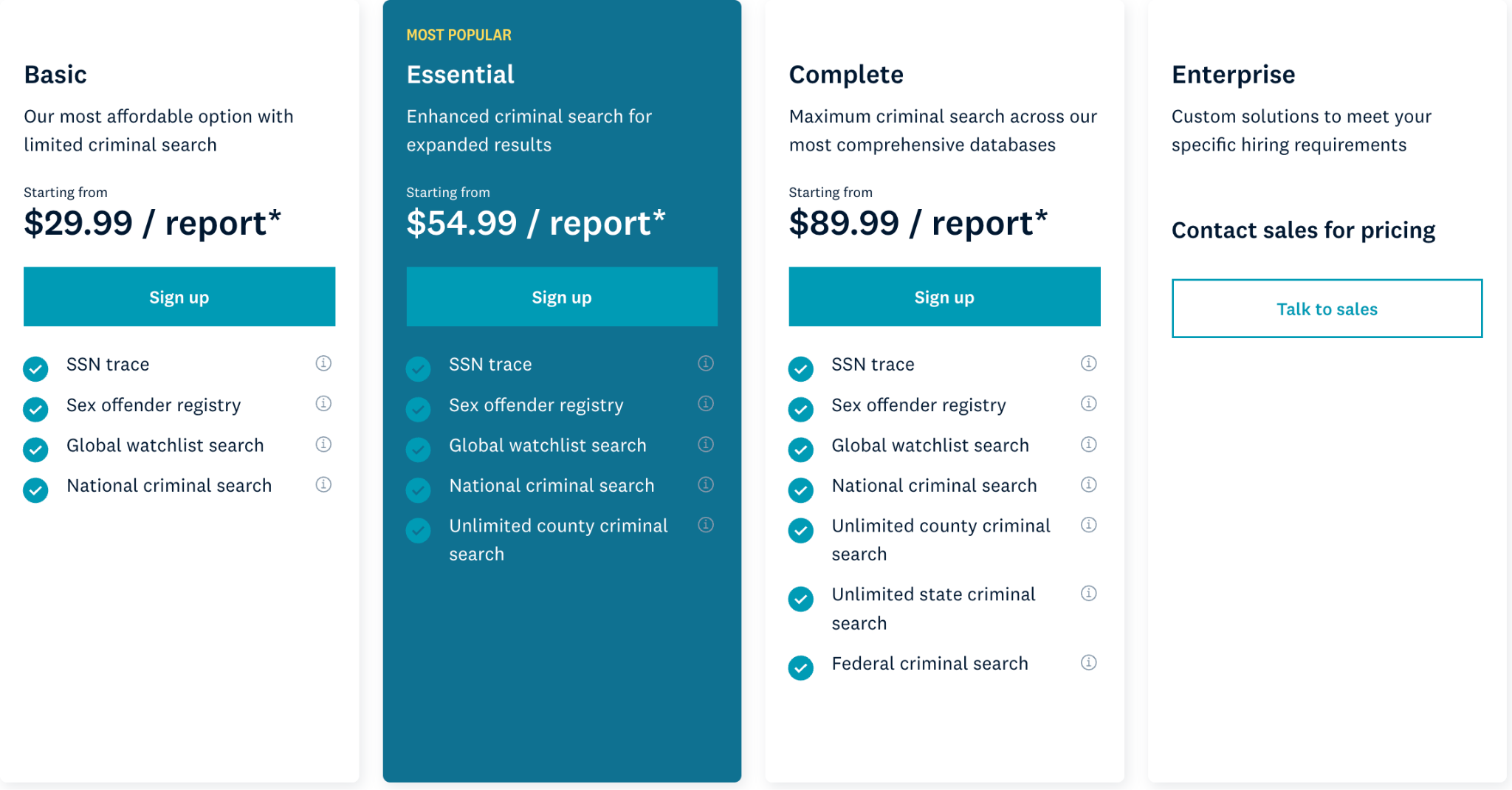
MVR checks, drug test coordination, and employment verifications are priced as add-ons.
For a broader look at the cost of screening components and how to budget for them, see our insider's guide to background check costs.
What Checkr Gets Right
Before getting into the gaps, it is worth being specific about where the platform genuinely performs. These are not marketing claims. They are patterns that hold up across G2, Capterra, and third-party editorial reviews.
- Speed: 84% of checks are complete within 24 hours. For employers where time-to-fill drives operational outcomes, this is a real competitive edge over slower providers.
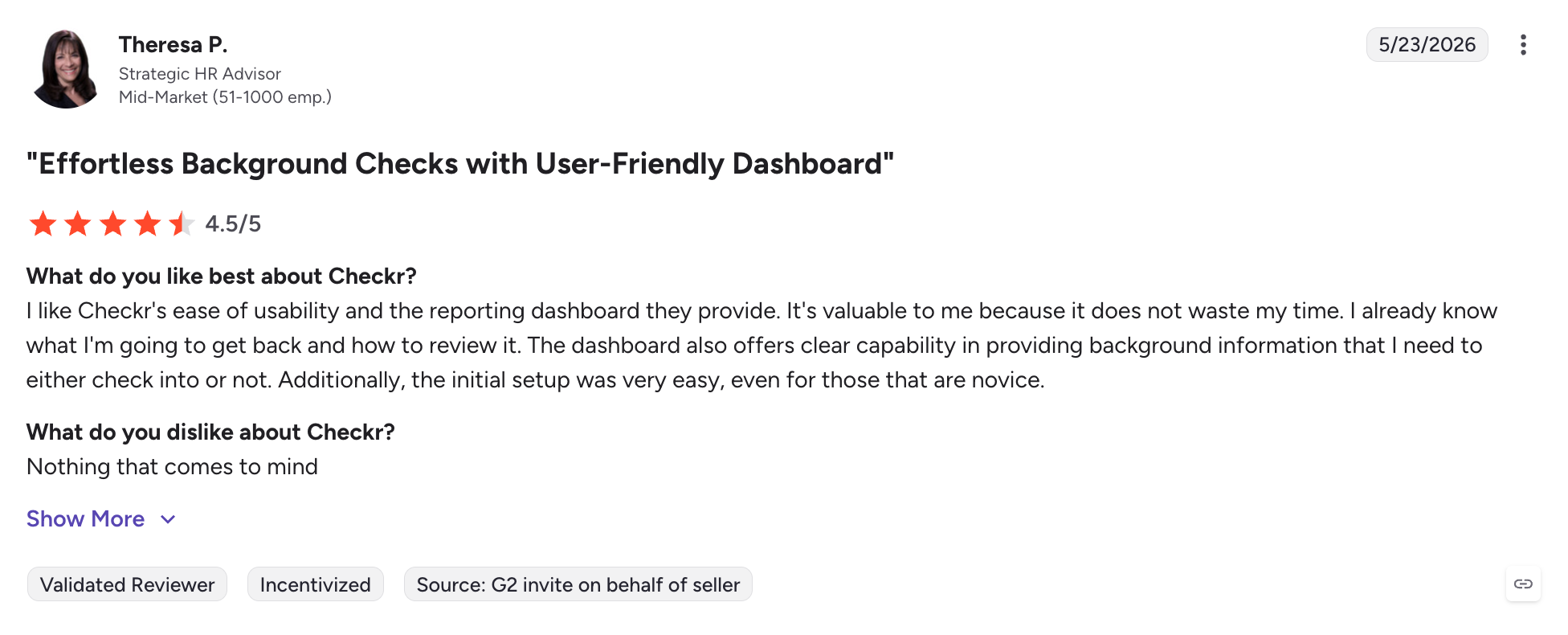
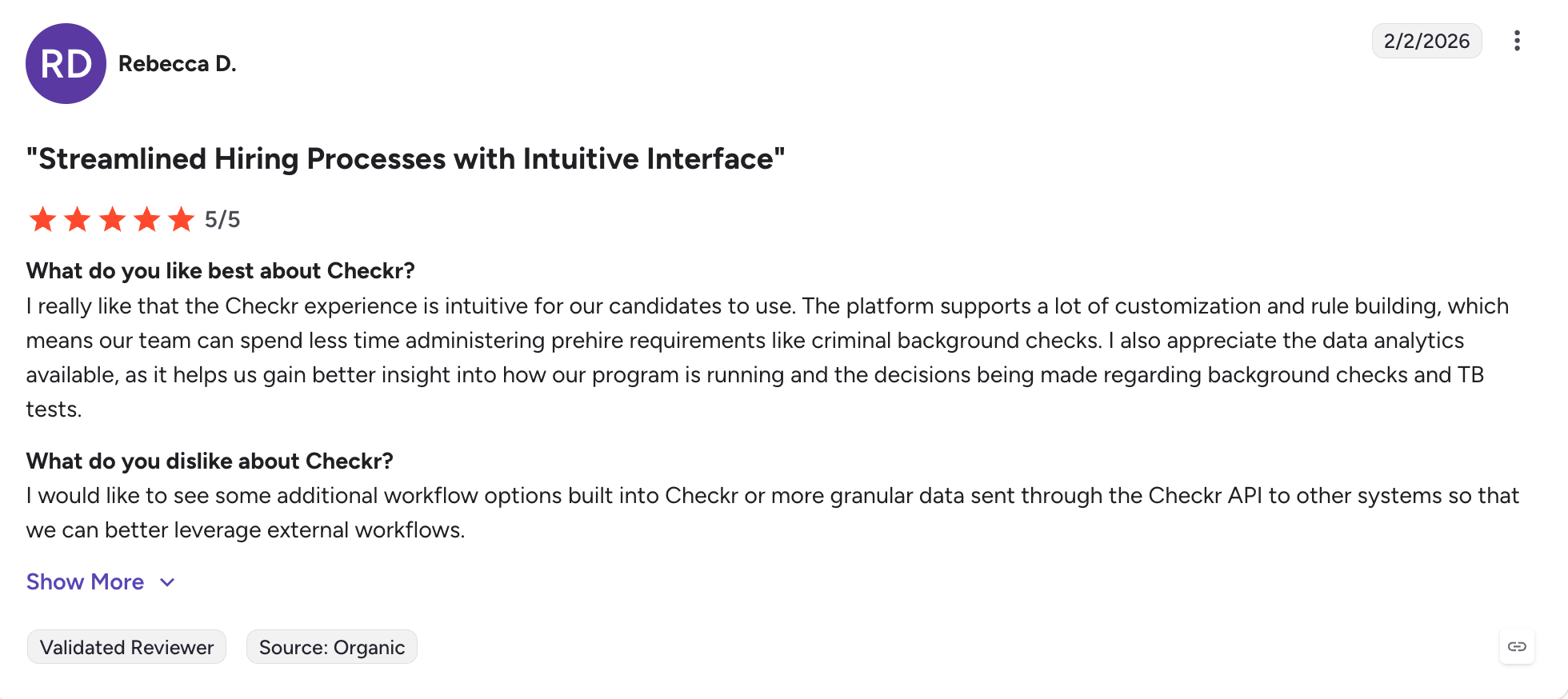
- Interface: G2 rates Checkr at 4.5/5 based on 399 reviews. Capterra gives it 4.5 out of 5 from over 300 reviews. HR teams consistently describe the daily workflow as clean and low-friction.
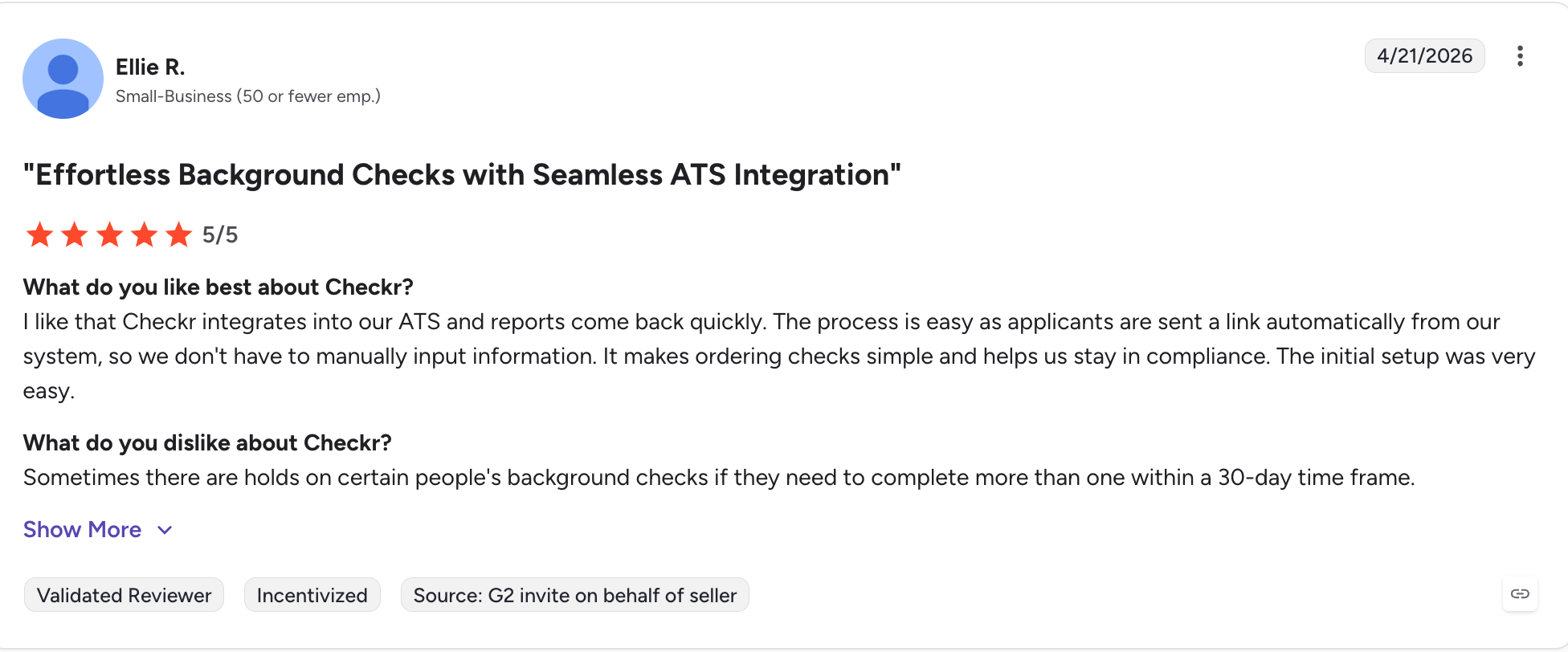
- Integrations: Connects to 100+ ATS and HRIS platforms. Employers running Greenhouse, Paylocity, Workday, Rippling, or iCIMS report genuine bidirectional data flow.
- Candidate experience: Mobile-optimized portal with real-time tracking and self-service dispute submission. Reduces the volume of candidate-facing communication HR teams have to manage.
- AI charge classification: Standardizes criminal charge language across jurisdictions automatically. Cuts manual interpretation time for HR teams processing high volume across multiple states.
- Pricing visibility: Published per-check pricing is rare in background screening. Most competitors require a sales call before disclosing numbers. Checkr's published tiers make initial comparison easier.
In terms of user experience, Checkr consistently outpaces HireRight and Sterling/First Advantage in G2 ease-of-use and implementation scores. That gap is real. The divergence shows up in the compliance infrastructure and service model, which the next two sections cover.
The Real Cost of a Checkr Background Check
The published per-check prices are more transparent than most competitors. The issue is that published prices and actual invoices do not match. The gap depends on where your organization hires.
Why Published Prices Understate Actual Cost
Base pricing rarely reflects what employers actually pay. Court access fees are passed through separately and vary widely by jurisdiction, which is where costs start to diverge.
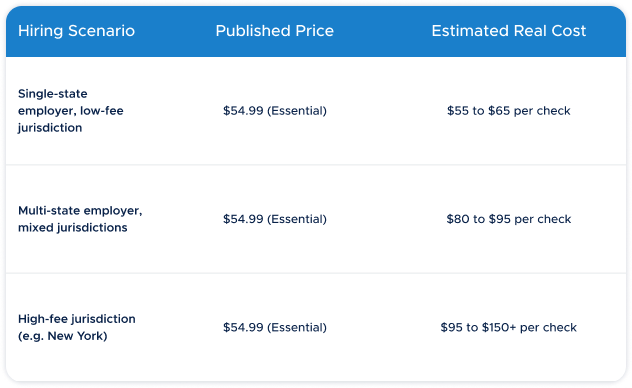
The gap becomes more pronounced as hiring expands across states. Analysis by CheckThat.ai shows real-world costs often run 40–70% above base pricing for multi-state employers. That aligns with what healthcare and transportation organizations see in practice, where hiring routinely spans multiple jurisdictions.
What to Watch for in Enterprise Contracts
- Minimum commitment: Vendr transaction data documents a $10,000 minimum that can sometimes be waived in negotiation
- Auto-renewal terms: Pricing typically locks at the existing rate on auto-renewal. Volume-based adjustments require explicit renegotiation before the renewal date.
- Median contract value: Around $61,000 annually per Vendr's transaction database
- Billing surprises: Complaints include a recurring pattern of unexpected passthrough charges. Map your hiring jurisdictions and calculate realistic per-check totals before committing.
Where Checkr Falls Short
The gaps cluster in three areas. Each one is structural, meaning a product update will not fix it. These are consequences of the design decisions that make Checkr fast and self-serve for its core market.
No Phone Support. No Named Account Manager. No Escalation Path.
Checkr does not publish a customer service phone number. There is no live-answer option for employers or candidates. Support runs through a web portal and email-based tickets.
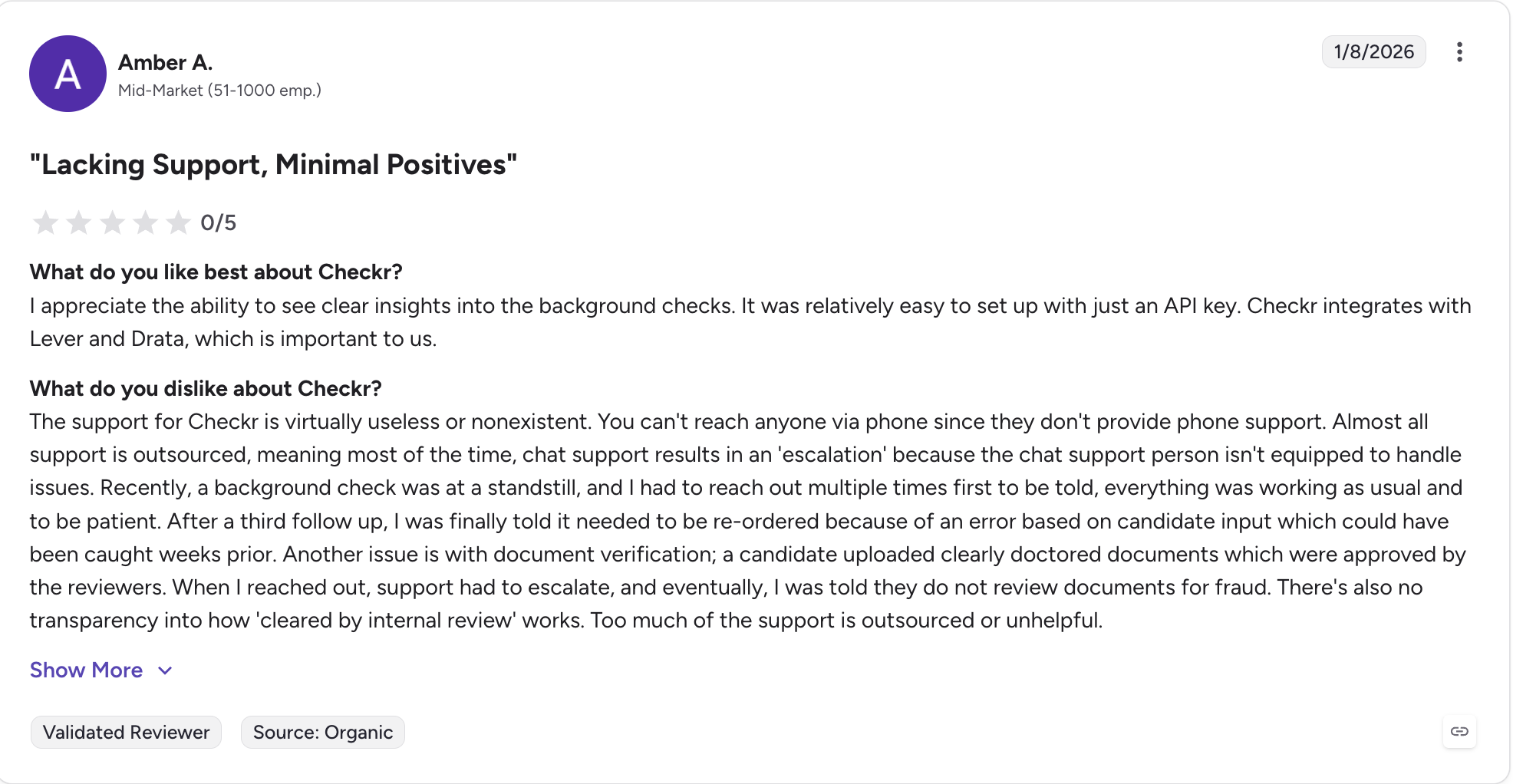
For routine questions, that is fine. For anything time-sensitive, it is not. Here is what the support gap looks like in practice:
|
Scenario |
What Happens Without Live Support |
|
Incorrect record is blocking a hire |
Dispute enters a ticket queue. No phone escalation. Better Business Bureau (BBB) complaints document cases running 50-plus days without resolution. |
|
FMCSA audit documentation gap |
Organization needs an immediate answer. A ticket queue is not an escalation path. |
|
False flag on a clinical hire's license |
The role stays unfilled while HR waits on an email response. Every day costs patient-care coverage and reimbursement. |
|
Billing dispute on passthrough fees |
No live agent to resolve. Multiple BBB complaints cite difficulty obtaining corrections. |
PissedConsumer aggregates over 550 Checkr reviews at a 1.3-star rating. The top complaint across those reviews is the inability to reach a human being. On ConsumerAffairs, reviewers describe submitting documents and hearing nothing back for weeks.
AccuSourceHR operates on a different model: 100% U.S.-based client care, a 95% live-answer call rate, and named account managers. For employers who need a human on the phone when something goes wrong, that is not a nice-to-have. It is the minimum standard.
See the AccuSourceHR commitment to security and compliance for a closer look at the service model.
Compliance Is a Baseline, Not a Differentiator
Checkr operates as an FCRA-governed consumer reporting agency, which means it must comply with the Fair Credit Reporting Act. This is a baseline compliance, mandatory for any screening provider
What separates providers is everything built on top of that baseline. The strength of the compliance program, the depth of internal expertise, and the ability to interpret state-specific regulations are what hold up under audit.
Background check laws vary significantly by state. For a sense of how much variation exists across state-specific background check laws, the expertise of the provider's compliance team is the variable that protects the employer.
In this section, we have provided a detailed overview of the essential differences between Checkr and AccuSourceHR:
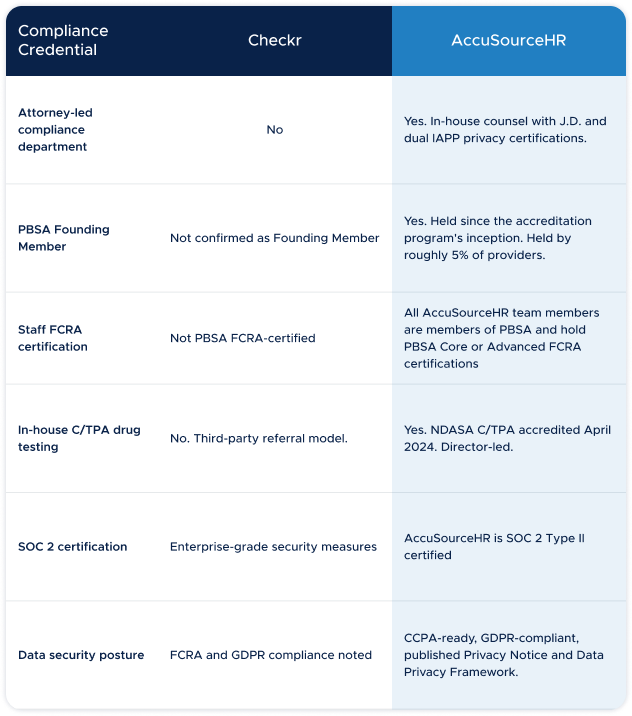
When a compliance question needs an attorney's interpretation, Checkr routes it to a help center. AccuSourceHR routes it to in-house counsel. The difference becomes visible during an adverse action decision, a multi-state jurisdiction conflict, or an audit. For data security and compliance best practices in healthcare and government, the screening vendor's security posture is itself a compliance requirement.
Where Regulated-Industry Employers Feel It Most
Checkr offers the core components required for DOT-regulated screening, including MVR reports, CDLIS searches, FMCSA Clearinghouse queries, and DOT physical coordination. On paper, the coverage looks complete.
The difference shows up in execution. Regulated programs require consistent adjudication workflows, audit-ready documentation, and ongoing compliance support—not just access to individual checks. That’s where employers start to see gaps, especially when managing DOT requirements across multiple states, drivers, and reporting obligations.
For transportation employers:
- No in-house C/TPA: FMCSA-regulated employers end up managing DOT drug and alcohol testing through a self-serve portal without a Consortium/Third Party Administrator handling random testing pools, DER support, or regulatory updates
- Audit exposure is high: In 2024, 94% of FMCSA on-site audits uncovered at least one violation. More than half found acute or critical violations.
- Compliance is more than check types: For what a full FMCSA program requires, see our guides to DOT physicals, DOT medical cards, and what an MVR covers.
DOT — Department of Transportation
MVR — Motor Vehicle Record
CDLIS — Commercial Driver’s License Information System
FMCSA — Federal Motor Carrier Safety Administration
For healthcare employers:
- License verification accuracy: Multiple G2 reviewers report mismatches between candidate-entered license details and the results returned by Checkr, often triggering false “Consider” flags. In clinical environments, that friction has a real impact; every delayed or rejected verification can leave shifts unfilled, affecting both patient coverage and reimbursement timelines.
- Sanctions monitoring is an add-on, not a default: Checkr offers continuous monitoring as a paid extra. AccuSourceHR's SanctionSource runs ongoing federal and state sanctions checks as built-in program infrastructure. Because of the associated costs, AccuSourceHR recommends sanctions monitoring where appropriate while allowing flexibility for customers who may not require it; an important distinction in an OIG review.
- Full program depth: A background check for healthcare must stand up to CMS, OIG, and Joint Commission review. See our healthcare background check requirements guide and the AccuSourceHR healthcare industry page for what a full HealthSource program covers.
For continuous monitoring across both verticals:
AccuSourceHR supports continuous monitoring across both criminal and sanctions screening through CrimSource and SanctionSource, with the option to configure these services based on client needs.
Where it differentiates is in execution: post-hire monitoring feeds into the same adjudication workflows and documentation framework as pre-hire screening, creating a single, unified audit trail.
Checkr's continuous monitoring is a separate configuration, managed by the employer. For what continuous background screening looks like, built into a compliance program, see the continuous monitoring services overview.
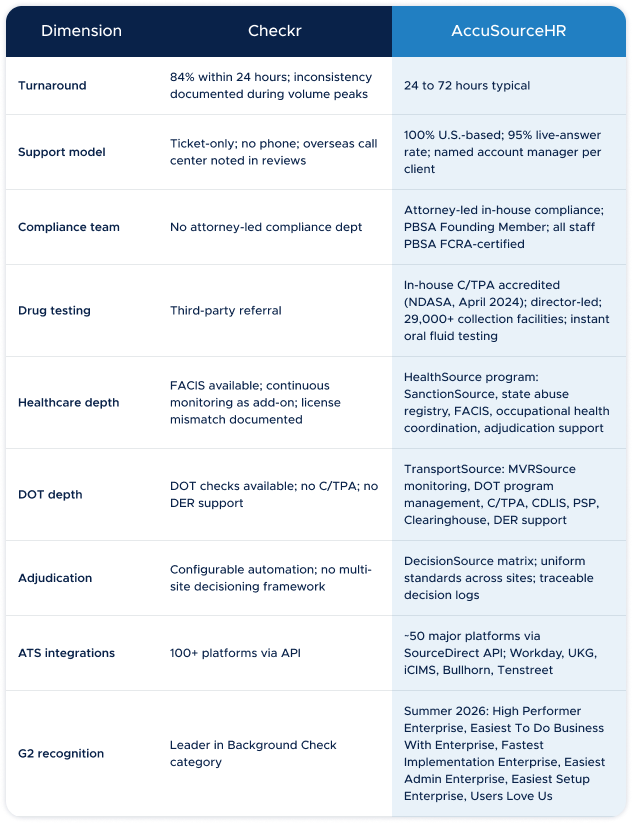
Checkr vs. AccuSourceHR: Side-by-Side Comparison
Both platforms screen candidates. The differences are in what happens after the check runs and around it. This table covers the dimensions that matter most for regulated-industry employers.
Who Should Use Checkr (And Who Shouldn't)
The answer depends less on company size than on the regulatory environment. Checkr is strong in its lane. The question is whether your organization is in that lane.
Checkr is a good fit when:
- Hiring is high-volume and low-complexity: gig platforms, tech startups, and SMBs with straightforward screening needs and no DOT or healthcare regulatory obligations
- Self-serve setup is a priority: the team wants to configure packages, manage adjudication rules, and run reports without a support conversation
- Speed outranks compliance depth: the primary evaluation criteria is turnaround time and platform UX, not audit defensibility or regulated-industry program support
Checkr is not the right fit when:
- FMCSA compliance is on the line: Carriers that need DOT program management, C/TPA drug testing, DER support, and audit-ready documentation under a single provider
- Healthcare credentialing must hold up to audit: It includes continuous Office of Inspector General (OIG) exclusion monitoring, accurate license verification, and adjudication records defensible under Centers for Medicare & Medicaid Services (CMS) standards.
- Staffing places workers in regulated environments: Agencies that need the screening program to flex across client verticals, each with its own compliance requirements. See the PeopleSource staffing program for how AccuSourceHR handles this.
- A human on the phone is a requirement: Any employer managing safety-sensitive roles where a dispute, a compliance question, or an audit cannot wait for a ticket response
Small regulated-industry employers have options too. AccuSourceHR's RapidSource is built for companies with fewer than 100 employees that need a compliant program without the complexity of enterprise systems, paired with a high level of support; including a 95% live answer rate for client and candidate calls.
Employers evaluating screening vendors should also review drug and health screening requirements alongside the background check program. Consolidating both under a single C/TPA-accredited provider eliminates the documentation fragmentation that creates audit exposure when records from two vendors need to be reconciled.
Conclusion
Checkr is a good product. It is fast, well-designed, and reliable for the employers it was built to serve. For organizations without significant regulatory exposure, the platform delivers on its core promise, and the review data backs that up.
For healthcare, transportation, and staffing employers, the question is not whether the platform can run the checks. The question is what happens to the compliance program when a record is disputed, when a regulation changes, when an auditor asks for documentation that was never built into the infrastructure, or when you need to pick up the phone and talk to a person who understands your industry.
A background check is a transaction. A compliance program is a relationship. The providers that understand that distinction are not hard to identify. The difference becomes clearest when the pressure is highest.
Frequently Asked Questions
How long does a Checkr background check take?
Checkr reports 84% of checks are complete within 24 hours. Turnaround slows when county criminal searches require manual access to the court. Multi-state checks and employment or education verifications typically extend beyond the 24-hour window. There is no guaranteed timeframe for complex searches.
What shows up on a Checkr background check?
Depending on the package: SSN trace, national and county criminal records, sex offender registry, global watchlist, employment verification, education verification, motor vehicle records, and healthcare sanctions. The exact searches depend on the employer's chosen tier and any add-ons configured for the role.
How much does a Checkr background check cost?
Published prices (as of 2026) start at $29.99 (Basic+), $54.99 (Essential), and $79.99 (Professional). Actual per-check costs typically run 40 to 70% higher once court pass-through fees are applied. For a broader cost breakdown, see what background checks really cost.
Does Checkr work for DOT and FMCSA-regulated transportation hiring?
Checkr offers MVR reports, CDLIS searches, Clearinghouse queries, and DOT physical coordination. It does not operate an in-house C/TPA drug testing program. For carriers needing full DOT program management with DER support, that gap requires evaluation.
How does Checkr handle healthcare sanctions screening?
Checkr offers FACIS sanctions screening and OIG exclusion checks. Continuous sanctions monitoring is a paid add-on, not a default. G2 reviewers document recurring accuracy issues with professional license verification. For organizations needing continuous healthcare sanctions monitoring as standard, this is a material gap.
How accurate are Checkr background checks?
Most employer reviews rate Checkr's accuracy as adequate for standard criminal and identity searches. The documented accuracy concern is professional license verification, where candidate-entered data frequently mismatches returned results. For what affects background check accuracy across the industry, multiple variables are at play.
Is Checkr legit and safe to use?
Yes. Checkr is a legitimate, well-funded background screening company that operates as an FCRA-governed consumer reporting agency, serving more than 100,000 employers including large, well-known platforms. Legitimacy questions that appear in search results generally trace back to the support experience rather than to any indication that the company is not legitimate or unsafe to use. PissedConsumer aggregates more than 550 Checkr reviews at a 1.3-star average, and ConsumerAffairs reviewers describe similar patterns, concentrated on the difficulty of reaching a live person when a dispute, a billing question, or a time-sensitive compliance issue comes up, since Checkr does not publish a customer service phone number. Candidates and employers evaluating Checkr should treat that as a real service-model trade-off to weigh, not as a sign that the company or its checks are illegitimate.
