
 Jon Daniel

Key Takeaways
- Every major ATS claims to integrate with background check providers. In practice, that integration ranges from a fully bi-directional REST API exchange to a one-way webhook notification that fails silently when something goes wrong.
- The most dangerous ATS-to-screening integration is not one that fails visibly. It is one that appears to work, initiating a request and firing a notification, while silently passing incomplete or corrupted candidate data downstream.
- Field-mapping failures, candidate portal friction, and limited visibility into adverse action workflows are three failure modes most ATS demos never surface. The employer bears the FCRA exposure when any of them go undetected.
- The five-point integration framework in this guide is the same one AccuSourceHR uses to evaluate every new ATS partner connection across its 50+ connector network.
- Pre-built connectors from AccuSourceHR's SourceDirect™ platform typically activate within 1 business day. Custom integrations go live in 1 to 5 business days, not the 3 to 6 weeks common with larger screening providers.
- Choose your ATS and your screening provider as a stack, not in sequence. The pairing decision determines whether your hiring workflow runs or whether your HR team manually reconciles it.
Most applicant tracking systems advertise background screening integrations as a standard feature. Pre-built connectors, automated workflows, and seamless data transfer have become expected capabilities. As a result, many HR teams assume that if an integration exists, the hiring workflow will run without issues.
In practice, the quality of those integrations varies widely. Two ATS platforms may connect with the same screening provider but handle data mapping, candidate workflows, and status synchronization very differently. Those differences rarely appear during a product demo.
The impact becomes visible later as hiring delays, candidate drop-off, incomplete background reports, or compliance tasks that happen outside the ATS without recruiters realizing it.
In this guide, we examine common integration failures, outline a five-point framework for evaluating integration quality, and explain what a well-built ATS-to-screening connection should look like before you commit to a provider.
What 'ATS Integration' Actually Means in Practice
An ATS integration with a background screening provider is not a single, standardized capability. The term covers a range of technical architectures, and the architecture determines how reliably hiring data moves between systems.
Most modern ATS-to-screening integrations use both REST APIs and webhooks. REST APIs handle actions such as creating screening requests, retrieving results, and exchanging structured data between systems. Webhooks complement those APIs by automatically notifying connected systems when an event occurs, such as a candidate reaching a new hiring stage or a screening status changing.
The real difference is not REST API versus webhook. It is whether the integration relies on a complete API architecture with webhooks for event notifications, or depends primarily on webhook notifications without robust retry, monitoring, or fallback mechanisms.
REST APIs and Webhooks: How Modern Integrations Work Together
A REST API integration creates a two-way connection between the ATS and the screening provider. The ATS can send candidate data, query screening status, and receive results through documented endpoints that both systems can read and write. When a request fails, the API returns an error code that can be detected, logged, and retried.
In practice, field-level data mapping is configurable, status updates flow back into the ATS in real time, and failures are visible before they become hiring or compliance issues.
Webhook: Event Notifications Within an API Integration
Webhooks are a standard part of modern ATS integrations. They work alongside REST APIs by automatically notifying connected systems when events occur, such as a candidate moving to the next hiring stage or a screening status changing.
Problems arise when an integration relies primarily on webhook notifications without retry logic, delivery monitoring, or a REST-based recovery mechanism. If a notification is missed and no fallback exists, recruiters may not realize that a screening request or status update never reached its destination.
A vendor demo may show the integration working, but it rarely shows how failures are handled. Ask how webhook deliveries are monitored, logged, and retried. Those safeguards, not the use of webhooks alone, determine how reliable the integration will be.
The comparison below highlights the five dimensions that matter most in an SMB screening workflow.
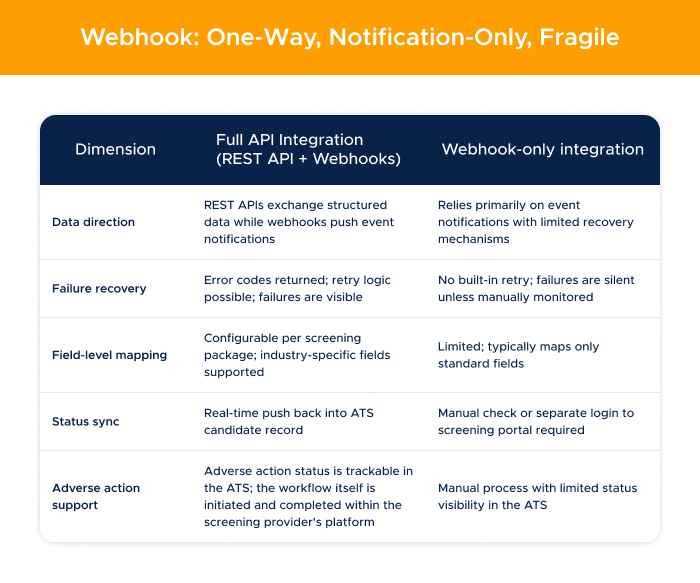
Most enterprise ATS platforms support REST API integrations. Whether the connector between your ATS and screening provider uses that architecture or falls back to a webhook is a different question. Most buyers never ask it.
The 4 Ways ATS-to-Screening Integrations Break
Integration failures in ATS-to-screening workflows tend to cluster around four specific patterns. Each produces a different downstream cost. Each is detectable before go-live if you know what to test.
Failure Mode 1: The Silent Failure
A silent failure occurs when an integration appears to work, but the screening provider never receives the data or receives incomplete information. The ATS confirms the request, no error appears, and the recruiter assumes the screening is in progress.
Because there is no immediate warning, these issues often go unnoticed until a hiring delay prompts a manual investigation. By then, candidates may have dropped out or accepted another offer.
Silent failures can result from API or webhook communication issues when an integration lacks monitoring, retry logic, or recovery mechanisms. Without automated detection, recruiters may not realize the screening process has stalled.
Failure Mode 2: Field-Mapping Gaps
Background screening depends on accurate personally identifiable information, including full legal name, date of birth, Social Security number, and current and prior address history. Regulated industries often require additional data, such as CDL numbers for transportation roles, professional license numbers, OIG exclusion screening parameters for healthcare positions, or sanctions screening identifiers for government-adjacent roles.
Most ATS platforms collect this information. Not all transfer every field correctly to the screening provider.
When field mapping is incomplete or misconfigured, screenings are run against partial data. A missing middle name, a merged employer record, or an incompatible date format can result in a report generated for the wrong individual or a report that returns inconclusive because identity verification requirements were not met.
The FCRA implication is straightforward. If an employer takes adverse action based on a report generated from corrupted or incomplete data, liability rests with the employer. The root cause may trace back to a field-mapping configuration that was never tested against the actual screening package before go-live.
AccuSourceHR has documented the broader risk of incomplete screening data here.
Failure Mode 3: Candidate Portal Friction
Shallow integrations often create a fragmented candidate experience. After completing an ATS application, candidates receive a separate email from the screening provider asking them to enter the same information again in a different portal, often one that is not optimized for mobile devices.
Every additional step creates another opportunity for candidate drop-off. In high-volume hiring environments such as transportation, healthcare, manufacturing, and hospitality, that friction can directly affect hiring outcomes. Candidates may abandon the process or accept another offer while waiting for a workflow they cannot track.
Meanwhile, the ATS shows the candidate as "pending screening," or the screening provider is waiting for the candidate's action, and the recruiter remains unaware that the process has stalled.
A stronger integration passes candidate information directly from the ATS to the screening provider at the field level, pre-populates disclosure and other information available in the ATS, and presents it through a mobile-friendly, text-enabled workflow.
Candidates enter information once and complete the process without switching systems.
Failure Mode 4: Adverse Action Orphaning
The FCRA requires a specific two-step process when a background check may affect a hiring decision. Employers must issue a pre-adverse action notice, including a copy of the report and a summary of rights, and allow at least five business days before taking final adverse action.
Documentation of both steps must be retained and readily available for audit purposes.
In most ATS-to-screening integrations, the adverse action workflow is initiated and managed within the screening provider's platform rather than inside the ATS. Recruiters may be able to track the status of an adverse action from the ATS, but the notices, documentation, timing, and regulatory workflow are handled within the provider's system. The important consideration is visibility and access. Recruiters should be able to see the adverse action status in the ATS and easily access the supporting workflow and documentation in the screening provider's platform so compliance steps are not overlooked.
The CFPB's October 2024 Circular reaffirmed that FCRA adverse action obligations remain with the employer regardless of which system generates the report
CDL: Commercial Driver's License
OIG: Office of Inspector General
FCRA: Fair Credit Reporting Act
Compliance Note
FCRA lawsuits increasingly target technical violations rather than malicious intent. Class-action settlements in employment screening frequently exceed one million dollars. The integration workflow, not the screening result itself, is often where the violation originates.
Why ATS Systems Matter More in Regulated Industries
Every employer is responsible for complying with the FCRA. In regulated and safety-sensitive industries, however, the impact of an integration failure goes well beyond FCRA compliance.
Missing or incorrect screening data can expose employers to industry-specific regulatory, financial, and operational risks:
.png?width=632&height=735&name=Frame%2029%20(8).png)
Note: The information available through an ATS integration depends on the ATS's API capabilities. When required screening data is unavailable, a well-designed integration should collect the missing information through a secure, mobile-friendly candidate workflow rather than requiring recruiters to manage the process manually. This helps maintain compliance while minimizing duplicate data entry.
The 5-Point Integration Test: Use This in Every Demo
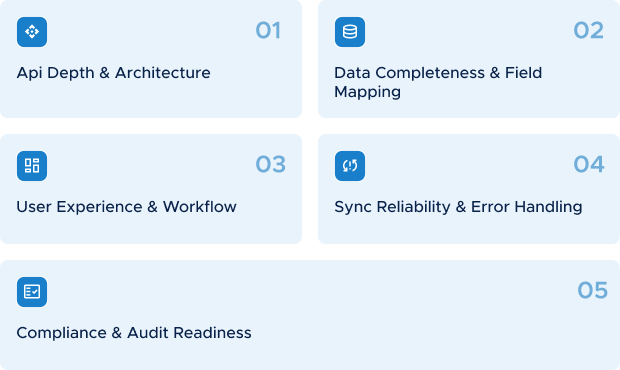
ATS demos are designed to showcase a product under ideal conditions. These five questions turn a sales presentation into a practical integration test. Each one is designed to uncover one of the failure modes discussed above.
Criterion 1: Integration Architecture — How Do REST API and Webhook Work Together
Most modern ATS integrations use both REST APIs and webhooks. REST APIs exchange structured data and perform actions, while webhooks automatically notify connected systems when events such as status changes occur.
The key question is whether the integration includes monitoring, retry logic, and fallback mechanisms if a webhook notification or API request fails.
Ask:
"How does this integration use REST APIs and webhooks together? If an API request or webhook notification fails, how is the failure detected, logged, and recovered?”
Criterion 2: Field-Level Data Mapping — Show Me the Actual Fields
Basic field mapping includes a candidate's name, date of birth, Social Security number, and address. Regulated industries often require additional data, such as CDL numbers, FMCSA Clearinghouse identifiers, professional license numbers, or OIG sanctions screening parameters.
Ask the vendor to show the field mapping for your actual screening package, not just a list of supported ATS integrations.
Ask:
"Can you show the field-level mapping between this ATS and my screening package, including industry-specific fields? What happens if a required field is missing from the ATS application?"
Criterion 3: Candidate Portal Sync—How Is Missing Data Handled??
Candidate information should automatically carry forward whenever the ATS supports it. If additional information is required due to ATS API limitations, the screening provider should collect it via a secure, mobile-friendly workflow that minimizes duplicate data entry.
Ask:
"What candidate information carries over automatically from the ATS? If additional data is required because of ATS API limitations, how is it collected? Can you show me the candidate experience on a mobile device?"
Criterion 4: Status and Result Sync — Does It Flow Back to the ATS?
Recruiters spend their day inside the ATS. They should not need to log into a separate screening portal to check progress. Screening statuses such as "initiated," "in progress," "clear," and "action required" should update the candidate record in real time.
Ask:
"Where does the screening status appear in the ATS? Is it updated in real time or through a batch sync? What does the recruiter see when a screening returns an action-required result?"
Criterion 5: Adverse Action Workflow — Where Does the FCRA Audit Trail Live?
The FCRA adverse action process should be fully documented and audit-ready, whether it is managed within the ATS or the screening provider's platform. In most integrations, the adverse action workflow is initiated and managed within the screening provider's platform. Recruiters should still be able to track its status from the ATS and easily access the required notices, timelines, and documentation in the provider's system.
Ask:
"Where is the adverse action workflow initiated? Can recruiters track its status from the ATS? Where are the pre-adverse action notice, five-business-day waiting period, and audit trail managed and stored?"
Seven Questions for Every ATS Demo
A polished demo rarely reveals how an ATS integration performs under real hiring conditions. The right questions expose how candidate data moves between systems, how failures are handled, and whether recruiters can manage the entire screening workflow without leaving the ATS.
Use the checklist below to move the conversation beyond marketing claims and verify how the integration works in practice.
- Is this a bidirectional REST API or a one-way webhook? If the transmission fails, how is the failure detected, logged, and communicated?
- Can you show the field-level data mapping between this ATS and my specific screening package? Don't settle for a partner list. Review the actual fields, including any industry-specific data your organization requires.
- Does candidate information carry forward automatically, or does it have to be entered twice? Ask the vendor to demonstrate the candidate experience on a mobile device.
- Do screening status updates sync back to the ATS in real time? Ask where recruiters can see statuses such as initiated, in progress, clear, and action required.
- What happens if the integration fails or times out? Ask whether recruiters receive an alert in the ATS or whether the failure remains invisible until someone investigates.
- How is the adverse action workflow managed? Ask where the FCRA adverse action workflow is initiated, how its status is tracked in the ATS, and where the pre-adverse action notice, five-business-day waiting period, and audit trail are managed and stored. In most integrations, the workflow is initiated and completed within the screening provider's platform, with status visibility surfaced back to the ATS.
- What happens after implementation? Ask who supports the integration 90 days after go-live. Will you continue working with a dedicated integration team, or will future issues be routed through a general support queue?
Red Flags to Watch for During the Demo
The right answers matter, but so do the answers vendors avoid. If you encounter any of the following during a demo, treat them as signals to dig deeper before moving forward.
- The vendor confirms integration with your ATS but cannot show the field-level mapping. A partner logo or marketplace listing is not the same as a field map.
- Integration setup is described as taking "a few weeks." Pre-built connectors with mature ATS and screening platforms should typically be deployed in days, not weeks.
- The demo shows a screening initiated from the ATS, but never shows the results flowing back into the candidate record. A one-way data flow is only part of the integration.
- Integration support and ATS support are handled by separate teams. When issues arise between the two systems, ownership can become unclear, and resolution often takes longer.
- The implementation team hands the integration over to a general support queue after go-live. The team that built the integration should remain accessible for post-launch issues, especially during the first few months.
AccuSourceHR SourceDirect™ connects to 50+ ATS, HCM, and HRIS platforms. Pre-built connectors activate in under one business day. |
What a Working Integration Actually Does — Step by Step
The five-point framework above explains what to evaluate. Here's what the workflow should look like when those elements work together. The process below reflects how AccuSourceHR's SourceDirect™ platform operates across its network of more than 50 ATS, HCM, and HRIS integrations.
- The candidate applies through the ATS as part of the standard application workflow. No additional steps or portals are introduced at this stage.
- Candidate data is automatically passed from the ATS to the SourceDirect™ platform at the field level. Name, DOB, address history, and industry-specific identifiers map directly to the screening package requirements for that role. No recruiter intervention is required.
- The screening package initiates automatically. The recruiter does not log into a separate portal or manually submit a request. The screen fires when the candidate reaches the configured stage in the ATS pipeline.
- Candidates receive a text-enabled link to the MySource™ portal. Depending on the ATS integration, information already collected in the ATS is pre-populated automatically. When additional information is needed, MySource™ guides candidates through a seamless, mobile-friendly process designed to minimize duplicate data entry.
- Status updates push back into the candidate's ATS record in real time. The recruiter sees 'initiated,' 'in progress,' and 'complete' directly in the platform they use every day.
- Results and status updates are returned via the integration, depending on the capabilities of the ATS platform. Recruiters can view screening progress within the ATS where supported, while detailed report information and compliance workflows remain available through SourceDirect™. The level of visibility and workflow automation varies by integration.
- If a result requires adverse action review, the FCRA pre-adverse action workflow is initiated through SourceDirect™. The notice is generated, the five-business-day window is tracked, and the full documentation trail is stored in SourceDirect™, not scattered across email threads and portal exports.
For regulated industries, the same integration architecture extends to industry-specific data workflows.
Transportation clients receive DOT-specific field mapping for CDL numbers, FMCSA Clearinghouse queries, and PSP crash report requests wherever the ATS integration supports those fields.
When required information is unavailable through the ATS, MySource™ securely collects it through a mobile-friendly workflow. Healthcare clients follow the same approach for license verification, immunization tracking, and Office of Inspector General (OIG) and General Services Administration (GSA) System for Award Management (SAM) sanctions screening.
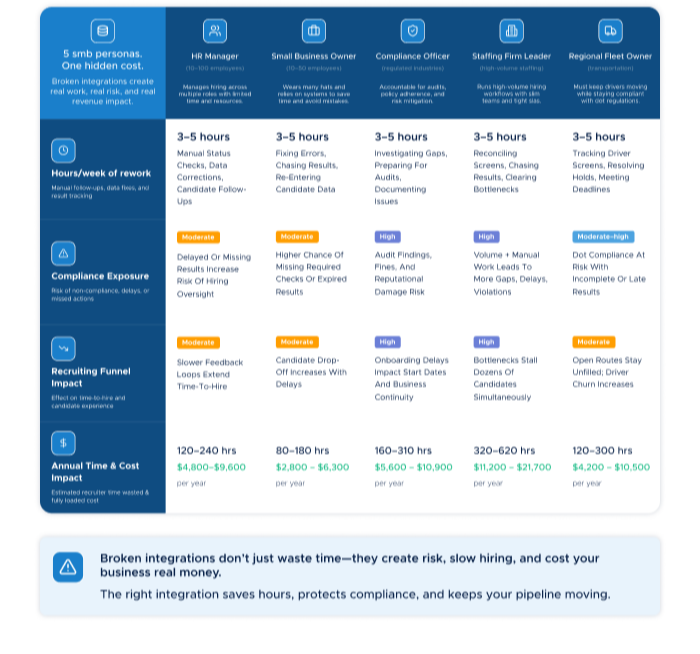
The Cost of a Broken Integration
When ATS background check integrations fail silently. The work (and risk) falls on your team.
The Integration Is Your Compliance Infrastructure
In regulated industries such as healthcare, transportation, staffing, and manufacturing, disconnected data and silent failures can expose employers to FCRA and industry-specific compliance issues.
AccuSourceHR's SourceDirect™ platform is built to reduce those risks. It connects with more than 50 ATS, HCM, and HRIS platforms through pre-built integrations that support field-level data mapping, real-time status updates, automated screening workflows, and compliant adverse action tracking.
Most pre-built integrations are activated in less than one business day, while custom REST API integrations are typically deployed within one to five business days.
A technical demo can show exactly how the integration works with your ATS, screening package, and hiring workflow before you commit.
Frequently Asked Questions
-
What does ATS background check integration mean?
ATS background check integration is the technical connection between an applicant tracking system and a background screening provider. It enables candidate data to flow automatically between systems, initiates background checks, and syncs screening statuses and results back to the ATS.
Most modern integrations use REST APIs alongside webhooks, and overall quality depends on factors such as field-level data mapping, monitoring, retry mechanisms, and how the integration handles ATS API limitations.
-
What is the difference between a REST API and a webhook for background check integration?
REST APIs and webhooks serve different roles within a modern ATS integration. REST APIs exchange structured data, initiate screening requests, retrieve results, and support error handling and recovery.
Webhooks automatically notify connected systems when events such as status changes occur, reducing the need for continuous polling.
A reliable integration combines both with monitoring, retry logic, and fallback mechanisms while supporting field-level data mapping, real-time status updates, and compliant workflow tracking.
-
How do ATS systems integrate with background check providers?
ATS-to-screening integration typically works through one of two patterns: a REST API (deep, bidirectional data exchange with structured fields, error handling, and real-time status sync) or a webhook (shallow, one-way notification that fires when an event happens, with no built-in failure recovery).
The best integrations pass candidate PII directly to the screening provider, automatically initiate checks, and sync results back to the ATS record without requiring the candidate or recruiter to re-enter data.
-
How long does it take to set up an ATS background check integration?
Setup time varies based on the ATS, the screening provider, and the complexity of the integration. AccuSourceHR's pre-built connectors, covering more than 50 ATS, HCM, and HRIS platforms, are typically activated within one to three business days. Custom API integrations generally go live within five to thirty business days, depending on workflow complexity, data mapping requirements, and platform-specific configuration needs. Integrations requiring custom development, extensive testing, or unique workflow automation may take longer to deploy.
-
Can a broken ATS screening integration pose a compliance risk?
Yes. If incorrect candidate data, such as a misspelled name, incorrect date of birth, or improperly mapped information, flows from the ATS to the screening provider, the screening process may be delayed, incomplete, or associated with inaccurate candidate information. Those issues can create compliance, hiring, and operational risks. Employers that rely on inaccurate or incomplete screening information when making employment decisions may face FCRA-related exposure, even when the underlying issue originated in the integration workflow.
-
Do I need a separate background check provider if my ATS offers built-in screening?
Many ATS platforms offer screening through integrated partnerships with background check providers. For small and mid-sized businesses (SMBs) with straightforward hiring needs, those solutions may be sufficient. However, SMBs in regulated industries such as healthcare, transportation, financial services, and staffing should evaluate whether the screening provider supports their specific compliance, verification, and reporting requirements.
When comparing solutions, look beyond the ATS integration itself. Consider the screening provider's compliance expertise, industry-specific screening capabilities, customer support model, turnaround times, and ability to support workflows such as license verification, sanctions screening, DOT-regulated screening, and adverse action management. The key question is not whether the screening is embedded in the ATS, but whether the provider can support your organization's hiring and compliance requirements as they grow. -
What if I'm a small business and don't even have an ATS?
Employers with fewer than 100 employees often face the same hiring and compliance obligations as larger organizations, but without dedicated HR, compliance, or IT resources.
RapidSource is AccuSourceHR's streamlined onboarding pathway for small businesses. New accounts complete a brief questionnaire, sign the service agreement electronically, and are typically ready to begin ordering background checks within one business day.
While this guide focuses on ATS integrations through AccuSourceHR's SourceDirect™ platform, not every small business uses an ATS. RapidSource provides direct access to AccuSourceHR's screening technology and services without requiring an ATS integration. For employers that do use an ATS, SourceDirect™ supports integration with 50+ ATS, HCM, and HRIS platforms.
The goal is simple: make professional background screening easy to implement, compliant, and scalable as hiring needs grow.
We have written about the small business screening decision in more depth here.